

Audio By Carbonatix
The 2024 KPMG Customer Experience Survey has revealed that the Ghanaian investment landscape reflects a cautious approach to investments with interests in both low and medium risk opportunities as individuals navigate economic challenges in pursuit of financial security and independence.
According to the report, the recent insights reveal that treasury bills remain the most preferred investment option, with 39% of respondents opting for these low-risk instruments.
Fixed or term deposits closely follow at 25%, further reinforcing the cautious approach among many Ghanaians, who prioritise stability and guaranteed returns amidst economic uncertainty.
However, the report said there are signs of gradual diversification in investment choices.
Mutual funds, selected by 23% of respondents, are gaining traction as a medium-risk option offering balanced returns.
Additionally, commodities such as precious metals and agriculture products, accounted for 20%, which demonstrated a growing appetite for alternative investments as a hedge against inflation and economic instability.
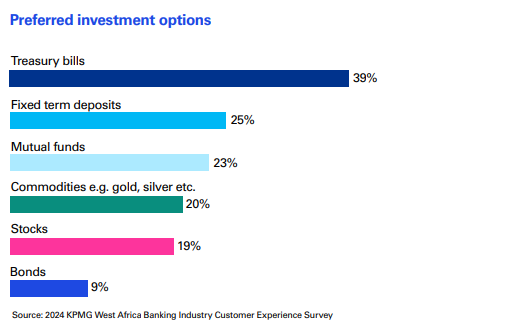
Expectedly, higher-risk instruments such as stocks (19%) and bonds (9%) remain underutilised, pointing to limited confidence.
The report added that the hesitancy of Ghanaians to adopt these investment options highlights the need for banks to provide education and solutions to bridge knowledge gaps and demystify complex financial products.
Despite these trends, the survey also revealed that 34% of respondents are willing to take risks with their investments, signalling an underlying desire for wealth creation and financial independence.
Despite these challenges, the survey also highlighted how Ghanaians are channelling resources toward personal growth, financial security and family welfare.
24% Ghanaians Invest in Skills Acquisition, Businesses
When asked about their top three priorities, approximately 24% of respondents are investing in skill acquisition and business ventures reflecting a desire for career advancement and financial independence.
Family obligations remained a central priority, with 24% dedicating funds to education, healthcare and general welfare.
Similarly, wealth generation through investments and property sales also gained traction, with 22% of respondents pursuing these strategies.
Latest Stories
-
Anthony Joshua declines showdown with Tyson Fury but admits they ‘probably’ clash next
9 minutes -
Tyson Fury dominates Makhmudov, calls out Joshua next
29 minutes -
I have supported highway authority financially to fix roads in my constituency – A Plus
2 hours -
US, Iran fail to reach peace agreement after marathon talks in Pakistan
2 hours -
ECG kicks off Phase Two of transformer upgrades at Lashibi; brief outages expected
3 hours -
Port crises loom as 11,000 drivers threaten four-day strike
3 hours -
A source of excellence across generations – Vice President Opoku-Agyemang lauds Mfantsipim
4 hours -
(Photos) Mfantsipim School launches historic 150th anniversary
5 hours -
Knights and Ladies of Marshall group backs Catholic Bishops’ stance on anti-LGBTQ+
6 hours -
Bright Simons writes: All the Filla in the Ibrahim Mahama/E&P – Gold Fields Saga
6 hours -
Monetise Idiocy In Ghana
6 hours -
The Ghanaian prophet and the mysterious death of his scottish wife Charmain Speirs
7 hours -
Nearly 400 sentenced in Nigeria for links to militant Islamists
7 hours -
Ghana’s recovery supported by gold strength despite global oil price pressures – Standard Bank Research
7 hours -
Methodist Church hails Mfantsipim@150; calls for “fresh consecration” to excellence
8 hours