

Audio By Carbonatix
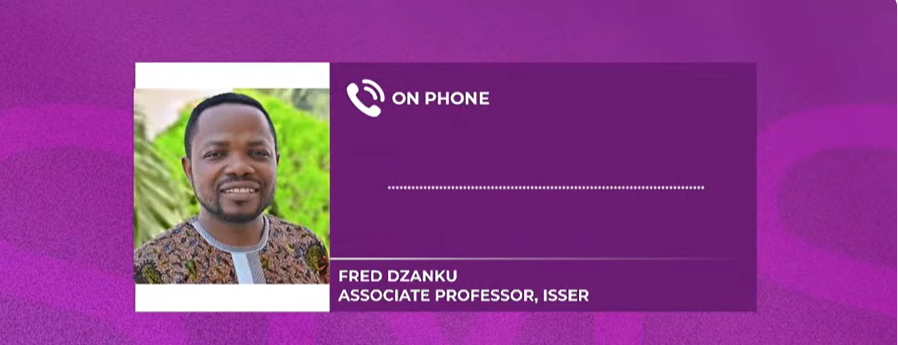
Development economist Fred Dzanku has described the intense competition for security service jobs in Ghana as a reflection of deeper structural weaknesses in the economy rather than merely a recruitment issue.
Speaking on the Super Morning Show on Joy FM on Thursday, 12 March, Prof Dzanku highlighted the huge gap between the number of applicants and available jobs.
“It’s pathetic to say the least, because we know there’s a general problem of youth unemployment across the continent of Africa. And Ghana is no exception. And we need to step back a bit,” he said.
He criticised what he described as the country’s tendency to respond to problems only when they become urgent rather than addressing their root causes.
“I always say that we like to fight fire as a country. We see a problem, and then we talk about it a little bit,t and then we go back to sleep,” Prof Dzanku added.
Using data to illustrate the structural challenges, he noted that manufacturing should be the main driver of youth employment, yet its contribution to Gross Domestic Product (GDP) remains very low.
“As a country, our manufacturing value-added share of our GDP should be rising because that is where you expect to generate the jobs for the youth. As I speak to you, our manufacturing value-added share of our GDP is less than 10%. So where are the jobs going to come from? The jobs are not going to be coming from the other sectors of our economy as much as they would from manufacturing,” he explained.
Prof Dzanku linked these economic realities to the ongoing recruitment into the country’s security services, where the Interior Minister, Muntaka Mohammed-Mubarak, announced that only 5,000 applicants would be recruited in the first phase due to fiscal constraints.
“So what we are seeing — 5,000 jobs and 500,000 people chasing them — is a fundamental definition of how our economy is structured and how our economy is working. That is the basis of the problem. The problem is that we are not generating the jobs in the sectors that should be generating the jobs, let alone talk about even the decency of the jobs that are being turned out,” he said.
The Interior Minister had earlier explained during a press conference at Parliament of Ghana that the recruitment process into the Ghana Police Service, Ghana Prisons Service, Ghana Immigration Service, and the Ghana National Fire Service mainly involves body selection and documentation, with the limited vacancies dictated by fiscal realities.
Latest Stories
-
Telecel Ghana wins 2 awards at the CCIFG Gala and Awards 2026
17 minutes -
Petrol, diesel prices set to fall from Oct. 16 as LPG faces 18.5% hike
36 minutes -
Bank of Ghana engages stakeholders in Techiman
42 minutes -
PIAC unable to verify GH¢21m petroleum-funded projects in Ayawaso West
49 minutes -
Ketu North MP led delegation petitions government over deteriorating Weta Irrigation Scheme
53 minutes -
Unpaid contractor delays KATH Mother and Baby Unit as materials deteriorate
58 minutes -
Kofi Adams says Ghanaians ignored warnings over World Cup visa payments
1 hour -
Banks to apply 20% VAT on cross-border digital payments with Ghana-issued cards
1 hour -
Education Minister appeals to GAUA to call off strike, resume work on October 19
1 hour -
Mahama assures Assemblies of God of support for World Congress
1 hour -
Ghana must prioritise home-grown AI solutions to meet national needs – UNDP
1 hour -
Mahama truly cares – Obuobia Darko-Opoku
1 hour -
Fire at GRIDCo Mallam substation disrupts power in parts of Accra
2 hours -
Your client is Parliament, not a party; remain honest even when unwelcome – Speaker
2 hours -
Mahama urges chiefs to help tackle galamsey, protect water bodies
2 hours