

Audio By Carbonatix
On March 1, the day after the first coronavirus death in the United States was announced, brothers Matt and Noah Colvin set out in a silver S.U.V. to pick up some hand sanitizer. Driving around Chattanooga, Tenn., they hit a Dollar Tree, then a Walmart, a Staples and a Home Depot. At each store, they cleaned out the shelves.
Over the next three days, Noah Colvin took a 1,300-mile road trip across Tennessee and into Kentucky, filling a U-Haul truck with thousands of bottles of hand sanitizer and thousands of packs of antibacterial wipes, mostly from “little hole-in-the-wall dollar stores in the backwoods,” his brother said. “The major metro areas were cleaned out.”
Matt Colvin stayed home near Chattanooga, preparing for pallets of even more wipes and sanitizer he had ordered, and starting to list them on Amazon. Mr. Colvin said he had posted 300 bottles of hand sanitizer and immediately sold them all for between $8 and $70 each, multiples higher than what he had bought them for. To him, “it was crazy money.” To many others, it was profiteering from a pandemic.
The next day, Amazon pulled his items and thousands of other listings for sanitizer, wipes and face masks. The company suspended some of the sellers behind the listings and warned many others that if they kept running up prices, they’d lose their accounts. eBay soon followed with even stricter measures, prohibiting any U.S. sales of masks or sanitizer.
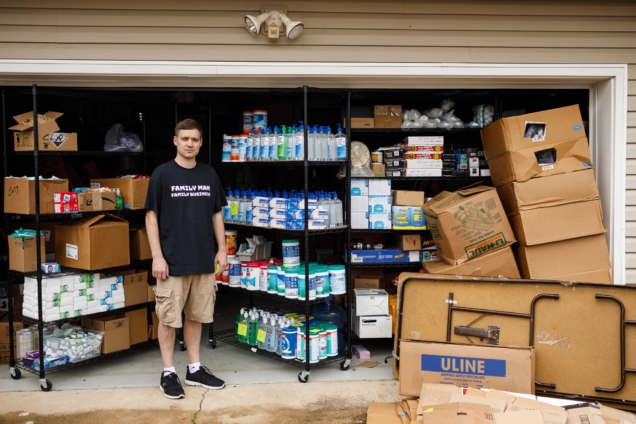
Now, while millions of people across the country search in vain for hand sanitizer to protect themselves from the spread of the coronavirus, Mr. Colvin is sitting on 17,700 bottles of the stuff with little idea where to sell them.
“It’s been a huge amount of whiplash,” he said. “From being in a situation where what I’ve got coming and going could potentially put my family in a really good place financially to ‘What the heck am I going to do with all of this?’”

Mr. Colvin is one of probably thousands of sellers who have amassed stockpiles of hand sanitizer and crucial respirator masks that many hospitals are now rationing, according to interviews with eight Amazon sellers and posts in private Facebook and Telegram groups from dozens more. Amazon said it had recently removed hundreds of thousands of listings and suspended thousands of sellers’ accounts for price gouging related to the coronavirus.
Amazon, eBay, Walmart and other online-commerce platforms are trying to stop their sellers from making excessive profits from a public health crisis. While the companies aimed to discourage people from hoarding such products and jacking up their prices, many sellers had already cleared out their local stores and started selling the goods online.
Now both the physical and digital shelves are nearly empty.
Mikeala Kozlowski, a nurse in Dudley, Mass., has been searching for hand sanitizer since before she gave birth to her first child, Nora, on March 5. When she searched stores, which were sold out, she skipped getting gas to avoid handling the pump. And when she checked Amazon, she couldn’t find it for less than $50.
“You’re being selfish, hoarding resources for your own personal gain,” she said of the sellers.
Sites like Amazon and eBay have given rise to a growing industry of independent sellers who snatch up discounted or hard-to-find items in stores to post online and sell around the world.
These sellers call it retail arbitrage, a 21st-century career that has adults buying up everything from limited-run cereals to Fingerling Monkeys, a once hot toy. The bargain hunters look for anything they can sell at a sharp markup. In recent weeks, they found perhaps their biggest opportunity: a pandemic.
As they watched the list of Amazon’s most popular searches crowd with terms like “Purell,” “N95 mask” and “Clorox wipes,” sellers said, they did what they had learned to do: Suck up supply and sell it for what the market would bear.
Initially, the strategy worked. For several weeks, prices soared for some of the top results to searches for sanitizer, masks and wipes on Amazon, according to a New York Times analysis of historical prices from Jungle Scout, which tracks data for Amazon sellers. The data shows that both Amazon and third-party sellers like Mr. Colvin increased their prices, which then mostly dropped when Amazon took action against price gouging this month.
Latest Stories
-
Nana Yaa Jantuah calls for renewed commitment to Nkrumah’s vision
31 minutes -
CAGD explains delay in teachers’ promotion arrears, says 6,079 cases already paid
36 minutes -
Fuel, taxes and loans are driving up airfares – Prof Quartey
41 minutes -
Ghana, Côte d’Ivoire mark major border milestone with 37 new pillars
1 hour -
Almost everything in Ghana is expensive – CUTS Director on airfare debate
1 hour -
NAFCO builds GH¢100m food buffer as Ghana moves to strengthen food security
1 hour -
Oil heads higher as US-Iran peace talks in stalemate
2 hours -
GAF sets Sept. 28–30 for Documentation, Body Selection Exercise
2 hours -
Eric Obuaba declares intention to contest NDC National Executive position
2 hours -
I resigned five months ago – BoG Governor Asiama explains GoldBod Board exit
2 hours -
Trump says men arrested at UK air base used by US were looking to do ‘big damage’
2 hours -
Trump confirms meeting with Anthropic’s Amodei, repeats dismissal of AI fears
3 hours -
China pushes back against US on Iran and Cuba in UN speech
3 hours -
OpenAI, Anthropic CEOs called to appear at Australian AI probe
3 hours -
Small market, low incomes keep Ghana’s domestic airfares high, says Prof Peter Quartey
5 hours