

Audio By Carbonatix
Humans settled in the Americas much earlier than previously thought, according to new finds from Mexico.
They suggest people were living there 33,000 years ago, twice the widely accepted age for the earliest settlement of the Americas.
The results are based on work at Chiquihuite Cave, a high-altitude rock shelter in central Mexico.
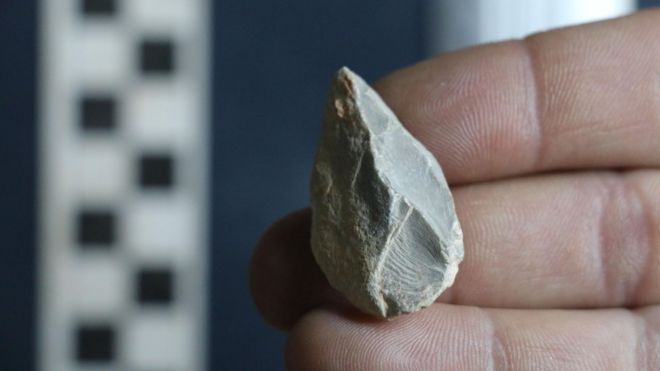
Archaeologists found thousands of stone tools suggesting the cave was used by people for at least 20,000 years.
Ice age
During the second half of the 20th Century, a consensus emerged among North American archaeologists the Clovis people had been the first to reach the Americas, about 11,500 years ago.
The Clovis were thought to have crossed a land bridge linking Siberia to Alaska during the last ice age.
This land bridge subsequently disappeared underwater as the ice melted.
And these big-game hunters were thought to have contributed to the extinction of the megafauna - large mammals such as mammoth, mastodon and various species of bear that roamed the region until the end of the last ice age.
Break down
As the "Clovis First" idea took hold, reports of earlier human settlement were dismissed as unreliable and archaeologists stopped looking for signs of earlier occupation.
But in the 1970s, this orthodoxy started to break down.
In the 1980s, solid evidence for a 14,500-year-old human presence at Monte Verde, Chile, emerged.
And since the 2000s, other pre-Clovis sites have become widely accepted - including the 15,500-year-old Buttermilk Creek site in central Texas.
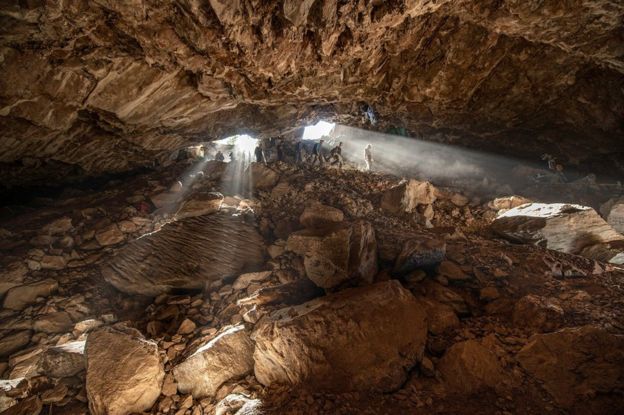
Now, Ciprian Ardelean, from the Universidad Autónoma de Zacatecas, Mexico, Tom Higham, from the University of Oxford, and colleagues have found evidence of human occupation stretching back far beyond that date, at the Chiquihuite site in the central-northern Mexican Highlands.
"This is a unique site, we've never seen anything like it before," Prof Higham said.
"The stone-tool evidence is very, very compelling.
"Anyone can see that these are deliberately manufactured stone tools and there are lots of them.
"The dating - which is my job - is robust.
"And so, it's a very exciting site to have been involved in."
Dating techniques
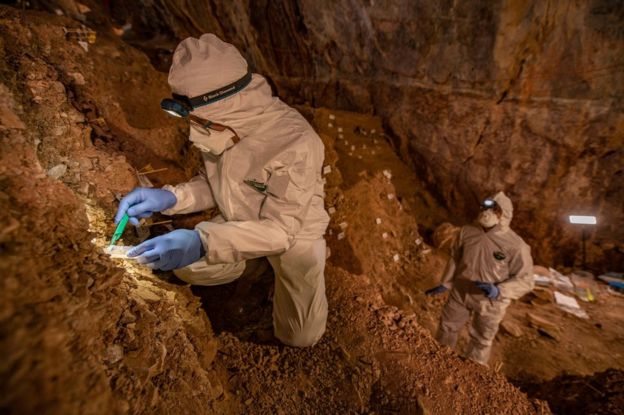
The team excavated a 3m-deep (10ft) stratigraphic section - a sequence of soil layers arranged in the order they were deposited - and found some 1,900 stone artefacts made over thousands of years.
Researchers were able to date bone, charcoal and sediment associated with the stone tools, using two scientific dating techniques.
The first, radiocarbon dating, relies on the way a radioactive form of the element carbon (carbon-14) is known to decay over time.
The second, optically stimulated luminescence (OSL), works by measuring the last time sediments were exposed to light.
Using two different techniques "added a lot of credibility and strength, particularly to the older part of the chronology", Prof Higham said.
"The optical dates and [radiocarbon] dates are in good agreement," he said.
And the findings could lead scientists to take a fresh look at controversial early occupation sites elsewhere in the Americas.
"In Brazil, there are several sites where you have stone tools that look robust to me and are dated 26-30,000, similar dates to the Chiquihuite site," Prof Higham said.
"This could be an important discovery that could stimulate new work to find other sites in the Americas that date to this period."
Native Americans
The scientists also used "environmental DNA" techniques to look for human genetic material in the cave sediments.
But they could not find a strong enough signal.
Previous DNA evidence has shown the Clovis settlers shared many similarities with modern Native Americans.
And scientists will now want to understand how these older populations relate to later human groups who inhabited the continent.
Latest Stories
-
Northern Regional Minister praises GROW 2 Project for transforming women’s agriculture in Northern Ghana
3 minutes -
GCB extends CSR to communities through staff- led initiatives
9 minutes -
Electricity generation falls 3.99% in July 2026 despite year-on-year growth – PURC
18 minutes -
Bawumia wishes PRESEC, Augusco and Accra Academy well ahead of NSMQ final
21 minutes -
Mahama commends GoldBod’s GH¢896m profit, urges sustained growth
25 minutes -
Jamestown waste evacuation to begin next week – Local Gov’t Minister
25 minutes -
Three years, three 100m titles; Isaac Botsio cements his legacy among NCAA Division II’s greatest
32 minutes -
CHRAJ boss urges OSP, AG’s office to close gaps in corruption prosecution
34 minutes -
Ghana woos China into mining partnerships, pushes value addition
56 minutes -
Daily Insight for CEOs: Capital allocation as a CEO responsibility.
1 hour -
GWL water sales grow faster than production in Q1 2026 -PURC
1 hour -
I don’t like Stonebwoy’s approach to issues – DJ Slim
1 hour -
Ghana Water Limited records 49.2% non-revenue water in Q1 2026
1 hour -
Force-feeding children can cause serious complications —Paediatrician warns
2 hours -
Mahama warns board chairpersons against taking over executive roles
2 hours