

Audio By Carbonatix
Montenegro's new government wants to rewrite a controversial law on religion that had sparked anger from the Serbian Orthodox Church. Protesters say the new leaders are betraying Montenegrin identity.
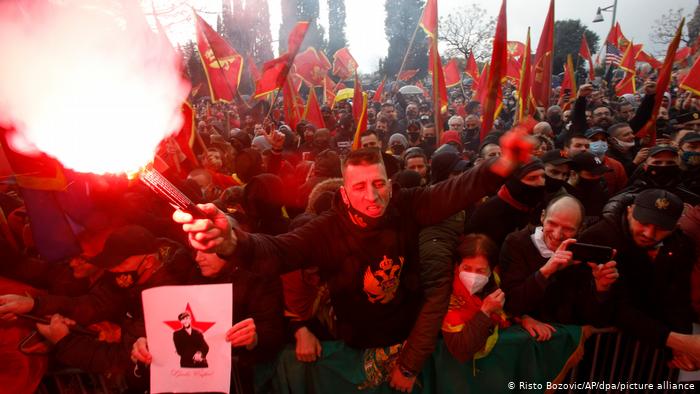
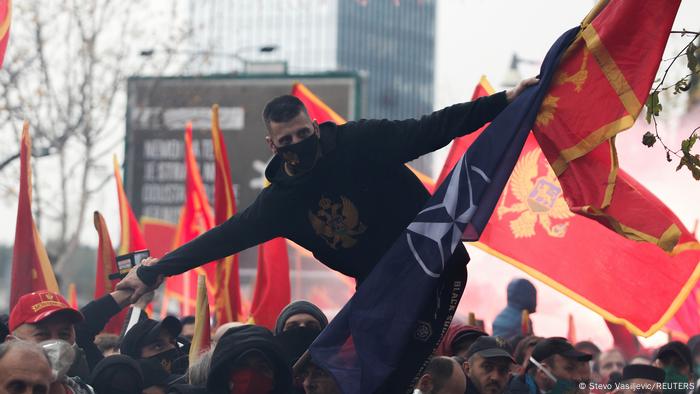
Thousands of protesters rallied in front of the Montenegro parliament on Monday as lawmakers launched a procedure to change a divisive religion law passed by the previous government. The law had angered the Serbian Orthodox Church, and the new government's initiative is widely seen as an attempt to end the row.
The marchers, however, believe the new cabinet aims to undermine Montenegrin national identity and to give control over religious sites to the Serbian state.
Protesters waved Montenegrin flags and chanted "Treason" and "This is not Serbia" during the Monday rally. Some of them carried signs decrying the ruling majority as "Serbian mercenaries."
They also applauded opposition lawmakers who came out of the building.
The participants crowded the area in front of the fenced-off parliament, with many of them not wearing masks despite coronavirus concerns.
What is the conflict about?
The previous government, strongly influenced by longtime strongman Milo Djukanovic, pushed the law through parliament in December, 2019, despite strong opposition from the Serbian Orthodox Church and pro-Serbian political parties. Critics slammed the legislation as an attempt to seize church property. The authorities have denied such plans.
Eventually, the conflict sparked a full-blown protest movement, which saw church leaders lead religious processions in opposition to the law. High-ranking priests also supported the anti-Djukanovic bloc ahead of the August election.
The bloc then managed to win a slim majority and — following long and arduous talks — confirm a new government led by Zdravko Krivokapic earlier this month.
Krivokapic has pledged to maintain Montenegro's independence from Serbia, but his critics claim he intends to steer Montenegro closer to its bigger neighbor and traditional ally.
The revisions to the legislation, discussed by lawmakers on Monday, aim to revoke all disputed sections on the transfer of church property. It was not immediately clear when the new parliament would vote on the changes.
What ties Montenegro and Serbia?
Montenegro's statehood and identity are emotionally-charged issues in the smaller nation, as the country only regained full independence from Serbia after a 2006 referendum. The countries remain connected by historic and cultural links. Nearly 30% of Montenegrin citizens consider themselves ethnic Serbs.
However, many see the Serbian Orthodox Church in Montenegro as a close ally of nationalist politicians in Belgrade. Many also fear the row with the church will lead to Serbia expanding its political influence in Montenegro.
Latest Stories
-
Government must go beyond short-term fuel relief – COPEC
10 seconds -
‘Revive traditional values to fight plastic pollution’ – EPA CEO
4 minutes -
Mahama’s administration is Ghana’s worst ever – Amin Adam
12 minutes -
BSIFF 2026 puts local language cinema at the centre of African film conversation
18 minutes -
MMFL makes strong showing at 2026 JoySports Invitational
20 minutes -
NPP vetting was candid and went beyond routine questions – Afoko
20 minutes -
CIIG 6th Insurance Excellence Awards highlights need to protect professional standards
26 minutes -
GEXIM Bank’s interest income surges 90% to GH¢153.9m – SIGA report
27 minutes -
GNFS rescues man trapped beneath loaded truck after it overturns at Kibi
28 minutes -
African Union backs Sudanese-led dialogue to end conflict
29 minutes -
VRA reverses GH¢106m loss to record GH¢88m profit in 2025
31 minutes -
University of Memphis has not terminated scholarship deal with GSA – Director-General
38 minutes -
Ken Blege announces global release of ‘He Found Me’ album
45 minutes -
The transfers to watch before window closes
53 minutes -
Nana Kwadwo Osei Bonsu I installed as Odikro of Tepa Ankaase in Ashanti Region
1 hour