

Audio By Carbonatix
Ukrainian President Volodymyr Zelensky has called on Western countries to ban all Russian visitors - and the Kremlin has responded with scorn.
Russians should "live in their own world until they change their philosophy", Mr Zelensky told The Washington Post.
Such a ban, he argued, would be more effective than the current sanctions, which bar Russian airlines and officials linked to the Kremlin.
Russians can still get EU and US visas.
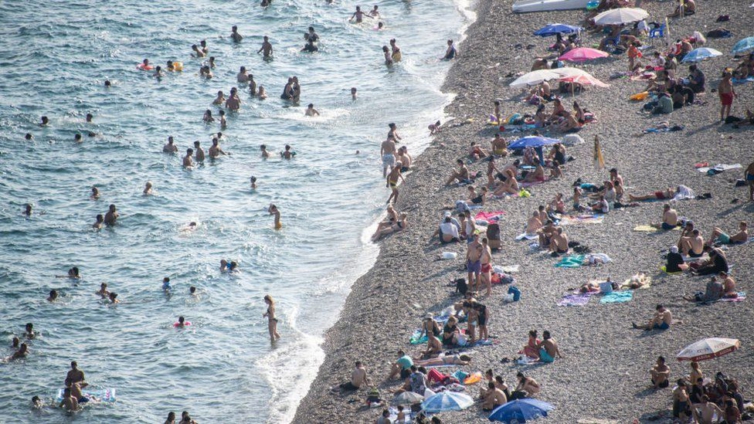
Mr Zelensky's call may get only limited support, as Russia - despite sanctions - has extensive global business ties and Russian tourists are still welcome in holiday destinations such as Egypt, Turkey and the United Arab Emirates.
But on Tuesday, Estonia's Prime Minister Kaja Kallas tweeted: "Stop issuing tourist visas to Russians. Visiting Europe is a privilege, not a human right."
Last month, Latvian Foreign Minister Edgars Rinkevics told the Politico website that EU countries should restrict issuing visas for Russians, with an exemption for humanitarian reasons.
And on Monday their Nordic neighbour Finland also backed restrictions on Russian visitors.
Finnish Prime Minister Sanna Marin told national broadcaster YLE "it's not right that at the same time as Russia is waging an aggressive, brutal war of aggression in Europe, Russians can live a normal life, travel in Europe, be tourists".
Estonia and Finland are expected to raise the visa issue at an EU foreign ministers' meeting soon.
President Vladimir Putin's spokesman Dmitry Peskov condemned Mr Zelensky's proposal, saying "this can only be viewed extremely negatively".
"Any attempt to isolate Russians or Russia is a process that has no prospects," he said.
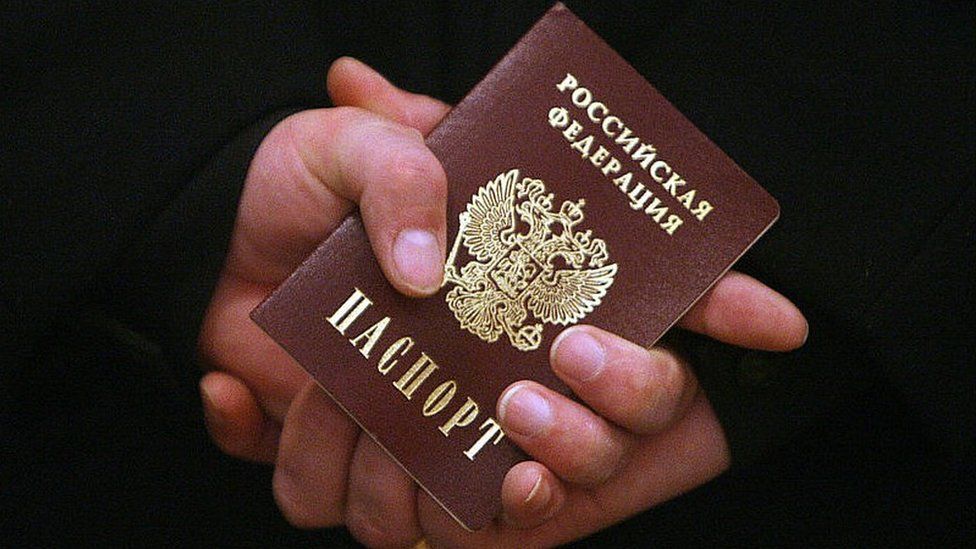
The EU's Schengen visa allows a visitor to stay in the EU for up to 90 days for tourism or business.
The visitor can travel freely within the 26-nation Schengen zone in that period - a zone embracing 22 EU states plus Iceland, Norway, Switzerland and Liechtenstein.
So Russians can still visit most EU countries despite the lack of direct air links. Those on Western sanctions lists however - many oligarchs and officials linked to President Putin and the Russian military - are barred.
Russia's 24 February invasion of Ukraine triggered far-reaching Western sanctions and prompted tens of thousands of Russians to go abroad. They include opposition activists, but also many who are politically disengaged and see better opportunities outside Russia.
Mr Zelensky said "the most important sanctions are to close the borders - because the Russians are taking away someone else's land".
He has previously condemned the Western failure to ban all imports of Russian gas and oil - a trade which helps to fuel Mr Putin's Ukraine campaign.
The Russian invasion has killed thousands and forced millions of Ukrainians to flee abroad, mostly to Poland and other nearby EU countries.
Ukrainian anger at Russian aggression has expressed itself in a backlash against the Russian language and culture.
Some Ukrainian celebrities announced on social media they were no longer using Russian in public - yet the language is widely used in Ukraine, and has been for centuries.
In the capital Kyiv earlier this year, an online public vote picked new names for five metro stations, to replace names with Russian or Soviet-era connections.
So Leo Tolstoy Square is to be called Vasyl Stus, and Heroes of the Dnieper will become Heroes of Ukraine. Druzhby Narodiv station - meaning "friendship of peoples" - will be called Botanical.
The Baltic states previously in the Soviet Union - Estonia, Latvia and Lithuania - are among the EU members most strongly supportive of Ukraine.
Estonia and Latvia now no longer issue Schengen visas to Russians - yet they have large ethnic Russian minorities. Russians with Schengen visas issued by other EU members can still enter the Baltic states and travel on, however.
Bulgaria had a diplomatic spat with Russia and they have stopped issuing tourist visas for each other's citizens.
Mr Peskov compared that stance to nationalist attitudes that prevailed in the run-up to World War Two.
"In their unfriendliness, many of these countries slip into forgetfulness," he said. "And they resort to statements that we heard from several European countries in the centre of Europe 80 years ago."
In France, the Château de Vincennes near Paris has barred entry to Russians since the invasion of Ukraine. The former royal residence - a popular tourist attraction - has French armed forces archives.
Latest Stories
-
Domelevo backs OSP probe into GH¢70k allegation
11 minutes -
CAF Confederation Cup: Dennis Korsah confident Nations FC can overturn Mali defeat
27 minutes -
‘Avoid political comments’ – Domelevo advises Chief Justice
1 hour -
‘I don’t trust OSP’ to probe GH¢70k ‘bribe’ allegation – Kwasi Kwarteng
1 hour -
Road inspections not to witch-hunt contractors – Kwame Agbodza
2 hours -
Inter Milan mount stunning comeback to beat Napoli
2 hours -
Modric plans to play for Croatia past 41st birthday
2 hours -
Bayern fail to score for first time in 59 games
2 hours -
Bawumia preparing new cocoa policy package for farmers – Annoh-Dompreh
2 hours -
Wa-Tumu-Bolga road upgrade will unlock agriculture, trade – Agbodza
2 hours -
Ghana Maritime Authority readies oil-spill response vessel for deployment
2 hours -
Ayariga turns to drones, AI to tackle Agbogbloshie waste mountain
2 hours -
Agbogbloshie waste heap must go – Mahama Ayariga declares
3 hours -
Government to upgrade all rural telephony sites to 4G – Communications Minister
3 hours -
Rural calls, data to become cheaper by Q1 2027 – Sam George
3 hours