

Audio By Carbonatix
The type of compensation we pay our policy and lawmakers, not to mention the juicy end-of-service benefits to former Presidents (two houses, house-helps, drivers), Ghana is not a country that should be importing onions and tomatoes.
And of all the countries in the world, we are importing onion and tomatoes from Sahelian economies. Wikipedia describes Niger as the largest landlocked country in West Africa. According to the 2023 Multidimensional Poverty Index (MPI) report, Niger is one of the poorest countries in the world.
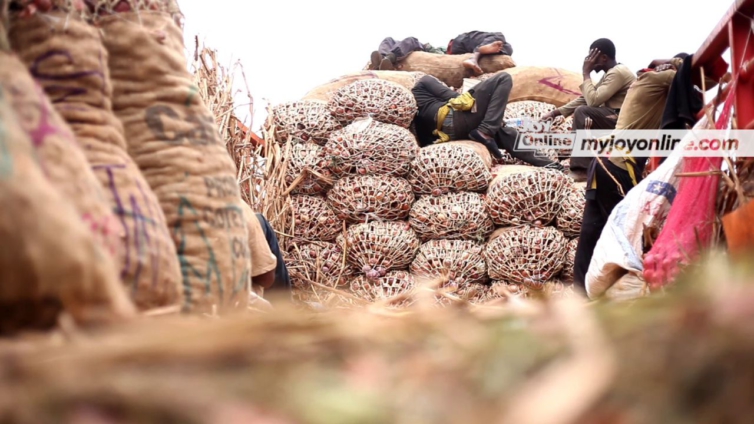
Over the past week or so, news has been that over 100 trucks loaded with onions and bound for Ghana were stranded behind the Benin-Niger border following the border closure to enforce ECOWAS sanctions in the wake of a military takeover in Niger.
Oh, of course, onions and tomatoes grow in Ghana, mostly in the northern parts of the country, but it is a rain-fed crop that abounds at harvest time between December and March.
Year after year, farmers look on helplessly as market kings and queens arrive from Accra and Kumasi offering prices that insult their brawn and brain. All the same (as we’d say in Ghana), “How for do?” To keep body and soul together, they accept the low prices and watch their strength and labour reduced to pittance and penury.
At the government policy level, the value chain is not developed to absorb the excess supply. All we use onions for is to eat them.
Soon, April comes. From April through December, acute shortage hits crisis levels. To get onions, we go to the land where nearly nothing grows.
Countries that put their money where the mouth is – where the cart does not pull the horse, where Professors, Ministers and MPs commute to work by train and bus - have discovered that any human specie that depends on nature, alone, to feed itself from the farms and kraals are doomed to reduce their populations to beggars.
In those countries, their governments, placing emphasis on science and technology have, through research, learned that it is possible to grow onions and tomatoes - in fact, any and all crops - all year round, and it is not even rocket science.
It is called Greenhouse Technology, a technology that makes it possible to replicate the best conditions under which crops are cultivated. With good temperature control and plenty of light, greenhouse growers in most areas of the world can get two crop yields per year.
Those are countries where being in Parliament is not for a fashion show.
Thanks to them, the technology is available to researchers in Ghana. So why do we still do rain-fed agriculture that produces crops only once a year?
In a country where Council of State members take home GH¢365.392.67 ex-gratia after four years while nurses take GHc25,000 after 30 years of cleaning up patients covered with excreta, the answer to this question will shock us: it is that government does not have money enough to fund research.
Governments in Ghana, over the years, have only enough to pay the salaries of scientists. Money for research comes from donors in the USA, the UK, Japan, Netherlands, name them.
Yet a Ghanaian MP can decide to stay away from Parliament for over a year and return to resume collecting GHc GH¢28,017 monthly a month! (O, I know: if you are the type that has so much that you can keep US$1 million at home, you’d be angry why Ghanaians are wasting time arguing over GHc365,000 ex gratia!)
Heard of Dr Trebi Ollenu and Professor Ave Kludze? They are Ghanaians who are celebrated in the USA for lending their brains to the development of rocket science at America’s NASA. In Ghana, they would be as “useless” and as helpless as the scientist at KNUST and CSIR.
Today, Ghanaians celebrate Guinness Ghana Brewery Limited for using locally grown sorghum in producing the dark bitter brew. That import substitution is hundreds of thousands of dollars saved. It has been made possible by research conducted into local varieties by the Savannah Agriculture Research Institute of CSIR.
What am I saying? If we learn to place our horse before the cart, if we spend on the scientist instead of MPs, Ghana will soon hoot at hunger.
Dubai chose to develop its economy. Today, through a desert, Dubai has the largest flower garden in the world, attracting big tourism dollars. This was done by paying scientists well.
In Ghana, our MPs are well-dressed. Our scientists are not even asking for better salaries. All they want is a Research Fund.
Ask Dr Francis Kusi. He is the Director of SARI. He will tell you of the symbiotic relationship between research and policy that spelt success for the Planting for Food and Jobs policy.
Latest Stories
-
A person stopped by police can record for evidence – NRSA
18 minutes -
New Road Traffic Law introduces separate licensing regime for commercial drivers
31 minutes -
Ghana must move beyond enforcement to tackle road deaths – Appiah Kusi Adomako
57 minutes -
Kusi Adomako calls for road crashes to be declared a public health emergency
1 hour -
Ghana makes history with international karting debut
2 hours -
Playback: The Law discussed new road traffic rules
2 hours -
What’s driving men to get penis fillers, despite the risks?
2 hours -
The world’s oldest president left for a ‘brief stay’ in Europe, he hasn’t returned in two months
3 hours -
Trapped driver rescued after accident on Kintampo–Tamale highway
3 hours -
Civil Service must put citizens at centre of decision-making – Vice President
3 hours -
Firefighters battle blaze at Accra New Town apartment
3 hours -
Ghana receives five new envoys to strengthen diplomatic relations – Ablakwa
3 hours -
Europe’s tallest Virgin Mary statue unveiled in rural Poland
3 hours -
Sammi Awuku denies reports of EOCO arrest
3 hours -
Stonebwoy makes history at OVO Arena Wembley with monumental BHIM Festival
4 hours