

Audio By Carbonatix
Israeli Prime Minister Benjamin Netanyahu says the strike which killed scores of displaced Palestinians in Rafah on Sunday was a "tragic mishap", amid growing international condemnation of the blast.
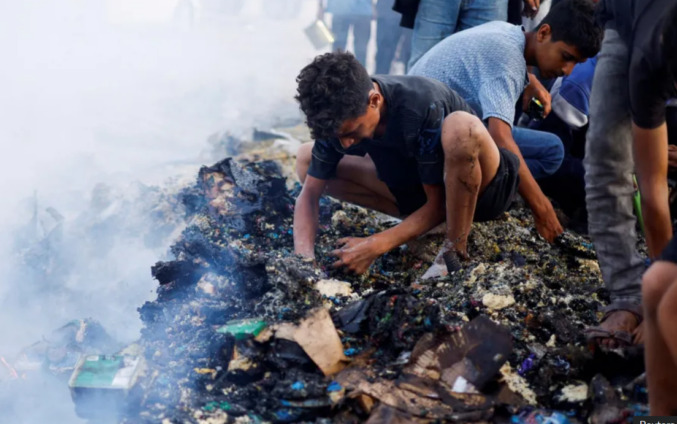
At least 45 people were killed according to the Hamas-run health ministry. Hundreds more were treated for severe burns, fractures and shrapnel wounds.
Speaking in the Israeli parliament, Mr Netanyahu said it was vital that Israel took "every precaution possible" to protect civilians caught up in the fighting in Gaza.
But he insisted the Israel Defense Forces (IDF) used their "best efforts not to harm those uninvolved" in the conflict and vowed to keep fighting against Hamas.
“I don’t intend to end the war before every goal has been achieved," Mr Netanyahu said during his address, which was interrupted by occasional heckles from family members of hostages taken by Hamas during the 7 October attack in southern Israel.
The prime minister has come under attack from some family members for failing to strike a deal for the return of their loved ones.
"In Rafah we already evacuated about one million non-combatant residents and despite our utmost effort not to harm non-combatants, something unfortunately went tragically wrong," Mr Netanyahu persisted.
"We are investigating the incident and will reach conclusions because this is our policy."
International organisations have lined up to condemn the strike, with the EU insisting that Israel respect a ruling by the International Court of Justice (ICJ) last week to halt strikes on Rafah. The bloc's top diplomat, Josep Borrell, called Sunday's strike "horrifying".
Despite the ICJ ruling, Israel has pledged to continue with the invasion of Rafah, with officials insisting the ruling left room for the attack to comply with international law.
Meanwhile the UN's human rights chief, Volker Turk, said the attack suggested that there had been "no apparent change in the methods and means of warfare used by Israel that have already led to so many civilian deaths".
Israel launched Sunday's Rafah attack just hours after Hamas launched its first missile attack on Tel Aviv in several months.
IDF officials said that the attack had killed two senior Hamas commanders, and that it was investigating the deaths of civilians in the area.
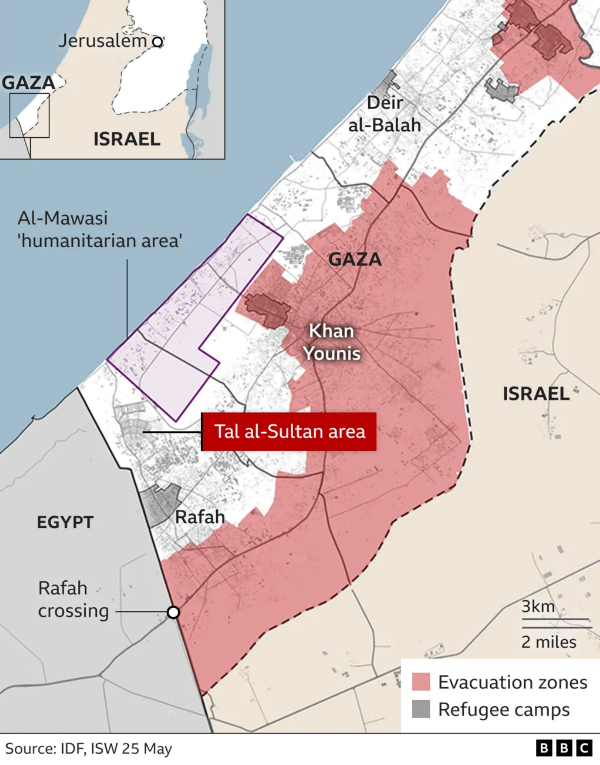
But the Palestinian Red Crescent said the air strike targeted tents for displaced people near a UN facility in Tal al-Sultan, about 2km (1.2 miles) north-west of the centre of Rafah.
Videos from the scene in the Tal al-Sultan area on Sunday night showed a large explosion and intense fires burning.
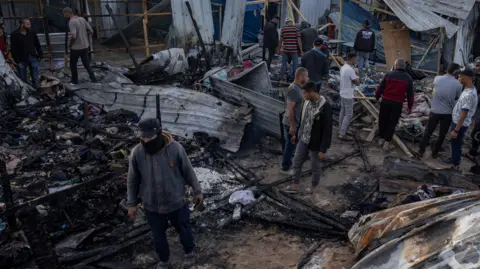
Graphic footage showed a number of structures ablaze next to a banner saying “Kuwaiti Peace Camp '1'”, as well as first responders and bystanders carrying several bodies.
Médecins Sans Frontières (MSF) said on Monday that one of its facilities had received at least 28 dead people following the strike, including woman and children.
In a statement, the organisation said it had treated another 180 wounded Palestinians, with most suffering from serious shrapnel wounds, fractures, traumatic injuries and burns.
MSF rejected Israeli claims that the strike was precise, saying the "attack on a populated camp in a so-called ‘safe zone’ in Rafah shows the complete disregard for the lives of civilians in Gaza".
In a statement on Monday evening, the US called the images "heartbreaking", but insisted that Israel had a right to defend itself.
"Israel has a right to go after Hamas, and we understand this strike killed two senior Hamas terrorists who are responsible for attacks against Israeli civilians," a White House national security spokesperson said.
But they conceded that "Israel must take every precaution possible to protect civilians".
Israeli officials had spent much of Monday scrambling to find out what went wrong in Rafah. How did a “precision strike” using specialised munitions with “reduced warheads” result in a firestorm which killed dozens and injured scores?
Following last week’s ruling by the ICJ, ordering Israel to halt any operations in the Rafah area that might inflict further harm on the Palestinian population, Israel knows that the eyes of the world are on it. It’s under enormous pressure to explain its actions.
It says the operation was based on intelligence, and it seems both Hamas figures were killed.
But the presence of huge numbers of civilians and, it seems, a significant quantity of flammable material, raises a great many questions about how this incident was planned and executed.
With top military officials, including Maj Gen Yifat Tomer Yerushalmi, the IDF’s advocate general, promising a thorough investigation, we can expect some kind of more detailed explanation to come quite soon.
But whether this marks a turning point in the campaign is another matter.
Mr Netanyahu remains committed to what he calls “total victory” in Rafah, so there’s no sign that Sunday's disaster will change his mind.
Despite the appalling scenes from last night, Israeli ground forces still appear to be acting somewhat cautiously as they edge closer to the city of Rafah itself.
Their operations so far have not resulted in a bloodbath.
But that’s exactly what last night’s air strike achieved, dealing yet another blow to Israel’s already battered image and undermining its rationale for pressing on.
Latest Stories
-
Vehicle assemblers must meet local content threshold to enjoy VAT exemption – Mahama
4 minutes -
Health Ministry secures new US employment pathway for qualified Ghanaian nurses
9 minutes -
GRIDCo completes 4km, 161kV transmission line linking Yendi Solar to Tamale-Yendi network
10 minutes -
Government to regulate EV charging stations to protect power stability – Mahama
13 minutes -
Withheld information, poor audit could account for GH¢624m fumigation gap – Domelovo
17 minutes -
GFA to launch 2026/27 Colts Football Season
18 minutes -
Fidelity Bank donates GH¢200,000 to Ghana Medical Trust Fund for vulnerable patients
28 minutes -
Jimmy Aglah: When Hollywood ended at Kwashieman…
28 minutes -
GoldBod, EOCO team up to track illicit financial flows in gold trade
30 minutes -
Climate x Culture Summit to spotlight role of creativity in Africa’s climate action on October 22 in Accra
31 minutes -
Ghana, City of Columbus sign MoU to establish nursing partnership programme
38 minutes -
AI regulation faces political deadlock as calls grow for Congress to act
44 minutes -
Former Auditor-General must explain GH¢624m fumigation expenditure gap – Domelovo
45 minutes -
Awaken to the North Mission combines faith, sport and community development in Lonto
48 minutes -
AFCON 2027Q: Somalia, Niger to play home matches at Accra Sports Stadium as CAF clears facility
50 minutes