

Audio By Carbonatix
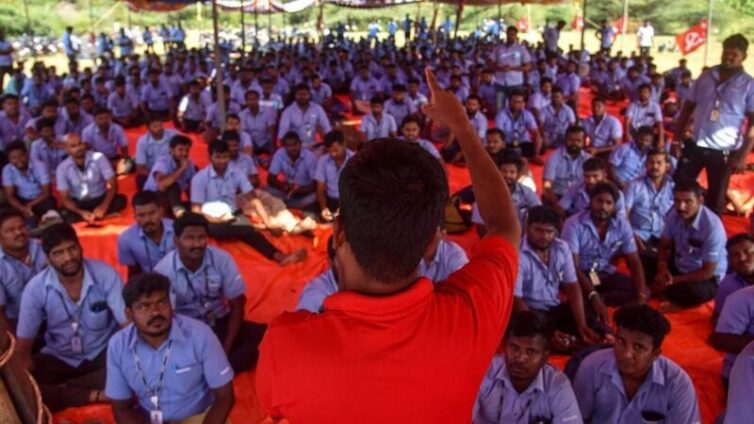
For the past 11 days, about 1,500 workers of South Korean technology giant Samsung Electronics have been striking work in the southern Indian state of Tamil Nadu, leading to major disruptions in production.
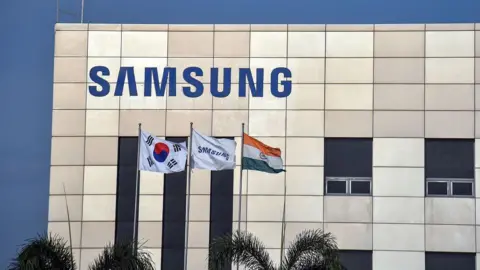
The plant in Chennai city, one of Samsung's two factories in India, employs nearly 2,000 workers and produces home appliances, contributing about a third to the company's annual $12bn (£9bn) revenue in India.
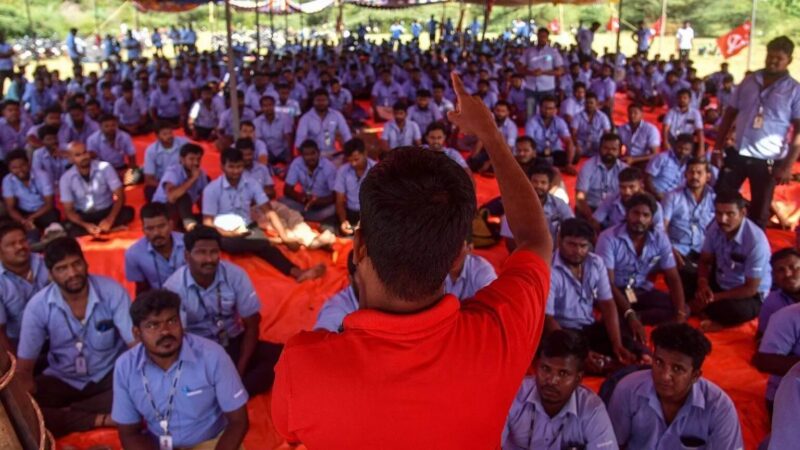
The striking workers gather at a plot of land near the 17-year-old factory daily, demanding that Samsung recognise their newly-formed labour union - the Samsung India Labour Welfare Union (SILWU). They say that only a union can help them negotiate better wages and working hours with the management.
The protest, one of the largest Samsung has seen in recent years, comes even as Prime Minister Narendra Modi has been courting foreign investment by positioning India as a viable alternative to China for manufacturing activities.
Samsung India has released a statement saying that the welfare of its workers was its top priority. "We have initiated discussions with our workers at the Chennai plant to resolve all issues at the earliest,” it said.
Hours earlier, the police had detained around 104 workers for undertaking a protest march without permission. The protesters were released in the evening.
"The workers have decided to strike work indefinitely till their demands are met,” said A Soundararajan, member of Centre of Indian Trade Unions (Citu), backed by the Communist Party of India (Marxist). Citu has backed the new union in the factory.
The workers have three key demands: Samsung must recognise the new union, allow collective bargaining, and reject competing unions as about 90% of the workforce belongs to SILWU, said Mr Soundararajan.
Workers, earning an average of 25,000 rupees ($298; £226) a month, are demanding staggered raises totalling a 50% increase over the next three years, according to Citu.
Citu also alleged that workers at the plant were being "pressurised to finish each product - like a refrigerator, washing machine, or TV - within 10-15 seconds", work non-stop for four to five hours at a stretch, and do their jobs in unsafe conditions.
Mr Soundararajan also alleged that workers were pressurised by the management to leave the new union and that their families were threatened as well.
The BBC has sent Samsung India a detailed set of questions for a response.
Meanwhile, Tamil Nadu's Labour Welfare Minister CV Ganesan said he had assured union officials that talks were under way to resolve their issues. "We will fulfil the demands of the workers," he said.
Sijo*, a protester, said that he arrives at the protest site daily at 08:00 IST (02:30 GMT) and stays until 17:00, joining hundreds of workers in their blue Samsung India uniforms.
The union arranges for lunch and water for the protesters, while a makeshift cloth tent protects them from the elements. There are no washroom facilities, so the workers use the outdoors.
"Since the factory was set up, employees have been working without complaints or a union. But things have been getting bad over the past couple of years, and now, we need the support of a union," Sijo said.
He added that his pay doesn't keep pace with the cost of living and that this has put a strain of his family's finances.
Up until 2020, the Samsung Group was known for not allowing unions to represent its workers. But things changed after the company came under intense public scrutiny after its chairman was prosecuted for market manipulation and bribery.
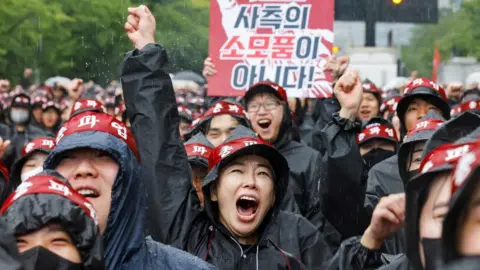
Millions of Indian workers join trade unions - often backed by leftist parties - who use their political clout to enforce labour laws and negotiate better conditions. "Foreign companies set up in India but resist following local laws on workers' rights to association and collective bargaining," alleged Mr Soundararajan.
Many prominent multinational companies, including Apple and Amazon, have set up factories in India. But labour rights activists allege that many of them underpay and overwork their Indian employees and collude with state governments to clamp down on workers' rights.
Shyam Sundar, a labour economist, said multinational corporations use various "human resource strategies" to prevent workers from forming unions in developing countries like India.
For one, they fiercely oppose workers joining external, politically-backed unions and encourage them to form "worker-led" internal ones.
"This ensures that the management has some control over the union's activities," Mr Sundar said.
Mr Soundararajan alleged that management at the Chennai plant had also approached workers with this solution, which they refused. The BBC has reached out to Samsung India for a response.
The second way, Mr Sundar said, is by hiring young, unskilled workers, especially from rural areas, by attracting them with a good starting salary. "These 'trainees' are promised to be made permanent employees after a couple of months, but this doesn't happen. The salaries too stay stagnant or have very low increments."
The rapid growth of "flexible workers" - employees hired on contract - has become a key strategy of multinational corporations to stop unionising by ensuring a pliant workforce, he added.
According to the latest government statistics, every two in five workers employed in factories in India in 2022 were contractual labourers, making up about 40% of the workforce in industrial establishments.
"Companies use the threat of re-location or non-expansion to discourage state governments from enforcing labour laws," Mr Sundar said. "But workers can leverage global labour unions to pressure companies to abide by international labour laws," he added.
Latest Stories
-
Black Star Experience announces national choral music contest to discover new Ghanaian talent
7 minutes -
Melcom serves 1,000 meals to children in selected orphanage homes
8 minutes -
Miracles Aboagye questions Mustapha Gbande’s authority to direct EOCO arrest of Manhyia South MP
9 minutes -
My music is a true reflection of who I am – Nigerian singer Ladé
9 minutes -
Activa International Insurance Ghana reinforces culture of compliance and customer protection
15 minutes -
Mining must prove its impact, not just publicise it — Chamber of Mines
25 minutes -
NDC disqualifies Dzifa Gunu from La Dadekotopon contest
32 minutes -
Togbe Afede XIV opposes proposed 5-year presidential term
35 minutes -
World Vision targets 90 percent universal WASH access in Asunafo North, Asutifi North
53 minutes -
I told EOCO to arrest Manhyia South MP – Mustapha Gbande
1 hour -
2028 election will be a combination of strategy and ‘buga’ – Miracles Aboagye
1 hour -
Bombs preventing rescue of kidnapped youths, Nigerian police say
1 hour -
Flydubai co-pilot planned to crash plane into Tel Aviv airport or building, reports say
1 hour -
National security must be built beyond Accra – Muntaka
1 hour -
Ghana bans preaching on buses with jail terms for offenders
1 hour