

Audio By Carbonatix
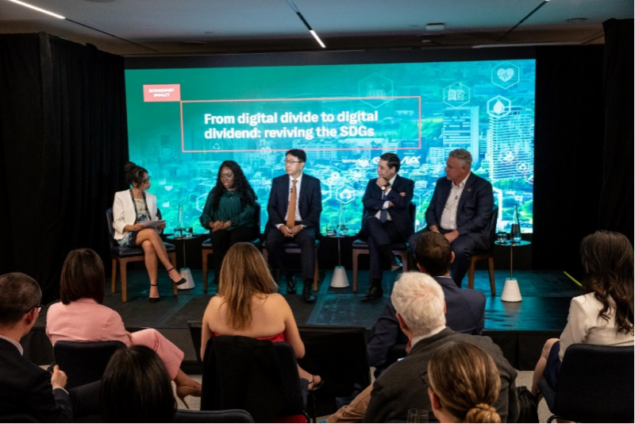
Chief executive of Telecel Ghana, Patricia Obo-Nai joined a pivotal panel on tackling connectivity barriers, addressing the internet usage gap and developing a more inclusive digital future during Climate Week 2024 in New York.
Hosted by policy and media think tank, Economist Impact and the Global System for Mobile Communications Association (GSMA) on the sidelines of the 74th session of the UN General Assembly, Obo-Nai articulated her vision for overcoming the digital divide that hampers progress in achieving the UN Sustainable Development Goals (SDGs).
The panel, titled ‘From Digital Divide to Digital Dividend: Reviving the SDGs’, brought together leaders from technology, academia, policymaking and civil society, in their quest to discuss solutions in digital connectivity for sustainable development.
Moderated by the Principal of Policy and Insights at the Economist Impact, Pratima Singh, other panellists were the Chief Regulatory Officer of GSMA, John Giusti; Vice President for Digital Transformation at the World Bank, Sanbu Kim; and Mauricio Lizcano, Minister of Information Technologies and Communications for the Government of Colombia.
Ing. Obo-Nai said access to digital technologies is a catalyst for economic growth and improved living standards. Reflecting on Ghana's progress, she acknowledged the strides made in digital transformation, particularly in financial services, governance and education.
“Ghana has made significant progress in the last few years, by digitalising government services to reduce revenue leakage and improve efficiency in service delivery but to realise the full potential of digital transformation, we need intentional investment in connectivity to rural areas and digital skills development for young people,” she said.
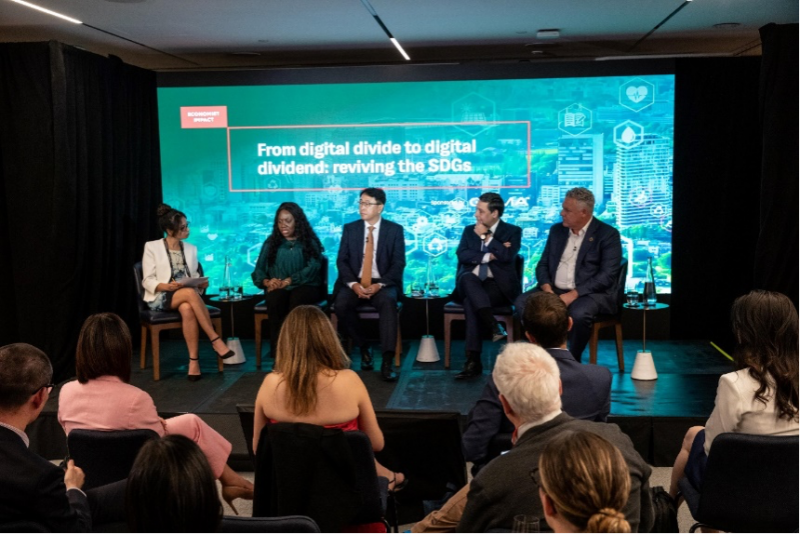
On how digital connectivity plays a role in advancing the SDGs Ing. Obo-Nai said equitable access to digital resources ensures that people in underserved areas can access crucial services.
“We are actively investing in fibre connectivity nationwide and providing cross-border connectivity. We are empowering people to use digital products and services to better their lives and businesses.
"Beyond infrastructure, digital literacy initiatives also ensure that all segments of society can utilise technology for greater inclusion and participation.”
Telecel Ghana’s substantial contribution to social impact through its Foundation helps to advance the UN SDGs 3,4 5, 8 and 10 on health, education and gender equality.
The Foundation’s Connected Health programme provides free rural ultrasound screening for expectant mothers in their communities to prevent them from travelling long distances to receive antenatal support and the results are transmitted to doctors through the power of mobile technology.
The Connected Education initiatives including STEM training, tech labs and digital libraries have impacted over 100,000 young people, 14 universities and several basic and senior high schools in all 16 regions.
Additionally, the Foundation’s women-centred digital and financial literacy training is helping more women in rural communities to be financially independent and digitally savvy.
Answering the question of the role of policy and regulation in ensuring access to connectivity, Ing. Obo-Nai said the potential of digital technologies is immense when paired with the right policy-making efforts.
“Policy can help achieve equity in digital infrastructure by ensuring access to affordable mobile devices through local assembly plants and fewer duties on devices and telecom equipment meant for rural deployment, fibre connectivity along major road corridors, diversified energy sources to power the connectivity infrastructure, access to spectrum auctions over the long term in exchange for investment into coverage expansion and financial incentive for startups to drive innovation and provide employment.”
Digital technologies directly contribute towards more than two-thirds of the UN’s SDGs targets, including climate action, quality education, zero hunger and no poverty.
Latest Stories
-
Black Stars must win next game against Côte d’Ivoire – Carlos Queiroz
33 minutes -
Global Game Scouting Tournament set for September 25 kick-off in Accra
55 minutes -
Queiroz outlines long-term plan to rebuild Black Stars for 2030 World Cup
1 hour -
‘Most important trophy now is the next game’ – Carlos Queiroz
2 hours -
Ahafo Ano South West DCE laid to rest as Muslims hold final prayers
3 hours -
Ghanaian professor Kofi Akamani shot dead in US; wife arrested
3 hours -
Sammy Gyamfi says 2018 NACOC removal from port inspections weakened drug checks
3 hours -
Greater Accra region accounts for 77% of total secured credit in half-year 2026 – BoG
3 hours -
Founder’s Day: We face forward, but are we moving?
3 hours -
Sheenah Naturals unveils Akuaba Collection at Beauty Inside Out Conference
4 hours -
T-bills: 91-day, 364-day yields to trade slightly higher in second half of 2026
4 hours -
Black Stars: It’s our decision to leave Kudus to recover – Queiroz
4 hours -
Sammy Gyamfi backs Mahama’s directive to restore NACOC’s at ports
4 hours -
Queiroz provides insight into Kudus’ decision to withdraw from Black Stars squad
4 hours -
I’m not changing after 47 Years – Queiroz fires back at critics
4 hours