

Audio By Carbonatix
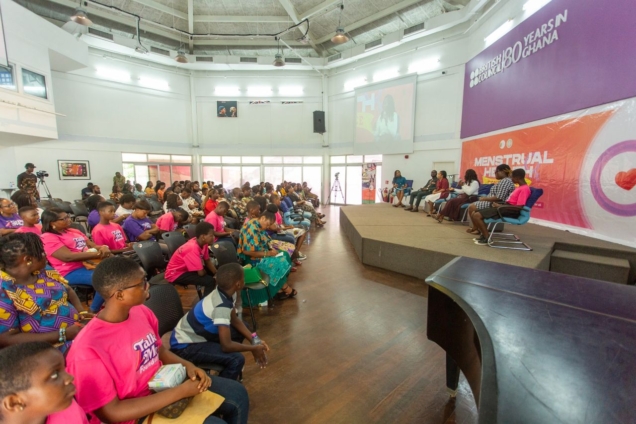
The Orange Girl Foundation, in collaboration with the William Wilson Turner Foundation, organized the maiden Menstrual Health Conference to promote menstrual health conversations, particularly for physically challenged girls.
The event, which was held at the British Council in Accra, brought together advocates, individuals and organizations, students, and teachers who are purposely driven by menstrual health conversations in Ghana to identify gaps and find pragmatic solutions for menstrual health management issues.
According to the founder, Ethel Nanayaa Amoako Baffoe, the brain behind the event is to bring everyone together to have one voice in the menstrual health conversations to achieve a common goal.
“We have all been contributing our quota in our various corners, and it was time to come together to have an extensive conversation,” she added.
She also called on the government to remove the taxes on sanitary pads to eliminate period poverty and promote girl child education.
The conference conversations also centered on providing supportive workplace policies for women, especially those with extreme period pain like endometriosis and dysmenorrhea.
Speaking to the news team, Paul Asante, an SDG advocate, said that physically challenged girls are mostly sidelined in the menstrual health conversations.
“Comprehensive education awareness tailored with special learning materials that can be accessed by persons with disabilities should be enforced by the Ministry of Education through the Ghana Education Service,” he said.
He also called for the passing of a legislative instrument or bill in parliament to design menstrual products that are easy to use for individuals with varying physical or cognitive abilities.
The organization stated that the Menstrual Health Conference will be an annual event.
One in ten girls in Sub-Saharan Africa misses school during their menstrual cycle, which can amount to as much as twenty percent of a given school year. Access to affordable menstrual hygiene products is increasingly challenging for many young girls and women in Ghana, especially those in underserved communities, and most importantly, persons living with disabilities.
Latest Stories
-
Ghana concludes evacuation of citizens from South Africa; total returnees reach 1,900 – Ablakwa
13 minutes -
Africa must define its own green transition path – Prof Fatima Denton
35 minutes -
WASSCE 2026: English Language performance falls to 62.4% – WAEC
58 minutes -
WASSCE 2026: Social Studies records sharp rebound as Maths, Science also improve
1 hour -
2026 WASSCE entry rises by 11% as 512,862 candidates sit exams
1 hour -
WASSCE 2026: English Language performance falls to 62.4% – WAEC
2 hours -
WAEC cancels 2026 WASSCE results of 8,295 candidates over examination irregularities
2 hours -
WAEC releases provisional 2026 WASSCE results for 512,862 candidates
2 hours -
CJ’s remarks on SOEs were made in good faith, not to undermine judicial independence – Judicial Service
5 hours -
Bright Future Alliance pays courtesy call on Akufo-Addo, invites him to African Leaders of Influence Lectureship Series
5 hours -
This is an attempt to break the Minority caucus – Patricia Appiagyei on alleged GH¢70k payment
6 hours -
‘OSP hasn’t contacted me’ – Patricia Appiagyei assures cooperation if invited
6 hours -
I find it strange that this memo was purportedly written by me – Patricia Appiagyei
6 hours -
Ayariga calls for stronger church partnership to tackle sanitation, environmental challenges
7 hours -
I don’t think we have an industry – Patchbay Band manager
7 hours