

Audio By Carbonatix
Exploration for iron ore in Ghana’s Oti Region is showing strong potential, with early data suggesting that the deposits could be commercially viable and possibly among the best in West Africa.
This development could significantly bolster Ghana’s mineral resource base and lay the foundation for a domestic iron and steel industry.
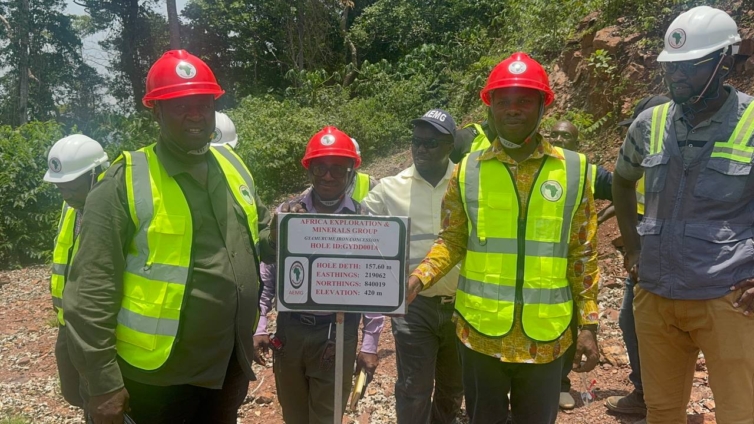
Driven by increasing global demand forecast to rise by 3% annually due to growth in construction and manufacturing the search for iron ore is being spearheaded by the Ghana Integrated Iron and Steel Development Corporation (GIISDEC) and its technical partner, Africa Exploration and Minerals Group (AEMG). The exploration has focused on the Gyamurume area within the Kadjebi District since 2020.
Initial findings are encouraging. GIISDEC officials report discovering oxidised iron ore with iron oxide concentrations as high as 82%, translating to about 57% iron. On average, samples contain 67% iron oxide or approximately 47% iron content.
“These are just preliminary figures, but the signs are very promising,” said William Okofu Darteh, Chief Executive Officer of GIISDEC.
“While we still need laboratory confirmation, the quality appears to be very competitive even better than some deposits being mined elsewhere in Africa", he pointed out.
These promising results have attracted the interest of several potential investors, but GIISDEC remains focused on completing its data collection before entering serious negotiations. “We are not rushing into anything. Accuracy and completeness are our priorities,” Mr. Darteh added.
So far, the exploration process has included remote sensing and geophysical surveys. From 54 initially identified targets, AEMG narrowed down 11 key drilling zones. Drilling began in mid-2024, with eight of the planned 30 drill holes already completed. The full drilling program spans 15 drill lines, covering approximately 2,500 metres. Completion is expected by June 2025, followed by a detailed resource estimate by September 2025.

Franklin Mace, Chief Geologist at AEMG, noted that the drilling has consistently intersected banded iron formations averaging 30 metres in width. Interestingly, serpentinite rocks potential indicators of nickel have also been found, adding unexpected potential value to the project.
Geological mapping has so far identified 42,000 square metres of fully oxidised ironstone and 36,000 square metres of partially oxidised deposits, extending over an 8-kilometre stretch that dips steeply eastward. Fault zones in the rock formations may improve accessibility to the ore.
Over 100 rock samples tested by Intertek Laboratory and the University of Ghana confirm high iron content. However, drilling is essential to verify the depth and continuity of the deposits.
“It’s visible on the surface, but we need to confirm what lies beneath,” explained Prof. Frank Nyame, a University of Ghana lecturer and technical advisor to the project.
Once the resource estimate is complete, GIISDEC plans to use the data to attract investment and establish a full iron and steel production value chain. This initiative could diversify Ghana’s economy, reducing reliance on gold and cocoa exports.
“This could be a transformative project,” Darteh emphasized. “By the end of September 2025, we should know the full potential, and then we can take the next big steps.”
Ghana currently holds about 1.7 billion tonnes of iron ore reserves, including the Shieni deposit (1.3 billion tonnes at 33.8% Fe) and the Opon-Mansi deposit (147 million tonnes at 52.5% Fe). A US$600 million mining operation at Shieni is scheduled to begin in late 2025, with the goal of reducing annual steel imports valued at around US$900 million. The broader national plan is to start domestic processing of iron ore by 2027, focusing on value addition and job creation.
Community engagement is also a key part of the project.
Osaberima Osei-Bonsu V, Paramount Chief of the Asato Traditional Area, expressed support, noting the difference between this structured effort and illegal small-scale mining.
“We are hopeful that our people will benefit through employment and other opportunities,” he said.
Although the terrain presents logistical challenges, GIISDEC is pressing ahead with support from partners like the Ghana Geological Survey Authority, consulting firm SRK, and local contractor BobJosh Drilling Company, which is supplying portable rigs suited to difficult conditions.
“We recognize the obstacles especially with access and transport but we’re addressing them as they arise,” Mr. Darteh concluded.
If successful, this initiative could become a cornerstone of Ghana’s future industrial landscape.
Latest Stories
-
La Liga chief dismisses Real’s ref conspiracy claims
24 minutes -
GMA rejects claims its vessel monitoring system is ineffective
35 minutes -
I was close to joining Liverpool in 2016 – Mbappe
47 minutes -
Ministry of Sports and Recreation holds national validation workshop on National Sports Policy Draft
51 minutes -
‘Do you want me to be happy with this poor performance?’ – Bono East Minister fumes over Kintampo market project with less than 1% work done
58 minutes -
London screening honours Nkrumah and 103 years of Ghana cinema
1 hour -
Founder’s Day: Is Nkrumah’s glory fading? – Nkrumah’s iconic fountain at Circle runs dry
1 hour -
GHS calls for stronger systems to ensure safe care for NCD patients
1 hour -
Kufuor calls for Africa’s resources and youthful population to be transformed into opportunities
1 hour -
Mahama administration not clamping down on free speech – Shamima Muslim
1 hour -
Ghana TVET Service, UNESCO, KPMG, Microsoft to train 100,000 facilitators in AI
1 hour -
Kejetia traders demand controls as shop owners resell spaces at inflated prices
1 hour -
Fix Ghana Maritime Authority surveillance system instead of ‘threatening’ NPP – Dennis Aboagye tells NDC
2 hours -
Poor land acquisition for development projects pushing people into poverty – Prof Helen Essandoh
2 hours -
‘This is what we expect from a statesman’ – Brazilian President commends Mahama for leading global reparatory justice push
2 hours