

Audio By Carbonatix
Director of the Regional Transport, Research and Education Centre (TRECK) at KNUST, Professor Helen Michelle Korkor Essandoh, has observed that many people are being impoverished by the failure to properly acquire land and resettle inhabitants for development projects.
She says although development projects are being executed across the country, some developers fail to properly acquire lands and resettle affected persons, a situation that prevents such projects from yielding their maximum benefits.
"When it comes to development projects, governments and others try to develop them as well as they can but it comes with environmental risks and social issues which are sometimes neglected," Prof. Essandoh said.
"One key issue is land acquisition and involuntary resettlement. When it comes to land, people's lives are tied to land. They live at the place, grow up there and have their culture and social network all tied to these places."
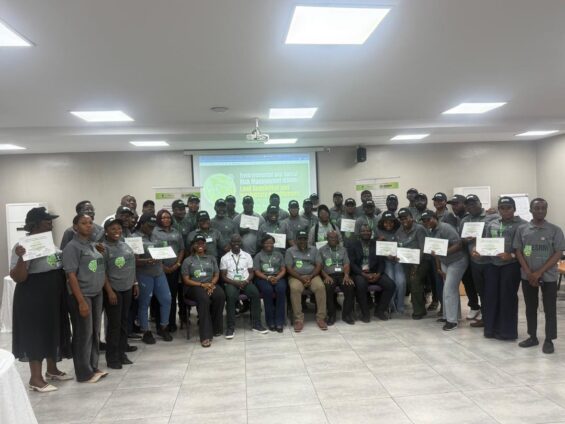
She spoke on the sidelines of a training program organised by TRECK in collaboration with Ghana Institute of Management and Public Administration (GIMPA), with support from the World Bank.
The professional certificate course was on Environmental and Social Risk Management, with a focus on Land Acquisition and Involuntary Resettlement.
According to her, people whose lands are taken for projects often lose more than just shelter. They lose businesses, farmlands, resources and social networks that sustain them.
"When you need to develop the place and if there are people there you will have to move them elsewhere. It is important that it is done in a way that minimizes the impact on the people because you want to reap the benefits of the project but if people are impacted negatively through losing their livelihoods, they become worse off," she explained.
Prof. Essandoh noted that the challenge is widespread in developing countries where rapid infrastructure expansion inevitably encroaches on inhabited communities.
"It is a problem that exists in developing countries. We are always trying to improve the lives of the people so governments are always bringing in new projects, expanding infrastructure, the roads; we need roads, facilities, water systems and others.
"In developing this infrastructure, there are people living in those areas so it's a big problem and sometimes people are not happy so when they complain a lot it reduces benefits that are supposed to be got from the project," she said.
To deal with the gaps, participants were taken through eight modules, including land acquisition for development projects, legal and institutional frameworks, planning land acquisition and involuntary resettlement, compensation, livelihood restoration and entitlements, stakeholder engagement, resettlement action planning and gender-based violence.
Meanwhile, the representative of GIMPA, Dr. Paul Rex Dankwah, speaking at the closing ceremony, encouraged participants to put the training into practice, stressing that such knowledge is critical to enhancing sustainable development.
Participants on their part lauded the programme for the insights gained, expressing confidence that the skills acquired would help them review and institute proper resettlement plans in their respective countries.
Latest Stories
-
LA 2028: Black Queens hold final training session ahead of second leg against Mauritius
9 minutes -
Standards are not Seasonal: What the EC appointments teach both sides
23 minutes -
King Mohammed VI urges private sector to create youth jobs and spread benefits of growth
24 minutes -
KGL U17 Colts 2026: Greater Accra win title after penalties win over Western Region
24 minutes -
UK Investment Roadshow opens in London to advance UK-Ghana growth partnership
35 minutes -
Assemblies of God requires pastors to resign before entering partisan politics – Rev. Wengam
45 minutes -
Ghana targets 20% annual reduction in maternal deaths – Health Minister
50 minutes -
Cyber attacks in Africa grow faster than global rate, report finds
52 minutes -
Ghana signs UAE deal to create 5,000 overseas jobs
59 minutes -
One Million Coders Programme targets 100,000 digital jobs in two years – Sam George
1 hour -
John Jinapor, Italian Ambassador explore opportunities for energy sector investment
1 hour -
NHIA seeks legal reforms to support Free Primary Healthcare
1 hour -
Beatrice Annan defends Afi Agbenyo’s EC appointment, cites record of gender advocacy
1 hour -
Ghana seeks investment deals in Bangkok amid global economic crises
1 hour -
IMF raises Ghana’s 2026 growth forecast to 5.7%, sees inflation falling to 4.8%
1 hour