

Audio By Carbonatix
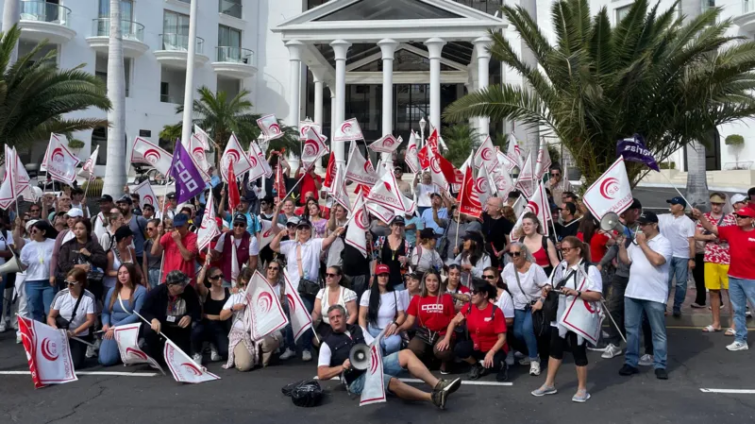
Holidaymakers heading to Tenerife in the Canary Islands are warned to prepare for disruption as hotel workers take part in strikes at the start of the Easter bank holiday weekend.
Organisers say workers on the island are striking on Thursday and Friday in a row over pay and conditions.
The industrial action was due to be across the Canary Islands but an agreement was reached on Gran Canaria, Lanzarote and Fuerteventura.
Unions say around 80,000 hotel workers on Tenerife, La Palma, La Gomera and El Hierro will still take action.
The UK Foreign Office warned travellers to expect disruption over the Easter weekend and to check their tour operator's advice and follow the advice of authorities.
By law, strikers have to provide a "minimum service" but the Comisiones Obreras union, which called the strike, says hotel cleaning, food and entertainment do not fall into this category.
It says suggestions that minimum service should include things such as reception and concierge or cleaning, restaurants and cooking, infringe upon the workers' right to strike.
"The imposition of minimum services constitutes an illegitimate, disproportionate, and legally unsustainable restriction on the fundamental right to strike," the union said in a press release.
For many holidaymakers the noise of protests is disruptive and there are noticeably fewer people by the poolside.

Fernando Cambon Solino is among those protesting.
He moved to Tenerife for work.
"Everybody knows the Canary Islands," he said. "You come here and you enjoy the sun, the beaches, the view. But it's not the same for the people who are working here."
Rodrigo Padilla is a journalist in Tenerife and was at a protest supporting his mother who works as a waitress.
He said the issue was with both pay and conditions.
"My mother leaves the house at 6am and it takes three or four hours to get to work and the same after her shift."

Advertisement
The industrial action comes after a series of protests last year in the Canary Islands and Spanish mainland over mass tourism.
Locals say tourism has pushed up housing costs beyond a sustainable level for people to live on the islands.
They stress they are not against the tourism industry, which makes up 35% of the Canaries' economy, but there was a need for a more sustainable model that factored in environmental impacts such as water shortages and which puts less pressure on costs and housing.
Latest Stories
-
Chief Doli-Wura Zakaria wins GSA President’s Award for contribution to statistics and data science
1 minute -
Government keeps GH¢2 diesel price cut for September
3 minutes -
2026 U20 WWC: 5 key Black Princesses players who will miss tournament
4 minutes -
Djokovic in tears during US Open first-round exit
8 minutes -
Yusuf Sulemana celebrates Gonja unity at Damba festival
9 minutes -
A Minister under watch: Zanetor’s burden of expectations
22 minutes -
Don’t make funding your starting point for green businesses – Entrepreneurs urged
28 minutes -
Skills gap in electric vehicles presents jobs opportunity for Ghanaian youth
35 minutes -
Mahama heads to Serbia for 65th anniversary of Non-Aligned Movement
40 minutes -
National Children’s Day 2026: Child Online Africa calls for child-led digital protection in Ghana
46 minutes -
Manasseh sets the record straight on Northshore Apparel GH; dispels 1D1F claim
46 minutes -
Supreme Court dismisses injunction bid seeking to halt Skytrain trial
51 minutes -
AU Chairperson reaffirms commitment to global African unity
59 minutes -
Air Pollution in Accra is not random; it is a burden carried by the poor
1 hour -
GEXIM Bank grows loan portfolio to GH¢1.56bn as equity hits GH¢2.1bn in 2025 – SIGA Report
1 hour