

Audio By Carbonatix
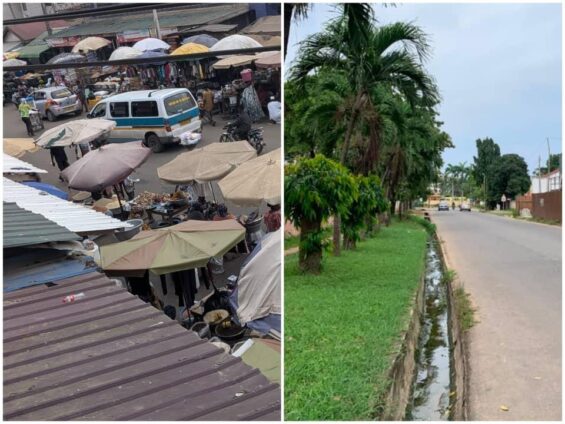
A comparison of air quality between the informal settlement of Nima and the wealthier community of Cantonments shows that in Accra, clean air is not shared equally — it follows the same pattern as much else in Ghana, where income and address determine quality of life.
It is not yet 7 am at Nima Market, and already the air has a texture to it. A trotro idles at the junction, its engine running loud, spewing black smoke as it waits for one more passenger before pulling away. Dust lifts from the unpaved edges of the market as traders wheel handcarts between stalls, and the market comes to life.
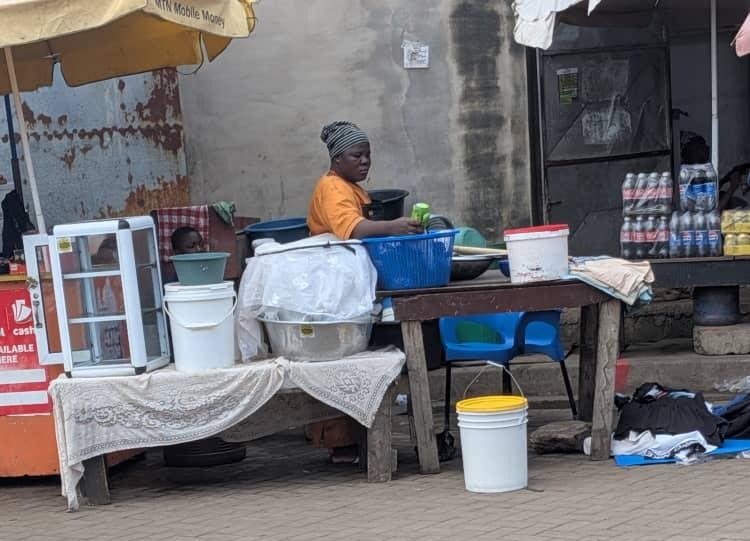
Amina Suleiman has been here since before dawn. For eighteen years, she has sold koko, a millet porridge, from a stall a few metres from the junction — a charcoal stove, a pot of beans and rice, plastic bowls stacked on a small table. By the time the sun is up, the smoke from her fire has blended with the diesel fumes and the dust into something she breathes for twelve hours a day.
"The smoke, I am used to it," she says, wiping her forehead with the back of her hand. "When I go home at night, my chest feels tight. Sometimes I cough and cannot sleep. But what can I do? This is how I feed my children."
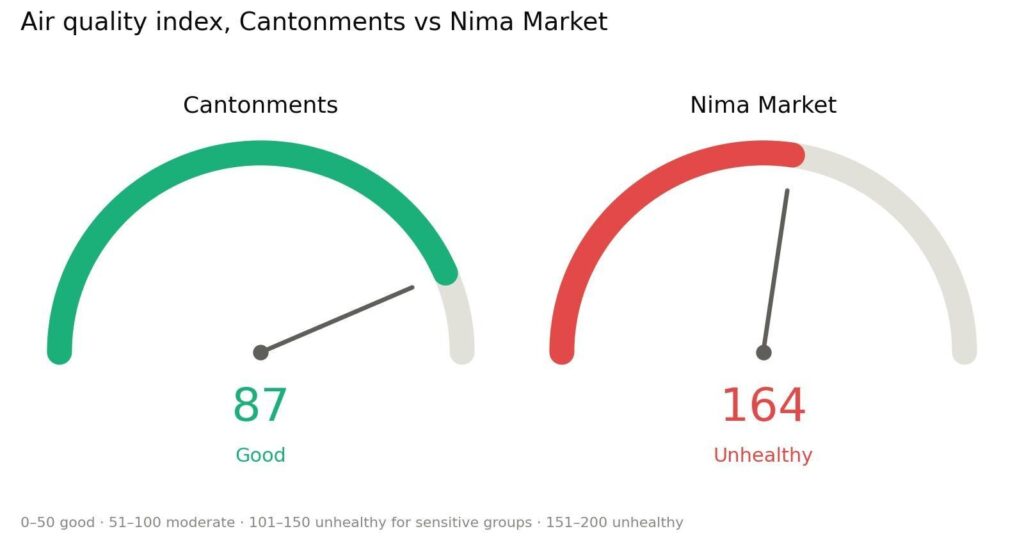
A small sensor placed near the market that morning recorded a reading of 164. In the language of public health, that number has one word attached to it: unhealthy.
Ten kilometres away, in the wealthy area of Cantonments — wide streets, walled compounds, trees casting shade over walled compounds— the same kind of sensor returned a different verdict entirely: good.
The two readings, taken in the same week of late July, describe two different cities within the same ten kilometres of the Ghanaian capital. And, advocates say, they tell a story of injustice.
Ghana's air pollution crisis is accelerating quietly, killing people prematurely and sickening thousands more with chronic disease, even as the country's attention remains fixed elsewhere.
Ghana's Environmental Protection Authority and researchers working with the Clean Air Fund say pollution-related illness now kills more people each year than malaria or HIV — a shift that has taken place without anything like the scale of alarm that infectious disease once commanded.
The burden of that shift is not shared evenly. Pollution-related illness now kills an estimated 12,870 people in Ghana every year and sickens another 107,000 — a toll public health experts say has overtaken malaria and HIV, even as its cost, some GHC 28 billion annually in healthcare and lost productivity, remains largely unacknowledged.
It falls almost entirely on the poor, who live closest to the two biggest sources of pollution in the city: traffic and open waste burning.
For Amina, injustice does not arrive as a statistic. It arrives as a tight chest at the end of a working day, and a nine-year-old son who spent a week in hospital last year after a cough that would not stop.
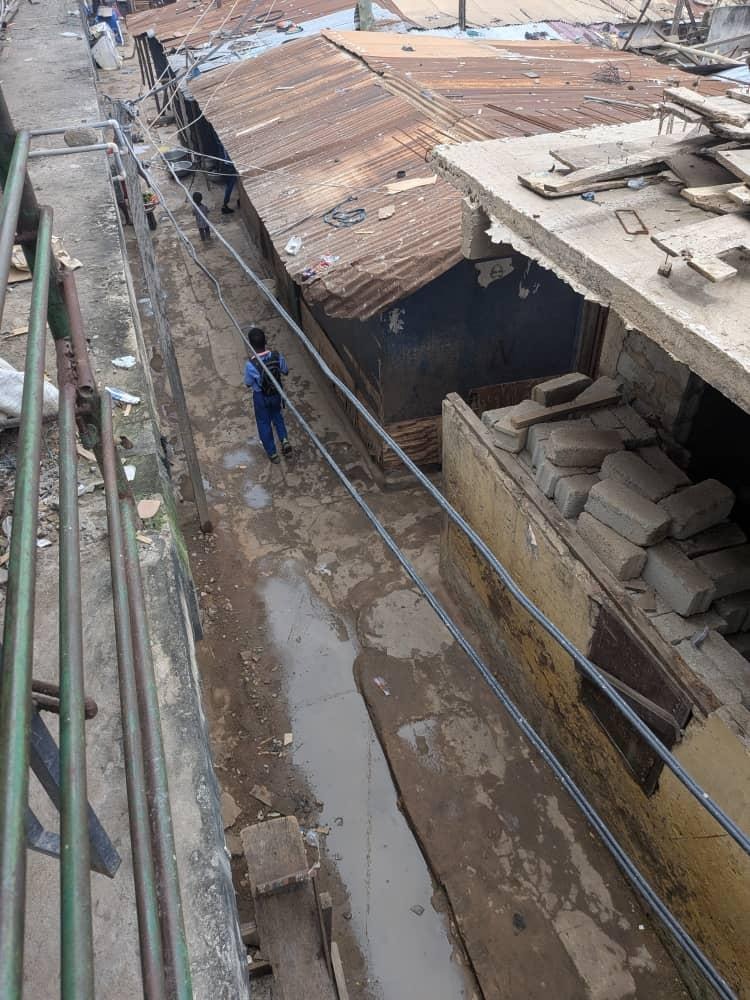
"When I take him to the hospital, they give him medicine and say, 'Keep him away from smoke and dust,'" she says, laughing bitterly. "Where am I supposed to keep him? We live in one room behind the market. The smoke is everywhere."
Amina does not use words like PM2.5 or particulate matter. She does not need to. Her body and her son's tell her every day what the air is doing.
The Numbers That Tell The Story
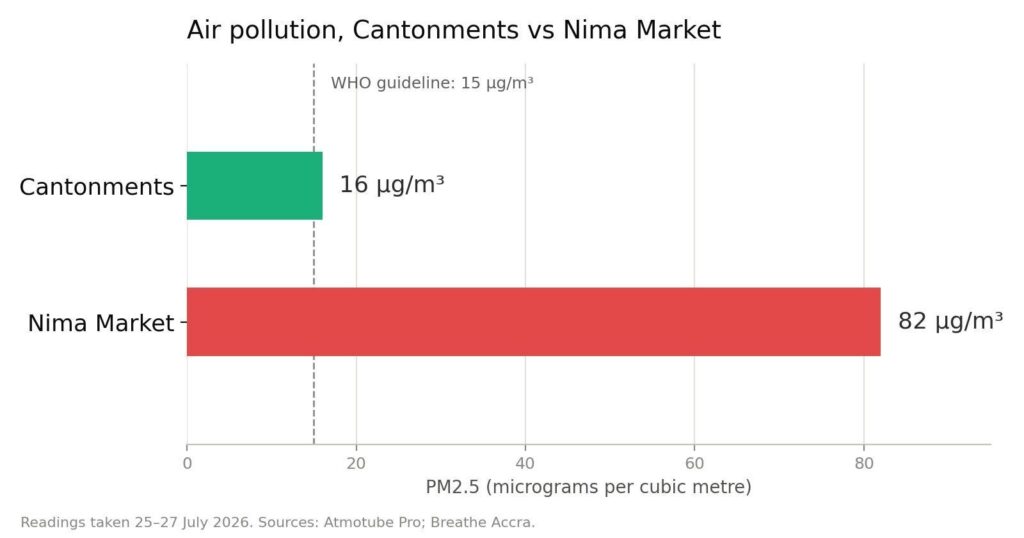
Over three mornings in July, Myjoyonline used two types of air monitors to check air quality in the two areas. In Cantonments, readings came from a portable, handheld device called an Atmotube Pro — the kind of consumer gadget anyone can buy and carry around. In Nima Market, readings came from a fixed monitor that feeds Accra's public "Breathe Accra" dashboard, alongside a similar handheld sensor.
Both devices measure something called PM2.5 — tiny particles of dust, smoke, and soot so small they can slip deep into the lungs and the bloodstream, making them one of the most dangerous forms of air pollution.
Over the three days, Cantonments recorded PM2.5 levels between 12 and 19 micrograms per cubic metre, rated “good” by the monitor.
In Nima Market, the reading was 82 micrograms per cubic metre — more than four times higher. That reading falls squarely into the "Unhealthy" category: a level at which even healthy adults, not just those with pre-existing conditions, may begin to experience adverse effects.
A Familiar Divide
The gap is not new information for researchers. Stretching back nearly two decades, the same pattern has been found: Nima and other low-income neighbourhoods are consistently more polluted than wealthier ones, even as pollution levels citywide have gradually fallen. What has narrowed over the years is the size of the gap — not the fact of it.
"It's an inequality issue," says Dr Elvis Kyere-Gyeabuor, portfolio manager for Breathe Cities Accra at the Clean Air Fund, who has studied air quality and urban transport in the city for the better part of a decade. Poorer residents, he says, are simply less able to escape the air around them. "Someone who lives in Nima probably doesn't have an air-conditioned house, doesn't drive in an air-conditioned car."
In Cantonments, he says, the picture is different by design, not accident — shade, greenery, paved compounds.
Public schools compound the exposure. "Most public schools, from the Newtown cluster of schools to the Nima cluster of schools to the Kaneshie cluster of schools to the Teshie cluster of schools, all have bare parks. There is not a single blade of grass on these parks."
Children and teachers alike breathe the dust those bare compounds produce, on top of whatever waste burning is happening nearby.
Over a lifetime, he argues, that difference adds up to something closer to lost years.
"By the time they all live to 70, if they do," he says, "the more you get exposed to these pollutants, the more life you lose."
When Kyere Gyeabuor talks about pollution, he does not begin with the air. He begins with the body.
"If I live in Old Fadama and I'm exposed to 220 micrograms every day, what will happen is that in five years, I will probably have high blood pressure," he says.
"Currently, medication and research on HIV and even malaria have advanced so much that deaths from those diseases have fallen. We're rather seeing increasing deaths with things that relate to stroke, things that relate to high blood pressure, and air pollution contributes to stroke and high blood pressure."
What Burns, and Where
Ask what actually drives the gap between a place like Nima and a place like Cantonments, and Kyere-Gyeabuor points to two things above all: open waste burning and vehicle emissions. Even wealthy neighbourhoods are not exempt — in Cantonments, he says, it is often garden waste, hedges and cut grass, set alight instead of collected. In Nima, Old Fadama, Jamestown, and Chorkor, it is household waste, burned for lack of any other way to get rid of it.
Not everyone in Nima agrees that the air is the community's biggest problem — or that it has gotten any worse.
Experts say this lack of awareness is preventing people from doing some of the things that could help reduce sickness, like wearing nose masks or keeping children away from burning.
Francis Awotwe, a respected elder at the Nima trotro station who has lived in the community for more than forty years, is unconvinced by the researchers and their instruments. "People talk about this air pollution like it is something new," he says.
"I have been breathing this air since before many of these researchers were born. I am still here. My children are still here. My grandchildren are still here."
Told of the children with asthma, the elders with chronic coughs, the funerals that come too soon, he waves a hand.
"That is just life. People get sick everywhere. In Cantonments, they get sick too. They have cancer; they have heart disease. It is not just here."
But even he concedes something has shifted. "I will say this: the smoke from the burning waste has gotten worse. When I was young, we did not have this much burning. Now, every morning, you cannot open your windows. It is not good, but what can we do?"
He is doubtful that outside attention will amount to anything.
"If they wanted to fix it, they would have fixed it by now."
Watching the Air
For most of Accra's history, the question of how bad the air actually was could only be answered anecdotally by a cough that lingered longer than it should, by the film of dust that settled on a windowsill overnight. That has begun to change, giving citizens a tool to help protect themselves.
Breatheaccra.org, a website, shows the readings of 55 sensors spread across the city. That means that for many residents, a monitor now sits somewhere within reach of their neighbourhood, feeding live readings to a public dashboard.
It is a modest infrastructure by the standards of cities with decades of effective monitoring behind them, but Kyere-Gyeabuor says it’s a step in the right direction.
"The fact that we're having this conversation means that it's getting better. It means people have become aware of it. It means people are beginning to talk about it."
He points to the passage of Ghana's National Air Quality Management Policy in 2025 as evidence that the shift in awareness has reached into government itself. But he says the next steps will require more political will.
What Would It Take
It is a deceptively simple diagnosis, and one that implies a deceptively simple prescription: stop burning waste, clean up the vehicle fleet. What is not in question, say experts, is where the responsibility lies. The government already knows what is polluting its air. What has lagged is the response: the political and institutional will to act on that knowledge at the scale the problem demands, and the resources to extend enforcement into the neighbourhoods that need it most.
Can you just add a sentence or two fleshing out what “enforcement” means? You’ve sort of left it out unexplained. Enforcement of laws that require XX, etc.
This is a collaboration with New Narrativesas part of the Clean Air Reporting Project. Funding was provided by the Clean Air Fund, which had no say in the content.
Latest Stories
-
Conflicts among care providers linked to maternal, neonatal deaths – Expert
60 minutes -
GIS marks 10th TIME conference, champions improved teaching practices
1 hour -
BRICS Or Balance? What Ghana’s bid really means
2 hours -
GPRTU wants full TRAFFITECH-GH implementation to start in 2027
2 hours -
Mahama announces plans to import electric wheelchairs for PWDs
2 hours -
KGL U17 Colts 2026: Western beat Prempeh Elite Academy to set up final final with Greater Accra Region
2 hours -
Late Solanke strike salvages 10-man Spurs draw at Man United
2 hours -
Gender Ministry to monitor welfare of Nana Akua Addo’s children amid domestic violence case
3 hours -
Benedict Okyere Yeboah: Ghana’s football problem goes beyond sacking a coach
3 hours -
GPL 2026/27: Darkwah Wiafe’s winner sees All Blacks beat Kotoko
3 hours -
ITF World Tour : Patel Wins Boys’ Singles Final at J100 Accra
3 hours -
Ghana must pursue BRICS partnership if it brings economic benefits – Kpebu
3 hours -
Success and Wright Claims J100 Accra Girls’ Doubles Championship
3 hours -
ITF J100: America’s Wright wins J100 Accra Girls’ Singles Title
3 hours -
Expedition hopes to find aviator Amelia Earhart’s plane on remote island
3 hours