

Audio By Carbonatix
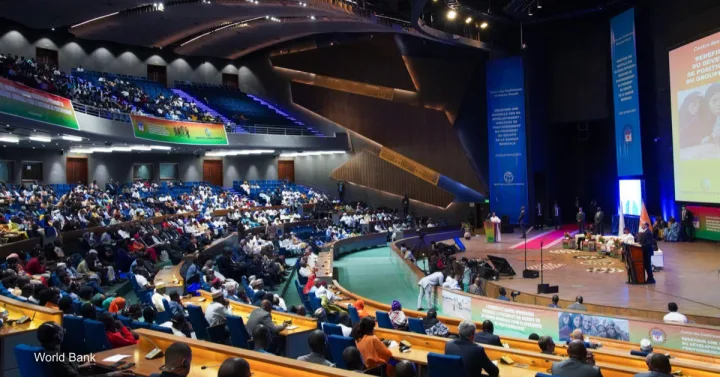
As the world grapples with economic uncertainty, the International Monetary Fund (IMF) and World Bank Group (WBG) are set to convene for their highly anticipated Spring Meetings in 2025.
The meetings will take place from April 21–26 in Washington, D.C., under the theme: “Jobs – The Path to Prosperity,” aimed at exploring international cooperation on the future of job creation.
This comes as the two Bretton Woods institutions estimate that approximately 1.2 billion young people in emerging economies will reach working age over the next decade, but only about 420 million jobs will be available to them.
The gathering of global leaders, finance ministers and central bank governors, policymakers, and experts will focus on exploring solutions to recent trade tariff tensions and shaping the future of international cooperation.
It will also serve as a platform for a call to action for global leaders to work together to address pressing economic challenges and build a more prosperous and sustainable future for all.
Ahead of the meetings, Mr Ajay Banga, President of the WBG, highlighted the risk posed by the disparity between workforce growth and available jobs, noting that without opportunity, the forces of fragility, illegal migration, and instability could intensify.
He urged developing countries to establish the right systems and frameworks that allow the private sector to contribute financing and investment, particularly in infrastructure and regulatory environments conducive to job creation.
Mr Banga said the Bank would expand its Private Sector Investment Lab to include the most critical sectors for job creation—energy and infrastructure, agribusiness, healthcare, tourism, and manufacturing.
He reaffirmed the Bank’s commitment to creating meaningful and sustainable employment opportunities, stating: “The idea is to build a Bank that delivers what is demanded—jobs—because jobs are the best way to drive a nail in the coffin of poverty.”
On global trade tariff tensions, he noted that the Bank was engaged in constructive dialogue with the US administration, despite prevailing uncertainty. “They’re asking the right questions, and we’re trying to give them the right answers,” he said.
The World Bank chief called for more efficient border processes, reduced trade costs, clearer rules of origin, and decreased friction to boost trade volumes and provide more stable and diversified growth in developing economies.
Ms Kristalina Georgieva, Managing Director of the IMF, observed that the resilience seen about six months ago was now being tested by the ongoing reshaping of the global trading system.
She outlined three consequences of the current trade tensions: costly uncertainty, a negative impact on short-term economic growth, and long-term productivity erosion—especially in smaller economies—caused by protectionism.
She called for a reset of global trends towards lower tariff rates and the reduction of non-tariff barriers and distortions, noting the importance of cooperation in a multipolar world.
Ms Georgieva expressed confidence in the Spring Meetings, calling them “a vital forum for dialogue at a vital time.”
“All countries, large and small alike, can—and should—play their part in strengthening the global economy in an era of more frequent and severe shocks,” she said.
The IMF chief added that when pushed “hard enough, things that were not possible become possible, mountains that couldn’t be climbed are climbed, vested interests that would not retreat are overcome.”
She called for cool heads, clear vision, and strong will, concluding: “We need a more resilient world economy, not a drift toward division. And to facilitate the transition, policies must allow private economic agents time to adjust and deliver.”
Latest Stories
-
Ghana gets nuclear power plant simulator
3 minutes -
GMTF, Atlantic Lifesciences explore local production of cancer and heart medicines
8 minutes -
GHS medical-legal claims hit GH¢400m in three years
14 minutes -
Mahama cautions Ghanaians not to take religious freedom for granted
30 minutes -
We need development pathway, not selection exercise – Sports Minister urges football stakeholders
37 minutes -
Government prioritises foundational learning to improve education outcomes
43 minutes -
Ghana, Côte d’Ivoire deepen maritime security cooperation through joint boundary inspection
49 minutes -
Three-hour rainfall exposes poor drainage system in Kadjebi
55 minutes -
Ghana, China push AI innovation in healthcare
1 hour -
Give young people skills and the systems to create jobs
1 hour -
Food inflation never responded – Dr Yamson says Ghana must stop throwing money at short-term fixes
1 hour -
Oil set for second weekly rise as unsettled US-Iran war crimps supply
2 hours -
US teen drops lawsuit against Meta, Google and Snap ahead of trial
2 hours -
Meghan could return to acting once back in UK
2 hours -
Bali jails Swiss tourist for insulting sacred Day of Silence
2 hours