

Audio By Carbonatix
Ghana’s economy experienced high, but volatile and unbalanced growth up to 2022 debt crisis.
According to former First Deputy Governor of the Bank of Ghana, Dr. Maxwell Opoku-Afari, the mid-2000 wascharacterised by strong Gross Domestic Product (GDP) growth, averaging 6% annually, driven by cocoa exports, gold production, and later, oil production.
Yet the expansion was also accompanied by rising fiscal deficits and an increasing dependence on external borrowing, setting the stage for future vulnerabilities.
Dr. Opoku-Afari disclosed this in an article titled ““How not to Miss a Crisis: Lessons from Ghana”.
He explained that Ghana’s macroeconomic trajectory began to show signs of strain by the early 2010, highlighting that the discovery and exploitation of oil boosted growth, but fiscal discipline weakened, particularly around election cycles.
“Election-driven spending booms produced some growth spurts but were quickly followed by deep fiscal and debt crisis. What is even more surprising is that this high spending often did not result in electoral victories for the ruling government, as the pattern of electoral outcomes shows a weak linkage between election spending and electoral outcomes”.
Dr. Opoku-Afari who is a Non-Resident Fellow of Finance for Development Lab said Ghana’s growth performance hid major vulnerabilities, as it was obtained at the price of high and growing fiscal deficits, and was not diversified, nor based on private investment or high-quality public infrastructure.
Growing Public Deficits Due to Expensive Borrowing Strategies
The former International Monetary Fund (IMF) Mission Chief further stated that Ghana’s debt story typifies the challenges of fiscal management in resource-rich, lower-middle-income countries, with high infrastructure gaps and a growing middle class.
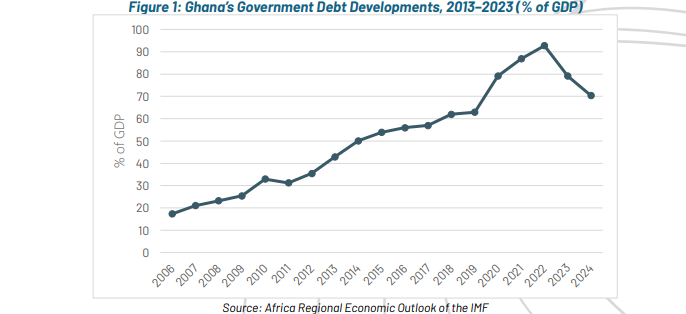
After HIPC relief, he alluded that Ghana started the decade with low gross public debt, but within twenty years, returned to debt distress, demonstrating the cyclical nature of fiscal vulnerability and the difficulty of maintaining debt relief gains. “Fiscal deficits averaged 8.3% between 2010 and 2024, while Ghana’s gross public debt (comprising both domestic and external debt) rose sharply from about 38.9% of GDP in 2010 to 92.7% by 2022, before declining after the 2023–24 debt restructurings”.
He noted that the key turning points included increased Eurobond issuance from 2007, accelerating after 2013, fiscal slippage and energy-sector costs, COVID-19 and terms-of-trade shocks, and exchangerate depreciation.

For instance, in 2022 alone, according to the Ministry of Finance, the depreciation of the Ghanaian Cedi alone added to the external debt stock GH¢93.9 billion, equivalent to 0.2% of GDP.
“A simple debt decomposition seems to indicate a paradox: until COVID-19, debt dynamics were not driven by primary deficits. The high interest bill and stock-flow adjustments played a stronger role, i.e. contingent debt that was not initially counted in the deficit. It is only in 2020 that primary deficits become dominant, and after 2022 that Cedi depreciation becomes the key driver”.
By 2018–2020, the former First Deputy Governor pointed out that debt service accounted for over 45% of government revenues, amplifying perceptions of an unsustainable debt trajectory, adding, debt pressures are visible in the share of interest payment which had outgrown primary balance as a share of GDP.
Between 2018 and 2022, interest payments absorbed an outsized share of Ghana’s public expenditure, averaging about 29% of total spending.
When combined with compensation of employees, these rigid obligations consumed nearly 60% of the budget, leaving little fiscal space for critical investments in education, health, water, and other essential public services.
As a result, Dr. Opoku-Afari noted that the national budget was increasingly constrained in its ability to function as an effective policy tool for driving development and improving livelihoods. “This created the foundation for the unsustainable borrowing cycle to close annual budgetary financing gaps”.
Latest Stories
-
Minority awaits formal notice of arrest warrant for Manhyia South MP – Annoh-Dompreh
1 minute -
LTIF announces 2026 Pan-African edition in Accra from October 6-7
2 minutes -
Mfantsipim needs broader funding partnerships to bridge infrastructure gap – Prof Baiden
3 minutes -
MP status must not shield anyone from law enforcement – Kwakye Ofosu
12 minutes -
EOCO had tactical team ready to arrest Baffour Awuah – Felix Kwakye Ofosu
32 minutes -
Afoko can unite NPP’s factions, says Charles Owusu Juanah
45 minutes -
Guardiola backing Man City after guilty verdicts
52 minutes -
Annoh-Dompreh questions EOCO’s claim that Manhyia South MP was unavailable for questioning
52 minutes -
Djokovic wins first match since Wimbledon at China Open
1 hour -
KAIPTC, National Peace Council move to bridge civilian-security trust deficit to counter violent extremism
1 hour -
Infantino should have no place in future of football – Pinto
1 hour -
A decade of duty: First Commander recounts the unexpected birth of Ministries Fire Station
1 hour -
Mfantsipim must cultivate more business leaders, entrepreneurs – Nana Awuah
1 hour -
MOBA must reduce reliance on donations to protect Mfantsipim’s future – Patrick Kittoe
1 hour -
GCB extends Customer Service Week into month-long customer engagement
1 hour