

Audio By Carbonatix
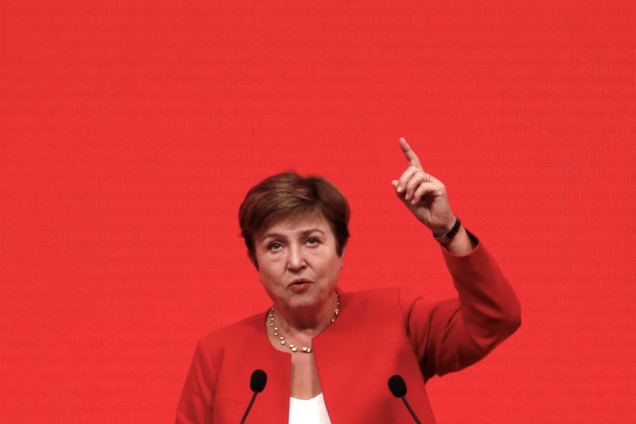
The Managing Director of the International Monetary Fund (IMF), Kristalina Georgieva, is urging central banks to keep an eagle eye on the data, including higher inflation expectations.
According to her, strong regulation and supervision remain essential to keep banks safe, adding, rising risks from nonbanks must be monitored and contained.
Speaking ahead of the World Bank/IMF Spring Meetings, which open today in Washington, USA, Madam Georgieva said that to protect price stability, monetary policy must remain agile and credible, supported by a strong commitment to central bank independence.
Her speech is also coming amid the US tariff war with the global economy.
According to her, emerging market economies should preserve exchange rate flexibility as a shock absorber, urging policymakers to look to the IMF’s Integrated Policy Framework for insights on how and when temporary measures may be warranted.
“Tighter budget constraints will entail difficult choices everywhere, but nowhere more so than in low-income countries. Here, weak revenues necessitate stronger efforts for domestic resource mobilization, but also call for support from international partners—both to improve capacity for reforms and to secure crucial financial assistance”, she.
She pointed out that countries with unsustainable public debt should move proactively to restore sustainability, including in some cases by taking the difficult decision to seek debt restructuring.
“I am very pleased to mention that the Global Sovereign Debt Roundtable will soon publish a playbook for country authorities considering debt restructuring—to help decision-making”, she alluded.
Policy Tradeoffs
She mentioned that policy tradeoffs can be eased by lifting growth potential.
“The U.S. economy has seen strong productivity growth while others have slipped behind. How can they catch up? Through ambitious reforms in banking, capital markets, competition policy, intellectual property rights, and AI preparedness, all of which can contribute to higher growth”, she added.
In many cases, Madam Geogieva said the state can and should do much more to reduce obstacles to private enterprise and innovation—in other words, eliminate self-inflicted injuries.
Macroeconomic Adjustment
She continued that the IMF will help countries manage macroeconomic adjustment and advance reforms.
Currently, 48 countries are relying on the Fund’s balance of payments support, including Argentina.
“As a second hugely important priority, countries should renew their focus on internal and external macroeconomic imbalances”, she pointed out.
Latest Stories
-
CSSPS placement results to be released tomorrow – Education Ministry
13 minutes -
His Excellency Professor Yaw Safo Boafo
13 minutes -
NSA Board Dissolution: Olympic, Paralympic representation expected to remain on new board
24 minutes -
When English became the safest Ghanaian language
37 minutes -
Nurses and midwives indispensable to resilient health system – Bawumia
40 minutes -
About 565,000 BECE candidates qualify for SHS placement – CSSPS
41 minutes -
Virtual InfoSec Africa renews partnership with Cyber Security Authority
45 minutes -
TMA is highest authority in Tema, TDC must comply with its regulations — President
1 hour -
Cyanide, unregistered cigarettes hidden under bags of millet, soya beans in major highway bust in Techiman
1 hour -
Security agencies call on civilians to volunteer information to combat crime
1 hour -
New maternal units commissioned in North Tongu to improve access to care
1 hour -
Enterprise Insurance reaffirms industry leadership with 4 wins at 6th CIIG
1 hour -
GES release national harmonised prospectus for 2026/27 SHS admissions
1 hour -
Presidency orders TMA, TDC to end dispute over Tema development authority
2 hours -
Ayew brothers among Ghanaians without clubs after transfer window closes
2 hours