

Audio By Carbonatix
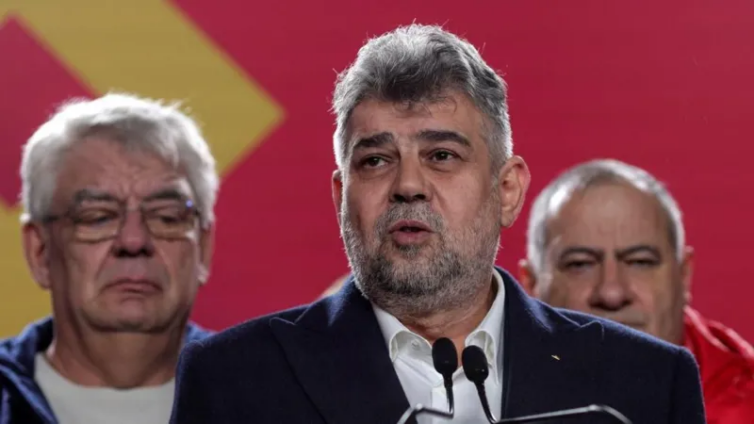
Romanian Prime Minister Marcel Ciolacu has resigned and his Social Democrat party is to leave the government after a right-wing nationalist candidate won the first round of the presidential election.
George Simion, a eurosceptic who has promised to put Romania first, won 40.9% of Sunday's vote and is expected to win a run-off vote on 18 May.
He will face liberal Bucharest Mayor Nicușor Dan, who narrowly defeated the Social Democrat (PSD) candidate.
Sunday's result plunged Romania - an EU state on Nato's eastern flank - into further political turmoil. Ciolacu told colleagues that as their coalition had failed to meet its objective and "has no legitimacy", they should pull out of the government.
Ciolacu, 57, had only come to power in a pro-EU coalition after elections in 2024, although George Simion's far-right party along with two other groupings had attracted a third of the vote.
The parties in that coalition had been holding emergency meetings on Monday to decide on their next steps.
Simion's victory on Sunday was largely driven by popular frustration at the annulment of presidential elections late last year. His likely success on 18 May is awaited nervously in European capitals, as well as in Kyiv.
He has said he wants an EU of strong, sovereign nations and his party has opposed supply weapons to Ukraine.
Ciolacu is now expected to submit his resignation to interim president Ilie Bolojan, who will then appoint a caretaker prime minister.
Bolojan himself took on the role of interim president last February because of the scandal surrounding the annulment of the presidential vote.
"Romania faces up to 45 days of political instability following Marcel Ciolacu's resignation," warned Elena Calistru of independent Romanian monitoring group Funky Citizens.
"This creates a dangerous power vacuum precisely when Romania needs steady leadership most."
Ciolacu's party was part of a three-party coalition and the prime minister told his colleagues they had come together with the aim of having a joint presidential candidate and a parliamentary majority.
"One of these two objectives has failed," he explained. "I've seen the vote from yesterday, and that tells us the current coalition no longer has legitimacy in this form."
"In any case, the new president would have replaced me – that's what I've seen and heard from the media. A new coalition will form to govern."
Catalin Predoiu, the leader of his liberal coalition partner PNL said they were now looking for a prime minister "capable of addressing the current challenges".
Meanwhile, the Social Democrat mayor of of Buzau, to the north-east of Bucharest, was highly critical of his party leaders: "We've embarrassed ourselves, and that's partly because of poor decisions taken over time by the leadership."
George Simion, 38, has cast himself as an admirer of US President Donald Trump. He became presidential frontrunner earlier this year when far-right pro-Russian candidate Calin Georgescu was barred from running
Georgescu had won last November's first round, which was annulled by the courts after allegations of Russian interference on social media and campaign fraud.
Simion cast his vote on Sunday alongside Georgescu, having told voters the election was "about every Romanian who has been lied to, ignored, humiliated, and still has the strength to believe and defend our identity and rights".
He has called for restoring Romania's old borders and has been banned from entering Moldova and Ukraine.
Political analyst Radu Albu-Comanescu told Romania public radio that Sunday's result was "a radical manifestation of hostility towards the current political establishment".
Simion did particularly well with Romania's diaspora voters, polling more than 73% in Spain and almost 65% in the UK among a broadly blue-collar electorate.
Public resentment at Romanian financial support for Ukrainian refugees has been a central plank in Simion's campaign, though he denies he is pro-Russian.
"Russia is the biggest danger towards Romania, Poland and the Baltic states, the problem is this war is not going anywhere," he told the BBC.
Elena Calistru said Romania was witnessing a remarkable political reset as both Simion and Nicușor Dan had positioned themselves as anti-establishment candidates with wildly different solutions.
"The outcome will reveal whether anti-establishment sentiment necessarily translates to anti-European positioning, or if Romania can channel its desire for change into constructive democratic renewal," she told the BBC.
Latest Stories
-
GPL 2026/27: Kotoko beat Heart of Lions to end decade-long winless run
1 minute -
GPL 2026/27: Hearts of Oak come from behind to beat GoldStars
12 minutes -
Construction of new Wa airport to commence soon – Mahama assures
18 minutes -
Government support for the arts industry is not enough — Aewura Arts
50 minutes -
Art can be lucrative, but have a side hustle – Aewura Arts to fellow artists
59 minutes -
No two-phone law – GRA clarifies Customs rules for travellers
60 minutes -
My parents opposed my decision to pursue art – Aewura Arts
1 hour -
IShowSpeed’s manager said my artwork was one of the best he received on tour — Aewura Arts
1 hour -
Chief of Staff directs ecological restoration of reclaimed Kpeshie Lagoon
1 hour -
Driver convicted over concrete spill on Madina-Adenta Highway
2 hours -
Photos: Prospective homeowners turn up in numbers for final day of JoyNews–Republic Bank Habitat Fair
2 hours -
Aggrieved teachers demand payment of unpaid four-year legacy arrears
2 hours -
Skipping breakfast bad for your health?
2 hours -
Kpeshie Lagoon reclamation linked to first-ever flooding at Tse Addo – ISD
2 hours -
GRA announces major policy proposal under Modified Taxation Scheme initiative
3 hours