


Audio By Carbonatix
Africa’s debt sustainability has become a pressing concern, advisory firm, Bridgewater Advisors has stated in its Africa Economic Outlook.
According to the firm, the continent’s public debt between 2010 and 2024, surged by a staggering 170%, partly due to the global financial crises, Covid-19, and geopolitical tensions.
In comparison, global public debt rose by just 54% over the same period. These debt burdens have been further exacerbated by recent exchange rate depreciations, which have significantly increased debt repayment burdens.
Compounding this, it said, is an international financial architecture ill-equipped to offer affordable liquidity at scale to close Africa’s developmental gap.
In a bid to turn the tide, African leaders have approved the establishment of the African Financial Stability Mechanism (AFSM), a $20 billion fund hosted by the African Development Bank. This facility aims to avert future debt crises by offering concessional financing to member states that commit to prudent macroeconomic and fiscal reforms.
The AFSM is anticipated to save African countries approximately $20 billion in debt servicing costs by 2035. While the AFSM offers a safety net, it is not a definite solution.
“Achieving lasting debt sustainability will require coordinated action across the continent, anchored in robust macroeconomic management, strengthened fiscal discipline, and improved domestic revenue mobilization, Prosper Melomey, Partner, Corporate Transactions & Investment Bank, Africa stated.
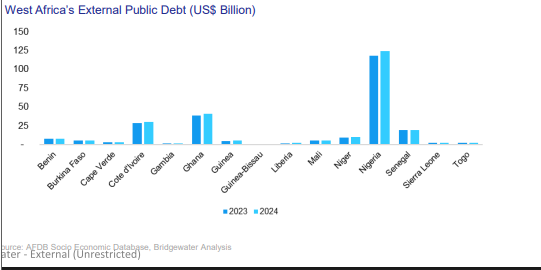
Ghana recorded $6bn debt increase in 2024
West Africa maintained a stable fiscal position with external debt-to-GDP ratio of 31%, despite a 5% rise in external funding.
However, Ghana and Nigeria recorded the highest nominal debt increases of $6 billion and $2.5 billion, respectively in 2024.
Nigeria accounted for about 48% of the region’s total external debt.
Bridgewater Advisors continued that Africa's external debt outlook for 2025–2026 remains high, with Southern Africa seeing the highest debt levels, rising from 30% to 31% driven by South Africa’s fiscal pressures and Zambia’s restructuring challenges.
East, North, and West Africa maintain stable debt at 22%, while Central Africa has the lowest at 3%. Debt sustainability remains a concern, especially in high borrowing regions like Southern Africa.
Latest Stories
-
Oil prices climb as traders weigh Saudi supply risk, Russian diesel flow
15 minutes -
Zimbabwean author denies using AI to write award-winning story
24 minutes -
Bank of America hit with $1.2bn fine for money laundering failings
33 minutes -
Robot seized by German police after allegedly groping teenage girl
44 minutes -
Subject EC appointment to ‘Akufo-Addo test’ – Kwapong
54 minutes -
English football’s independent regulator would quit over Man City interference
1 hour -
Anthropic seeks rehearing of case over Pentagon’s security risk branding
1 hour -
Torrential rains in Libya’s Tripoli kill two
2 hours -
Guinea-Bissau says it has not approved hepatitis B vaccine trial in newborns
2 hours -
NDC Deputy National Organizer Aspirant Hamza Umar targets grassroots mobilisation
2 hours -
Partisan appointment cycle will persist without meaningful reforms – Osae-Kwapong
3 hours -
‘This cycle is not going to be broken any soon’ – Osae-Kwapong on partisan appointments
3 hours -
Partisan appointments won’t help restore trust in EC – Osae-Kwapong
4 hours -
Villarreal fight back to beat Napoli and end losing run
4 hours -
Tresoldi nets hat-trick as Club Brugge win Inter thriller
4 hours