

Audio By Carbonatix
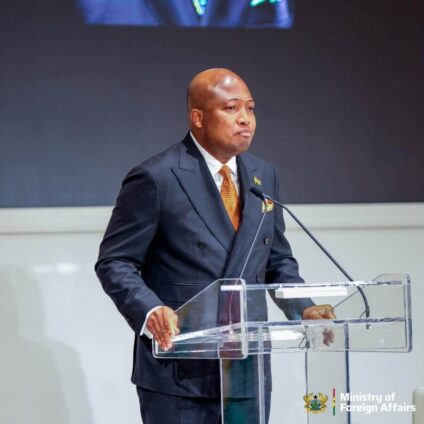
Foreign Affairs Minister Samuel Okudzeto Ablakwa says Ghana has made significant progress in its campaign for reparatory justice following the adoption of a Ghana-led United Nations resolution declaring the transatlantic slave trade the greatest crime against humanity.
He said the resolution, which received the support of 123 UN member states, had helped build international momentum for restitution, apologies and other measures to address the historical injustices associated with slavery.
Speaking in an interview on TV3 on Saturday, October 10, 2026, Mr Ablakwa said several countries and international institutions had begun taking steps towards addressing the legacy of the transatlantic slave trade.
He attributed the progress to the leadership of President John Dramani Mahama, who serves as the African Union Champion for Reparatory Justice, and Ghana’s diplomatic engagements at the 81st session of the UN General Assembly in New York.
According to the minister, Ghana’s participation in the global meeting was strategic, with engagements spanning railway development, artificial intelligence governance, agriculture, agribusiness and trade expansion, alongside efforts to advance the reparatory justice agenda.
He said a side event organised by Ghana on reparatory justice had attracted significant international support, including participation from several European countries that had previously abstained from the resolution.
Mr Ablakwa said some of the countries had expressed their willingness to work with Ghana on restitution and had presented catalogues of cultural artefacts they were prepared to return.
He also described the participation of the United States in the side event as a significant development, saying it suggested a shift towards engagement, although the country did not make a statement at the event.
The minister said the passage of the resolution itself was a major achievement, but added that Ghana was already witnessing concrete developments arising from its advocacy.
He cited an apology by French President Emmanuel Macron, the repeal of France’s Code Noir, and plans to establish a scientific commission with Ghana in Accra to conduct further research on the history and legacy of slavery.
Mr Ablakwa also said Denmark had apologised and pledged resources to support the preservation of Ghana’s forts and castles, which he described as important sites for historical education and truth-telling.
He noted that some of the historical structures had deteriorated, citing sites in Keta, Shama and the Awutu Senya area, and said the renewed international interest presented an opportunity to preserve them.
The minister further welcomed apologies from Pope Leo XIV and the Archbishop of Canterbury over the historical role of religious institutions in justifying slavery.
He said the Church of England had pledged a £100 million fund to support young African entrepreneurs and scholars, adding that the government was working with the church to agree on the modalities for implementing the initiative.
Mr Ablakwa also disclosed that the Netherlands and Germany had presented Ghana with catalogues of more than 2,000 artefacts they were prepared to return.
He said the Netherlands had already returned the head of King Badu II, a traditional leader who resisted enslavers.
According to him, the return of the historical artefact was significant because it demonstrated the resistance mounted by African traditional leaders against slave raiders and offered an important symbol of African courage and capability for future generations.
Mr Ablakwa said Ghana had also established three global panels to advance the reparatory justice agenda.
The panels include one on reparatory justice, chaired by President Mahama; a restitution panel chaired by Professor Gavua; and a panel of international legal experts examining possible legal grounds for compelling those responsible for slavery to make amends and provide compensation.
He said preliminary reports from the legal experts showed progress in exploring the legal dimensions of the campaign.
The minister also commended Jamaica for presenting a petition to the United Kingdom’s Privy Council, saying Ghana was closely monitoring the response as preparations continued for the Commonwealth Heads of Government Meeting in Antigua and Barbuda.
Mr Ablakwa maintained that the developments recorded since the adoption of the UN resolution demonstrated that Ghana’s campaign was producing tangible results and strengthening international cooperation on reparatory justice.
Latest Stories
-
Over 38,000 commercial, 150,000 residential customers unbilled – Ghana Water MD
14 minutes -
Several injured as Sprinter bus collides with ‘trotro’ at Odorkor
15 minutes -
Ghana records progress on reparatory justice agenda – Ablakwa
32 minutes -
Mahama commissions Christian Tetteh Yohuno Ward Complex at Police Hospital
47 minutes -
Vice President calls for wider access to Ghana’s political party histories
47 minutes -
Republic Bank JoyNews Habitat Fair to connect prospective homeowners with exhibitors in Ho from October 16 to 18
57 minutes -
Obaasima Summit: ‘AI is not a spiritual attack’ — Rev. Dr. Ofori-Boateng urges young women to embrace technology
1 hour -
GHS to distribute 80,000 pairs of locally-made protective footwear to health workers
1 hour -
GoldBod boosts local jobs as 90% of gold undergoes refining in Ghana – Sammy Gyamfi
1 hour -
The search for the politically unblemished: Are we asking the impossible of public appointees?
1 hour -
Ghana seeks climate finance access for debt-restructuring countries
1 hour -
Afenyo-Markin urges stronger media scrutiny of public institutions
1 hour -
GoldBod recovers GH¢38.7m in legacy PMMC debts, targets remaining arrears
2 hours -
62 out of every 100 commercial meters inspected missing from Ghana Water database – MD
2 hours -
GoldBod gets BoG authorisation to sell forex, Sammy Gyamfi tells PAC
2 hours