

Audio By Carbonatix
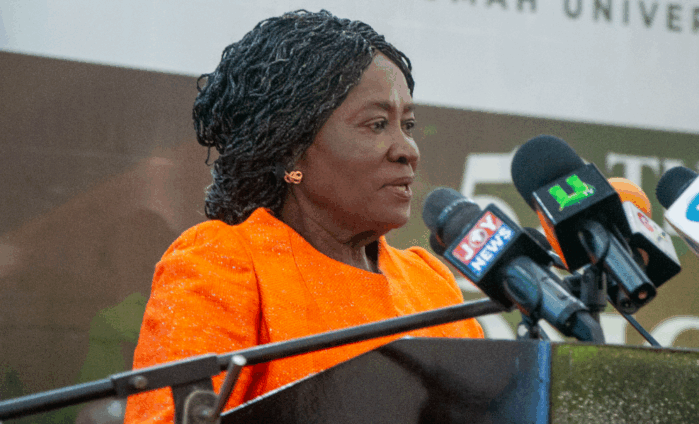
Vice President, Professor Jane Naana Opoku-Agyemang has underscored the need to safeguard academic freedom and shield university governance from political interference, while reaffirming national commitment to sustainable research funding through the Ghana National Research Fund.
Delivering an address at KNUST’s 58th Congregation in Kumasi, Vice President Professor Jane Naana Opoku-Agyemang emphasized that academic freedom is not just a cherished principle but a functional necessity for Ghana’s tertiary education system.
“Academic freedom is fundamental to the efficient running of our universities and the integrity of their governing structures,” she said, reiterating the importance of empowering university councils and management to carry out their duties without undue political influence.
Despite progressive legislation like the Universities Act, public debates on academic freedom continue to dominate Ghana’s higher education discourse. Key concerns revolve around the role of government in the appointment of vice-chancellors and university council members, a process many stakeholders argue is overly politicized.
Public universities’ dependence on government subventions has also raised alarms over potential influence on academic decisions. Legislative proposals such as the various versions of the Public Universities Bill have come under sustained criticism for threatening institutional autonomy by expanding executive control.
Professor Opoku-Agyemang, a former Vice-Chancellor herself, acknowledged these tensions and advocated a balanced approach. “Empowering councils does not mean compromising standards,” she noted. “We must be able to maintain accountability without strangling independence.”
She assured that a future government under President John Dramani Mahama would remain committed to non-interference in university operations, while still ensuring regulatory oversight through institutions like the Ghana Tertiary Education Commission (GTEC).
“The Ministry of Education will intervene only to ensure compliance, not to interfere with legitimate university processes,” she clarified.
Turning to Ghana’s research landscape, Professor Opoku-Agyemang highlighted recent strides with the operationalization of the Ghana National Research Fund (GNRF), aimed at transforming the country’s historically underfunded research ecosystem.
Established in 2020 under Act 1056, the GNRF is designed to provide predictable and locally driven funding for research, innovation, and technology development across all academic disciplines.
A major milestone was reached with the inauguration of the Fund’s 13-member Governing Board on June 4, 2025. Chaired by renowned plant geneticist Professor Eric Yirenkyi Danquah, the board is now poised to oversee the fund’s full implementation.
The Vice President announced an initial allocation of GH¢50 million for 2025 and a guaranteed minimum of GH¢100 million for 2026 from the Ghana Education Trust Fund (GETFund).
Latest Stories
-
Government has improved sanitation in one-and-a-half years — Salaga South MP
4 hours -
Nkwanta North Assembly to appear before Parliament over DACF sanitation spending
4 hours -
Mourinho prints out ‘red card’ incidents after Real lose derby
4 hours -
Atletico beat 10-man Real in feisty Madrid derby
4 hours -
Twelve Tribes of Israel Ghana to mark 40 years with anniversary celebration
5 hours -
GPL 2026/27: Hearts held by Bechem as Kotoko, Samartex share spoils
5 hours -
My Story (Kwaku Antwi-Boasiako)
5 hours -
We expect growth rate to re-accelerate in second-half of 2026 – IC Insights
5 hours -
The ungodliness and unrighteousness underlying the National Cathedral mess!
6 hours -
T-bills auction: Government fails to achieve target; yield on 91-day-bill remains unchanged
6 hours -
It’s Ghana’s shame to denigrate Nkrumah when the whole world honours him as African of the Century – Asiedu Nketiah
6 hours -
No other nationalist can compare to Nkrumah – Asiedu Nketiah
6 hours -
Collateral Registry: Foreign banks accounted for GH¢19.9bn of secured credit in quarter 2, 2026
6 hours -
This government should expect scrutiny – Asiedu Nketiah
6 hours -
Two-year-old girl dies in domestic fire at Cantonments
7 hours