

Audio By Carbonatix
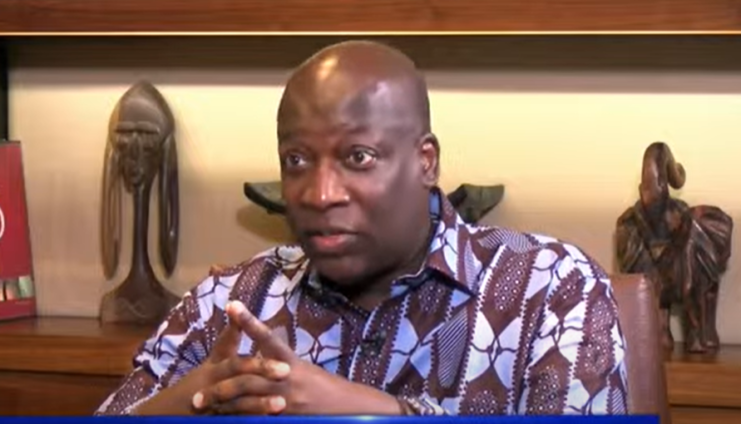
Former Executive Vice President of Unilever Ghana and Nigeria, Yaw Nsarkoh, says Ghana may have embraced the appearance of democracy, but the substance never arrived.
He said this during an unflinching conversation on JoyNews’ PM Express following his lecture titled “Iniquities of Iniquity in Our Santa Claus Democracy.”
In his view, what Ghana practices is not a homegrown democratic system, but an imported template lacking the critical foundations that make such a system thrive elsewhere.
He said in his Santa Claus democracy, he “was trying to describe a democracy that exists in form, but not always in substance. And what I tried to say was that a democracy exists to deliver tangible improvement in livelihoods when it doesn't deliver that something is already going wrong, and some of the features of a Santa Claus democracy are what I said.
“You see the institutional forms, but they exist in ritualistic ways, in the sense that accountability for delivery to the mass of the people is a little bit broken. I didn't make the statistics up.
“Ghana Statistical Services have just issued a report on May 28, where they say 70% of the population feels that they are not able to influence decision making. You cannot have a democracy that is functioning, a true democracy, and 70% of the population feel they cannot influence. Some of the salient feature are over monetization, the lack of transparency of fund flows and some things we spoke about earlier.
"One of things about democracy is an ongoing thing. You have to keep modifying things because you are learning. You need to keep customising things, there is no perfect template anywhere. But if you lock it, and you just say to yourself, ‘We became democratic on such a date and that’s it, then, there is political fermentation going to take place and we will land where we are," he said.
He said the language of power, English Language, which is used in Parliament and the court system has already excluded many people.
Yaw Nsarkoh said after 33 years of practising democracy it is time for the country to introspect, take the learnings, do the corrections and move.
“If we don’t do something about it, it can go in directions we don’t want. So we must start the conversation together saying that let’s begin the reforms,” he stated.
His argument is rooted in both history and political economy.
Unlike nations where modern democratic systems evolved after sustained industrialisation and capital accumulation, Ghana and much of Africa, he explained, attempted to graft democracy onto states still grappling with the hangover of colonialism and severe economic fragility.
“When modern European democracy took root, they were distributing wealth that had already been created. We didn’t have that. We started from under $3,000 per capita GDP. That’s a fundamentally different conversation,” he said.
Yaw Nsarkoh emphasised that democracy without a robust economic and institutional foundation simply becomes a transactional contest—what he termed “a public auction for the highest bidder.”
In such systems, the electorate is reduced to passive participants, voting every four years and then retreating into silence while elite groups trade power for personal gain.
He was especially critical of the idea that independence equated to sovereignty.
“Amilcar Cabral said it and got into a lot of trouble: what kind of independence do you really have if you don’t control your productive forces?” Yaw Nsarkoh asked.
“Having a dark-skinned president and a new anthem doesn’t mean you’ve achieved independence. You’re still navigating a distorted reality.”
Citing the work of political economist Claude Ake, Yaw Nsarkoh argued that African states did not emerge organically but were shaped by colonial disruptions, leaving behind weak and artificial structures.
“The post-colonial elite essentially took over the facilities of the state and became the new colonialists. They looked after themselves,” he said. “That’s the deformity we’ve refused to confront.”
He lamented the collapse of local governance, describing it as a symptom of a broader democratic decay.
“Look at the space we’re in, local government has essentially collapsed?” Yaw Nsarkoh asked.
Latest Stories
-
Bawumia charges NPP executives to rebuild party for 2028 victory
1 minute -
Unite the region and deliver victory in 2028 – Dr. Bawumia to new Greater Accra NPP executives
1 minute -
Ukrainian strikes kill six in Russia, acting governor says
2 minutes -
The goal is to win 2028 polls – Bawumia
2 minutes -
GoldBod secures 30% of large-scale gold output for Ghana’s strategic reserves
2 minutes -
FDA warns against unauthorised chemicals for ripening plantain
3 minutes -
‘If you sell gold at a loss, you’re not a good trader’ – Afenyo-Markin jabs Sammy Gyamfi
7 minutes -
Dr. Bawumia meets new Greater Accra NPP executives; charges them to bring all talents on board
10 minutes -
Before the Next Jason: When seniority becomes a weapon against young academics
23 minutes -
For President Mahama, every mother must live. What about you?
32 minutes -
OMCs commence fuel price reviews; Star Oil sells petrol at GH¢14.97, diesel kept at GH¢16.97
1 hour -
Residents of Brekusu-Kwabenya-Kitase protest over deplorable roads
1 hour -
Genser Energy secures 456m euros to accelerate next phase of growth across West Africa
1 hour -
COKA visits Kokofu after Ashanti NPP win, calls for unity ahead of 2028
1 hour -
Bono East crowns Kintampo SHS, Gyarko Community Day SHS for national public speaking finals
2 hours