

Audio By Carbonatix
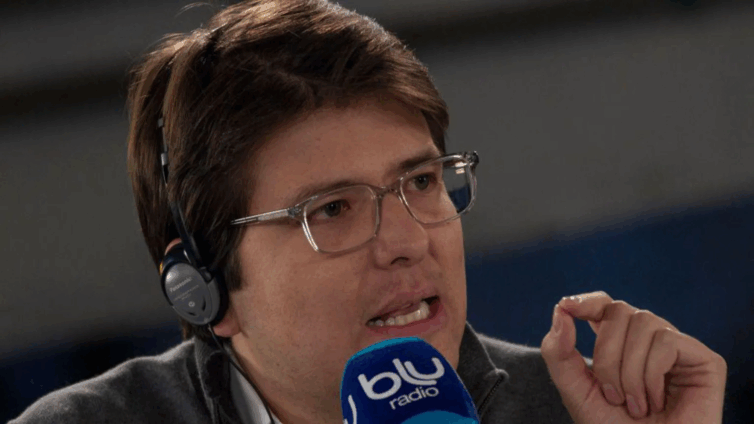
Colombian senator and presidential hopeful Miguel Uribe has died two months after being shot in the head in a targeted attack which shocked the South American nation.
The 39-year-old was hit by three bullets - two of them in the head and one in the leg - at a campaign rally on 7 June in the capital, Bogotá.
His wife confirmed his death on social media, paying tribute to "the love of my life".
A teenager has been arrested on suspicion of carrying out the shooting, but the motive behind the attack is still unclear.
Uribe's wife, María Claudia Tarazona, thanked her late husband for "a life full of love" and for being "the best father" for their children.
According to a statement published on Saturday by the hospital where Uribe was being treated, the senator had suffered a bleed to his central nervous system and was due to undergo surgery.
He had already had several surgeries since he was first taken to the Santa Fe clinic in June.
His wife had asked people to pray for his recovery, and thousands had turned out at vigils and rallies to show their support.
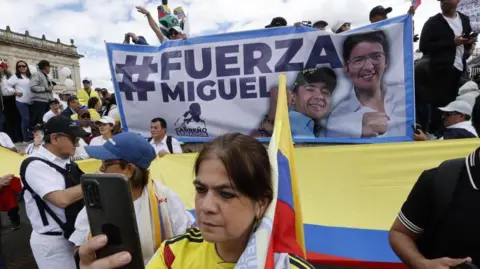
Uribe, who had been a senator since 2022, had been seeking his party's nomination for the 2026 presidential election.
He was popular in the polls and recognised as an up-and-coming figure in the right-wing Democratic Centre party, known for his outspoken criticism of the current left-wing president, Gustavo Petro.
President Petro's office released a statement expressing its condolences to the family of the slain politician.
Uribe was attending a political event in a middle-class neighbourhood of the capital when he was shot.
A teenage suspect was arrested as he was fleeing the scene. The 15-year-old has been charged with attempted murder and pleaded not guilty.
Several others have been detained on suspicion of aiding the gunman.
The brazen attack on the senator has brought back memories of the turbulent decades of the 1980s and 90s in Colombia, when several presidential candidates and influential Colombian figures were assassinated.
Uribe's own mother, journalist Diana Turbay, was kidnapped by Los Extraditables in 1990 - an alliance created by leading drug lords.
She was held hostage by them for five months before being shot dead during a botched rescue attempt.
Uribe often cited her as his inspiration to run for political office "to work for our country".
Los Extraditables, who said they would prefer a grave in Colombia to a prison cell in the US, abducted and attacked renowned Colombians in an attempt to force the government at the time to overturn its extradition treaty with the US.
In recent decades, Colombia's security indicators have substantially improved, and in 2016 a historic peace agreement was reached between the government and the leftist guerrilla group, Farc.
In 2024, Colombia recorded a murder rate of 25.4 per 100,000 inhabitants, the lowest in the past four years, according to security research group Insight Crime.
In 1990, the homicide rate exceeded 70 per 100,000 inhabitants.
However, Colombia's murder rate remains among the highest in the region, alongside those Ecuador, Brazil, and Honduras.
Politicians, members of the security forces, union leaders, environmentalists, and social leaders frequently face death threats, pressure, and attacks.
Various armed groups are engaged in a bloody territorial disputes in the country, often also clashing with the security forces.
Laura Bonilla, deputy director of the Peace and Reconciliation Foundation in Colombia (Pares), said that "the political outlook will now depend on who manages to capitalize on the narrative of security".
Ms Bonilla told BBC News Mundo that the situation in the wake of Senator Uribe's killing was likely to give more prominence to right-wing politicians and their rhetoric.
Vice-President Francia Márquez urged Colombians to unite and reject all violent acts, telling them that "violence cannot continue to mark our democracy".
"Democracy is not built with bullets or blood; it is built with respect, dialogue and recognizing our differences, regardless of political position."
Uribe's death also made waves beyond Colombia with US Secretary of State Marco Rubio among the first to post following the announcement of his death to demand that those responsible be brought to justice.
Latest Stories
-
Accra-Kumasi Expressway: Only nation-wreckers will oppose project – Frank Amoakohene
51 minutes -
Emerging agri-journalists gather in Croatia for global event
2 hours -
PPI Ghana congratulates Dr Abdul-Baasit Aziz-Bamba: Ghana needs a proper reset on value for money
2 hours -
Kasise Ricky Peprah writes: GBA’s face must be called out – for the record
2 hours -
Bernice Offei battled dementia for five years before death, former manager reveals
2 hours -
Jordan Ayew’s return offers Ghana timely boost ahead of AFCON qualifiers
2 hours -
De Zerbi raises doubts over Kudus’ availability for Ghana’s AFCON qualifiers
2 hours -
Ghana’s reputation must not be dented by self-centred individuals – Madina MP on cocaine seizure
3 hours -
MTN Ghana pushes digital growth for SMEs as sixth business clinic ends in Accra.
3 hours -
Black Maidens confident of WAFU B title defense ahead of Burkina Faso clash
3 hours -
5 players who deserve a Black Stars call-up for AFCON 2027 qualifiers
3 hours -
Photos: Vice President Jane Naana reviews changing of guard as Ghana Air Force takes over at Presidency
3 hours -
Africa’s richest man launches continent’s biggest share sale
3 hours -
Why Ghana’s MSMEs must rethink human capital investment: Seven strategic benefits
3 hours -
Asutifi South Assembly forms taskforce to stamp out illegal NHIS fees
3 hours