

Audio By Carbonatix
The Africa Food Systems Report 2025 says significant challenges remain in improving food systems on the continent despite good progress over the last 30 years.
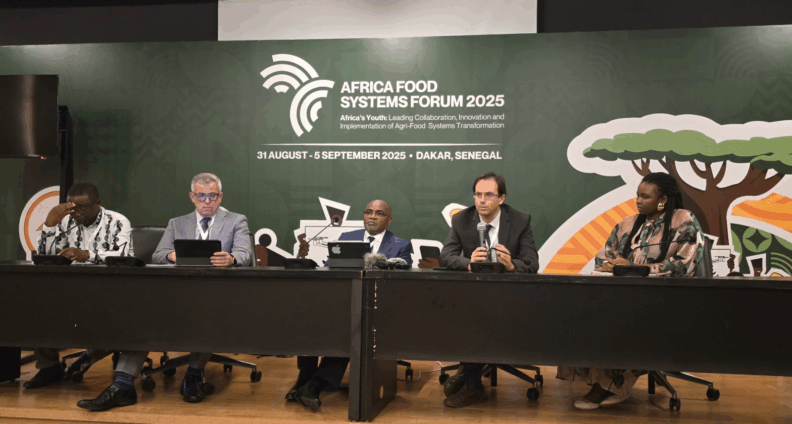
Launched at the 2025 Africa Food Systems Forum on Wednesday in Dakar, Senegal, the report points out that improvements in food systems have been fragmented, and productivity growth has not translated into achieving food security for all.
“Over the past three decades, Africa’s agrifood systems have recorded notable progress. Agricultural productivity has improved, poverty rates have declined, and regional trade integration has advanced,” the report commissioned by AGRA and edited by Dr. John M. Ulimwengu of the International Food Policy Research Institute (IFPRI), noted.
“These gains, however, remain uneven across countries, regions, and timeframes, and have not consistently translated into improvements in nutrition, environmental sustainability, or resilience.
"While there are pockets of success, areas of persistent underperformance remain,” the report added.
The report titled “Drivers of Change and Innovation” noted that Africa’s agrifood systems have achieved measurable gains since the 1990s, including a decline in extreme poverty from 58% to 35%, improved child nutrition, and higher life expectancy.
Yet these improvements are uneven across regions and domains, leaving persistent gaps in resilience, equity, and sustainability.
Also, agricultural output has grown at 4.3% annually since 2000, the fastest globally, but one in three children remains stunted, and the number of undernourished people is rising, exposing the disconnect between production gains and nutritional outcomes.
Forty per cent of food produced in sub-Saharan Africa is lost before reaching markets, largely due to poor storage, transport, and processing facilities.
Ninety per cent of rural roads in Africa are unpaved, constraining market access for farmers and raising post-harvest losses.
Although agriculture accounts for up to 30% of GDP in many African economies, the sector receives only 3–8% of total bank lending. Fewer than 10% of Africa’s 50 million smallholder farmers access formal credit or insurance.
The report observes that the Prevalence of Undernourishment (PoU) fell to 15% between 1990 and 2015 but rose above 19% by 2022, driven by conflict, climate shocks, and COVID-19, pushing Africa off track from achieving Sustainable Development Goal (SDG) 2 targets on no hunger. Official Development Assistance (ODA) is also declining.
Recommendations
The report says future progress will depend on integrated strategies combining governance, infrastructure, finance, and sustainability, reinforced by spatial approaches such as food baskets and corridors, and anchored in strong knowledge systems.
It recommends sustainable agricultural intensification that shifts Africa’s food production from land expansion to productivity gains through climate-smart agriculture, regenerative methods, and integrated soil fertility management practices for long-term food security and resilience.
Digital and data-driven solutions are also recommended to accelerate transformation. Tools such as AI-enabled platforms, mobile advisories, and data-driven digital climate advisories expand access to timely, relevant and localised information, but scaling requires addressing digital access and gender divides.
Multi-actor approaches that combine public, private, and community actors are recommended to deliver context-specific knowledge and advisories and encourage peer-to-peer learning.
Timely access to high-quality, climate-resilient seeds and balanced organic and inorganic fertiliser inputs are needed.
Climate information services, early warning systems, and nature-based solutions are also needed to help buffer smallholders from shocks and enable adaptive responses.
Women, youth, and local communities must be empowered through equitable access to land, finance, and technology, while integrating indigenous knowledge into innovation systems.
“Only through collective commitment to inclusive, sustainable, and de-risked investment strategies can Africa shift from food dependency to food sovereignty, building agrifood systems that foster resilience, shared prosperity, and equity on a healthy planet,” the report said.
At a media briefing to launch the report, Vice President for Technical Expertise at AGRA Jonathan Said, called for a holistic effort to deal with food system challenges.
“It is important that under the National Agricultural Food Systems Implementation plan, there is a pragmatic focus on implementing and addressing problems that undermine the implementation of those areas that need the most attention,” he observed.
“Whether it's irrigation, mechanisation, access to seeds, reducing post-harvest losses, etc, each country is different. But as a continent, we need to have a big picture of where things are going. And also where the relative weaknesses are so that support will be tailored where the greatest needs are,” Mr. Said noted.
Commenting on the report, AGRA President Alice Ruhweza called for robust investments in infrastructure.
“The transformation we seek must be built on strong governance, strategic investment, inclusive markets, robust infrastructure, and the power of data and knowledge,” she said.
“It must also prioritise youth inclusion, labour productivity, and pathways to decent work for the next generation,” she added.
Commissioner of Agriculture, Rural Development, Blue Economy, and Sustainable Environment for the African Union Commission, Moses Vilakati, said the role of the youth in dealing with these challenges cannot be overstated.
“Africa has the talent, the resources, and the energy of its young people to drive this transformation,” he said.
“To achieve food systems transformation, we must build integrated approaches, underpinned by innovative financing models that leverage public, private, and blended capital, and draw on partnerships across governments, private sector, farmers’ organisations, youth, women, researchers, financiers, and development partners,” he added.
Latest Stories
-
Ghana’s BRICS move requires clear strategy to manage risks – Godfred Bokpin
56 minutes -
Pay teachers realistic income – Duncan Amoah to gov’t
1 hour -
Bechem to become chicken capital of Ghana – Mahama projects
1 hour -
Gov’t targets recruitment of 16,500 health professionals in 2026
2 hours -
Two-week strike will not derail academic calendar – GNAT President
2 hours -
Headmaster detained after BBC investigation into alleged sexual abuse of students
2 hours -
GNAT pushes for clear implementation procedures of teachers’ conditions of service
2 hours -
Recurrent strikes threaten quality of education and academic calendars – Prof Bokpin
2 hours -
‘Cockroach’ group leaders among hundreds detained in Delhi protest
2 hours -
Don’t let speed of information become your judgement – CJ tells new lawyers
3 hours -
World Cup visa scandal: People have leveraged public office to facilitate fraud – Senyo Hosi
3 hours -
Glut! Farmers count losses as prices crash, customers happy
4 hours -
GSA postpones auction of unserviceable vehicles
4 hours -
Man charged with attempted murder after stabbing
4 hours -
World Cup visa scandal: Senyo Hosi says issue goes beyond calls for Sports Minister’s resignation
4 hours