

Audio By Carbonatix
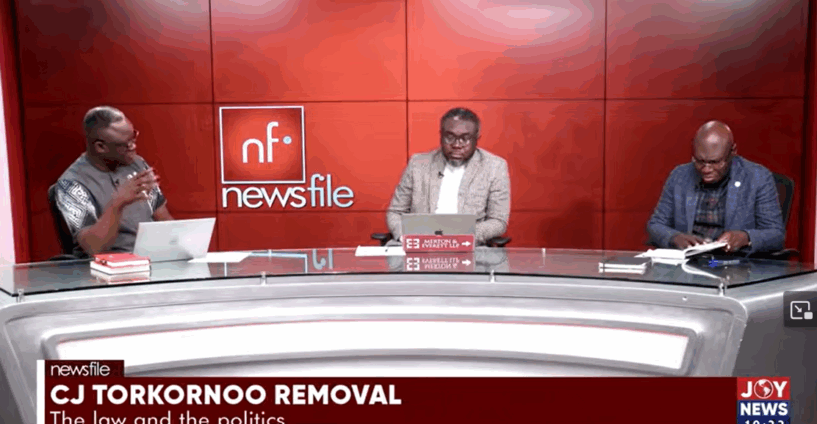
Legal practitioner, Oliver Barker-Vormawor, has expressed concern over President John Mahama’s decision to act on the removal of the Chief Justice before all pending petitions had been heard.
President John Mahama, on Monday, September 1, removed Chief Justice Gertrude Torkornoo from office with immediate effect on grounds of stated misbehavior.
This follows recommendations from a constitutional committee set up under Article 146 of the 1992 Constitution.
Speaking on JoyNews’ Newsfile, he criticized the committee’s decision to split the petitions, saying it created unnecessary legal and evidentiary complications.
“To be fair, I had a problem with the trifurcation. I’ll come to the reason. Because one, there were certain documents and things that have been solicited and obtained in the first petition, which were relevant to the second petition. Now we internally had to debate whether or not, because they're not part of the record, do we have to then resubpoena those matters as well? What does that order for the length of the process and the speedy nature of how we have to deal with this?” he asked.
Barker-Vormawor argued that the overly technical approach of the committee raised critical questions about admissible evidence.
“In my opinion, because we have taken a technical nature to how we are dealing with this more than we should,that it creates those evidentiary questions as to what is part of the evidence and what is not part and not to be excluded.”
He said he had expected the President to wait for the committee’s full consideration of all petitions before taking action.
“I do sincerely believe that, in fact, when I saw that the committee had reported to the President, my feeling at the time was that perhaps i didnt know what the substance was, the President was going to wait and hear the petition that he himself had referred to the committee to listen to before a decision will be taken in respect of it, irrespective of what the decision was. That was my feeling."
"So again, it is surprising to me that a decision has been made in connection with the Chief Justice, because now we are asking ourselves, we cannot move against a suspended Chief Justice. In fact, the nature of the person before the respondent has changed, and our petition was against a sitting Chief Justice. We don't even know whether, technically, in law, this petition, the second and not third, are still viable.”
Citing precedent, he questioned whether proceedings against the Chief Justice could even continue.
“There’s also the Supreme Court decision in Duabo, where the Supreme Court is saying that once the person is retired, you can’t bring proceedings against them. So the person is no longer there. So I don’t even think that this can continue as they are.”
For him, the presidency should have taken a broader, more deliberate approach.
“My feeling was that if, in whatever decision the committee took to report on the first, and in fact they did inform the President that they were going to hear the second, I think the presidency should have waited and gotten the full benefit of everything before the procedures. Whatever the case may be, it hasn’t happened now.”
Drawing a comparison with Ghana’s electoral history, he said lessons could be learned for how such processes are handled in the future.
“In 1992, when we decided to separate the presidential elections and the parliamentary elections, and the NPP then boycotted the second, we later on decided that we are going to hold both on the same day. That might inform subsequent proceedings that this is how we are going to move on them. But in my opinion, I think that perhaps a more tidier thing would have been one, to report on them holistically, or two, that the President, having received the one, would have waited for the others.”
Latest Stories
-
Ghana concludes evacuation of citizens from South Africa, total returnees reaches 1,900 – Ablakwa
10 seconds -
Africa must define its own green transition path – Prof Fatima Denton
22 minutes -
WASSCE 2026: English Language performance falls to 62.4% – WAEC
45 minutes -
WASSCE 2026: Social Studies records sharp rebound as Maths, Science also improve
59 minutes -
2026 WASSCE entry rises by 11% as 512,862 candidates sit exams
1 hour -
WASSCE 2026: English Language performance falls to 62.4% – WAEC
1 hour -
WAEC cancels 2026 WASSCE results of 8,295 candidates over examination irregularities
2 hours -
WAEC releases provisional 2026 WASSCE results for 512,862 candidates
2 hours -
CJ’s remarks on SOEs were made in good faith, not to undermine judicial independence – Judicial Service
5 hours -
Bright Future Alliance pays courtesy call on Akufo-Addo, invites him to African Leaders of Influence Lectureship Series
5 hours -
This is an attempt to break the Minority caucus – Patricia Appiagyei on alleged GH¢70k payment
6 hours -
‘OSP hasn’t contacted me’ – Patricia Appiagyei assures cooperation if invited
6 hours -
I find it strange that this memo was purportedly written by me – Patricia Appiagyei
6 hours -
Ayariga calls for stronger church partnership to tackle sanitation, environmental challenges
6 hours -
I don’t think we have an industry – Patchbay Band manager
7 hours