

Audio By Carbonatix
Madagascar President Andry Rajoelina was toppled Tuesday in a military coup that capped weeks of youth protests over poverty, power outages and a lack of opportunity in the Indian Ocean island country.
Right after parliament voted to impeach Rajoelina, who fled the country fearing for his safety, the leader of Madagascar’s elite CAPSAT military unit said the armed forces would form a council made up of officers from the armed forces and gendarmerie, a military unit that polices civilians, and would appoint a prime minister to “quickly” form a civilian government.
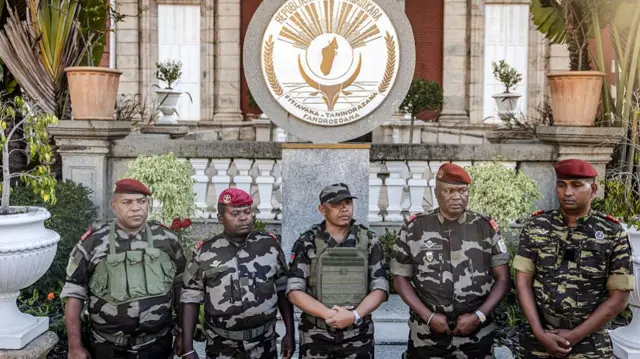
“We are taking power,” Col. Michael Randrianirina told reporters in front of a ceremonial presidential palace in the capital, Antananarivo, as protesters celebrated the news with soldiers. He said the constitution and High Constitutional Court’s powers had been suspended, and that a referendum would be held in two years, though he didn’t go into detail.
From an undisclosed location after fleeing, Rajoelina issued a decree Tuesday trying to dissolve parliament’s lower house in an apparent attempt to preempt being impeached. But lawmakers ignored it and voted overwhelmingly to end the rule of the 51-year-old leader, who himself came to power as a transitional leader in a military-backed coup in 2009.
Rajoelina’s office released a statement condemning Randrianirina’s announcement as an “illegal declaration” and “a serious breach of the rule of law.”
“The Republic of Madagascar cannot be taken hostage by force. The State remains standing,” it said.
Madagascar, a sprawling island country off the east coast of southern Africa, is home to about 30 million people. It is the world’s biggest vanilla producer and, because of its geographic isolation, is known for its biodiversity. Since gaining its independence from French colonial rule in 1960, it has struggled to overcome poverty and political instability, including a series of coups.
Rajoelina’s fall capped weeks of Gen Z-led protests that started over persistent electricity and water outages but snowballed into demonstrations of frustration with the government and Rajoelina’s leadership. Protesters raised a range of issues, including government corruption, access to higher education, the cost of living and poverty, which affects about 75% of Madagascar’s population, according to the World Bank. Although young people led the demonstrations, others also took part, including civic groups and unions.
The turning point came Saturday, when Randrianirina and CAPSAT troops joined the protests and turned against Rajoelina, which led the president to go into hiding. In a Monday night speech broadcast on social media, Rajoelina said he left the country for a “safe place” in fear for his life.
The protesters, who have been on the streets for weeks and packing a main square since Saturday, have said they were inspired by other Gen Z-led movements that toppled leaders in Nepal and Sri Lanka. The young protesters have made clear they don’t have a leader.
Demonstrators insisted that change is needed in Madagascar.
“We do not get a constant supply of electricity and water from the government,” said one protester, Soavololona Faraniaina. “If Madagascan children are studying in darkness, where will the future of this nation be? Where is the wealthy Madagascar that many countries envied?”
CAPSAT is the same military unit that turned against the government in 2009 and helped Rajoelina take power. The unit said over the weekend that it was taking charge of all of Madagascar’s armed forces, and new heads of the military and the gendarmerie security forces have been appointed.
CAPSAT commanders previously denied that they had carried out a coup, and said Madagascar’s people should decide what happens next. But the unit appeared to be in a position of authority in some areas of government decision-making since Saturday, and Rajoelina had called the military’s actions a rebellion against the government and “an attempt to seize power illegally and by force.”
Latest Stories
-
The job interview question you don’t have to answer
1 hour -
Trump unveils ‘Super Intelligence Force’ to oversee AI policy
1 hour -
Actress Chioma Chukwuka announces death of father in emotion-laden post
4 hours -
[Video]‘I have asked God to take me when it is time’ – Pete Edochie on health struggles
4 hours -
Manager remanded over $1m auto fraud
4 hours -
Mr President, Ghana was mentioned at the UN; why aren’t we talking about it?
4 hours -
US Marine arrested over murder of woman in Okinawa, Japan
4 hours -
Accra to convene Africa’s regulators and markets on tokenisation at AVAS 2026
4 hours -
Indian police accused of sexually harassing journalists at protest
5 hours -
Jeffrey Archer returns to his former school library
5 hours -
France to close up to 500 schools on Monday over student protests
5 hours -
The Paradox of Plenty — When every smartphone becomes a newsroom
5 hours -
Australia investigating Flydubai co-pilot’s links to country
5 hours -
GTA sensitises taxi drivers in ‘Know Ghana’ tourism campaign
6 hours -
Archbishop Agyinasare calls for responsible speech amid growing social media abuse
6 hours