

Audio By Carbonatix
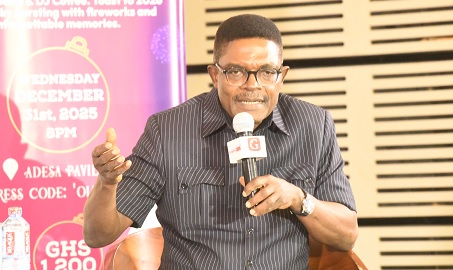
The Executive Director of the Institute for Democratic Governance (IDEG), Emmanuel Akwetey, has called for a stronger national push to help political parties act as real development institutions, with a clear warning that Ghana’s stability and investor confidence depend on long-term policy consistency.
He said Ghana needed a framework that aligned political parties with national development priorities to prevent disruptions that occurred every election cycle.
He made the call at the Graphic Business–Stanbic Bank Breakfast Meeting in Accra yesterday, which examined how looking beyond political cycles could secure a predictable investment climate.
The meeting, which was on the theme ‘Beyond Political Cycles: Creating Long-term Development Pathways for Sustainable Investor Confidence,’ brought together stakeholders from government, civil society, and the private sector.
Predictability
Dr Akwetey noted that political competition often fuelled short-term decision-making and weakened investor confidence.
He said investors required clear and consistent signals before committing long-term capital.
He proposed the creation of a multi-party democracy commission to ensure parties stayed aligned with Ghana’s long-term interests.
“We need to support political parties to become the development agencies we expect,” he said.
Dr Akwetey further argued that relying on election manifestos for policy direction create
Long-term risks
The Director of Research at the National Development Planning Commission (NDPC), Richard Tweneboa-Kodua, explained that consistent implementation of the National Development Plan could protect the economy from political swings.
He said long-term plans reduced risks and created a stable environment for growth and investment.
He, therefore, suggested that national development planning should guide every administration, regardless of which party was in power.
Building trust
The Managing Director (MD) of the Graphic Communications Group Ltd, Ato Afful, urged participants to reflect on how Ghana could build a development path that grew steadily across administrations.
He said trust was earned when promises made to citizens were followed by consistent delivery.
Mr Afful said policymakers must think beyond the 2026 Budget and Ghana’s expected exit from the IMF programme.
According to him, the country must define its own path rather than depending on external pressure to behave responsibly.
“We are capable of defining our own affairs, so we need to rethink how we go forward from here,” he said.
He encouraged experts to guide political leaders to shape a national agenda that would survive election years.
He added that improvements in inflation and exchange rate stability should be used to build momentum into 2026.
Latest Stories
-
Meghan could return to acting once back in UK
29 minutes -
Bali jails Swiss tourist for insulting sacred Day of Silence
36 minutes -
Nii Lante Vanderpuye apologises to Sammy Gyamfi, NDC over GoldBod comments
3 hours -
‘You want the trade, but not the people?’ – Dr Yamson tears into South Africa’s xenophobia
4 hours -
Walmart sales under strain as US shoppers pull back
5 hours -
The Premier League’s new plan to end corner chaos
5 hours -
US Open offers biggest prize fund in Grand Slam history
5 hours -
‘I feel I am imprisoning myself’ – Djokovic on drive & doubts
5 hours -
India’s Gen Z are driving up a mega boom in its beauty market
5 hours -
Ronaldinho seeks 300th goal with comeback aged 46
6 hours -
Your voice, your future – Opare Addo opens National Youth Forum 2026
6 hours -
GRA pushes data-driven tax administration to boost revenue mobilisation
6 hours -
NSMQ 2026: Presby SHS, Bompata crushes Sacred Heart’s hopes of reaching one-eighth stage
6 hours -
Africa Golf Tourism Convention opens in South Africa to unlock opportunities
6 hours -
BOGISS alleged sexual assault: Dr Apaak demands protection for autism victim
6 hours