

Audio By Carbonatix
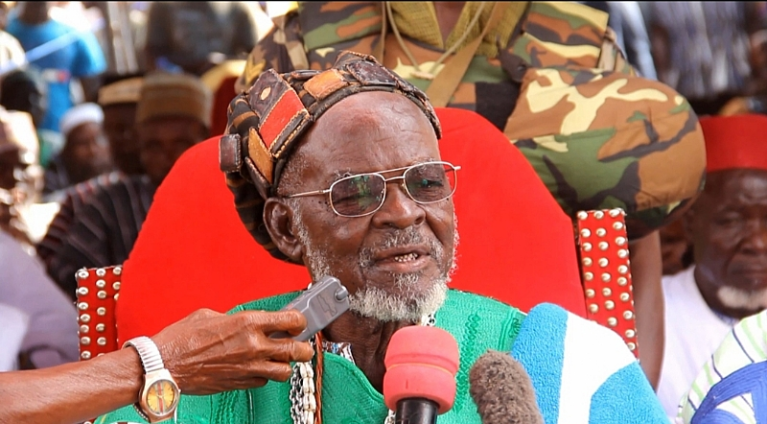
The Chairman of the special peace committee tasked with resolving the protracted Bawku Chieftaincy Conflict, Asantehene Otumfuo Osei Tutu II, has charged the government to decisively enforce the existing laws that recognise Zugraan Naba Asigri Abugrago Azoka II as the legitimate Chief of Bawku and head of the Kusasi Traditional Area.
It marks the final, non-negotiable recommendation to President John Dramani Mahama on the conflict between the Mamprisis and the Kusaasis that has claimed many lives and robbed Bawku of development.
The recommendation was presented today at the Jubilee House in Accra, marking the conclusion of the high-profile mediation effort initiated by the presidency to quell the deadly, decades-long dispute between the two factions.
Laws of the Land are Supreme
The Asantehene, in delivering the committee’s report, anchored his ultimate recommendation not only on traditional diplomacy or compromise but on the Constitution of Ghana and the Supreme Court’s final judicial determination of the matter.
This legal position affirms the status quo that was established by the Restoration of Status of Chiefs Law 75 (1983) and consolidated by the Supreme Court in 2003.
Addressing the President and his delegation, the Asantehene stressed that no traditional leader, regardless of their status, is above the law.
“We chiefs, no matter how exalted, do not live above the constitution of Ghana and the laws duly enacted and affirmed by the courts.”
He explicitly called upon Naa Mahami Abdulai Sheriga, the Nayiri (Overlord of Mamprugu), who has in recent years attempted to install a rival chief in Bawku, to accept the legal reality as presently constituted.
“The final recommendation, Mr. President, I recommend that my brother, the Nayiri, accept the laws as presently constituted as Asigri Abugrago Azoka II, the chief of Bawku and head chief of the Kusasi traditional area.”
The Government's Mandate: Enforcement and Stability
The committee’s report places the final responsibility for peace squarely on the Executive arm of government, demanding instant and firm action against anyone who challenges the legally recognised authority of Naba Azoka II.
This is critical to halting the continuous cycle of violence that has plagued the Upper East Region, costing hundreds of lives since late 2021.
The Asantehene’s recommendation leaves no room for ambiguous mediation or political equivocation:
“Accordingly, the laws which recognised Asigri Abugrago Azoka II must be enforced by the government of the Republic of Ghana until changed in accordance with the 1992 constitution or reviewed by the Supreme Court of Ghana.”
He emphasised that swift law enforcement is the only path to de-escalation.
The conflict, rooted in colonial-era policies that attempted to impose the Mamprugu chieftaincy tradition over the indigenous Kusasi of Bawku, has seen its legal status shift with successive political regimes.
However, the final legal determination in 2003 by the Supreme Court affirmed the legitimacy of Naba Asigri Abugrago Azoka II. The Supreme Court's ruling is binding on all citizens, including traditional leaders.
Latest Stories
-
Decline in external buffers complicates foreign exchange outlook – IC Insights
42 seconds -
Ghanaian filmmakers urged to tell local stories and take them to the world
6 minutes -
Educated but unable to communicate? The missing link in Ghana’s University education
9 minutes -
Informant demanded $20 million from NACOC for information on major drug consignment – Muntaka
15 minutes -
Gov’t introduces mental health and drug tests for security recruits amid suicide concerns – Interior Minister
15 minutes -
DVLA generates GH¢27.14m from dealer plates between January and September 2026
18 minutes -
DVLA registers over 7,700 excavators in Ghana under new tracking initiative
23 minutes -
DVLA introduces six Ghanaian languages for driving theory tests
24 minutes -
DVLA prints 440,000 licences to clear backlog dating to 2023
24 minutes -
Yagaba chief calls for sanitation officers as Mamprugu Moagduri prepares to enforce bylaws
26 minutes -
One Million Coders programme shifts focus to third- and final-year university students
31 minutes -
Former EC Finance Director and KNUST Law Lecturer Dr Joseph Kwaku Asamoah appointed Deputy Chair
49 minutes -
Ashanti cocoa farmers welcome new COCOBOD Act
52 minutes -
Muntaka vows not to compromise in prosecuting drug suspects despite political pressure
2 hours -
Cannabis traffickers using ambulances and bullion vans – Interior Minister
2 hours