

Audio By Carbonatix
The National Peace Council (NPC) says ongoing engagements between the Kusasi and Mamprusi communities in Bawku are yielding encouraging signs of commitment to dialogue and peaceful coexistence.
The Council said the engagements, supported by the United Nations Development Programme (UNDP) and the Government of Japan, have provided stakeholders with an opportunity to openly discuss their concerns, grievances, and aspirations for peace.
According to the NPC, the discussions have so far been frank and constructive, with participants demonstrating a willingness to pursue dialogue as a means of addressing the tensions that have affected the Bawku area.
The Council, however, cautioned that progress in the peace process should not be measured solely by how quickly the parties reach a final agreement.
It commended participants for their patience and commitment to peaceful means, stressing that building lasting peace requires sustained engagement, trust and a willingness by all sides to remain committed to the process.
The Council has also urged the media, commentators and social-media users to exercise greater responsibility when reporting or discussing developments concerning Bawku.
It called on all stakeholders to verify information before publishing or sharing it and cautioned against sensational or inflammatory content that could undermine efforts to restore peace.
Particular concern was raised over the circulation of unverified claims, videos and voice notes capable of heightening tensions between the communities.
The NPC said the challenge had become more serious with the rapid development of artificial intelligence, which has made it increasingly difficult for members of the public to distinguish authentic audio, video and images from AI-generated material.
The Council therefore urged the public and media practitioners to exercise caution when consuming and disseminating information relating to the conflict.
It warned that social media “must not become another arena for the conflict”, highlighting the potential for misinformation and inflammatory content to reverse gains made through the dialogue process.
The NPC further emphasised the importance of community ownership in achieving sustainable peace in Bawku.
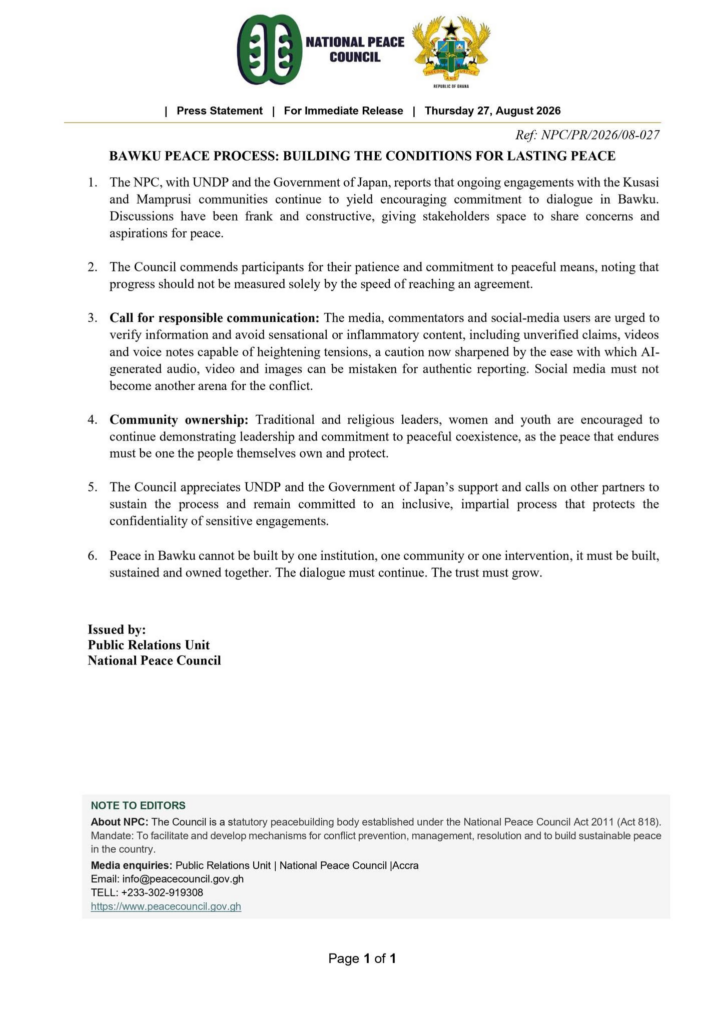
It called on traditional and religious leaders, women and young people to continue demonstrating leadership and commitment to peaceful coexistence.
The Council said these groups had an important role to play in building confidence within their communities and encouraging peaceful approaches to resolving disagreements.
It stressed that lasting peace could not be secured solely through interventions by external institutions.
Instead, the communities themselves must have a stake in the process and take responsibility for protecting any progress achieved.
The Council said the peace that endures must be one that “the people themselves own and protect”.
The NPC expressed appreciation to the UNDP and the Government of Japan for their support for the ongoing peace process.
It also called on other development and peacebuilding partners to continue supporting the initiative.
The Council urged all partners to remain committed to an inclusive and impartial process, while stressing the need to protect the confidentiality of sensitive engagements.
According to the NPC, maintaining confidentiality is important to creating an environment in which participants can speak openly and honestly during negotiations without concerns that sensitive discussions could be taken out of context or used to inflame tensions.
The Council said resolving the Bawku situation would require sustained collective efforts involving the affected communities, traditional authorities, government institutions and other stakeholders.
It rejected the notion that a single institution, community or intervention could independently deliver lasting peace.
“Peace in Bawku cannot be built by one institution, one community or one intervention; it must be built, sustained and owned together,” the NPC said.
The Council maintained that continued dialogue and the gradual rebuilding of trust remained essential to the process.
“The dialogue must continue. The trust must grow,” it added.
Latest Stories
-
Chairman and fellow patriots – Irene Ponu-Brenyah writes to NPP
5 minutes -
Nothing Disappears: What Jamestown Beach reveals about Ghana’s styrofoam ban
7 minutes -
Court delays former NAFCO CEO trial to resolve access to seized gadgets
13 minutes -
Joy FM to offer free LPMs to Super Morning Show advertisers on Oct. 9 to mark Customer Service Week
16 minutes -
Sri Lanka’s ex-first lady arrested over alleged misuse of children’s hospital donations
23 minutes -
La Traditional Council kicks against redevelopment of La Pleasure Beach without consultation
25 minutes -
Some basic schools have just 2 or 3 teachers despite needing 9 – Right To Play
30 minutes -
Mahama to cut sod for SSNIT-funded Accra Convention Centre
31 minutes -
FAO calls for stronger REDD+ systems to unlock climate finance
32 minutes -
Illegal mining pushes Birim River turbidity to 50,000 NTU – Abuakwa South MP
33 minutes -
Bawumia’s opponent in 2028 will face nearly two decades of experience and preparation – Gabby Otchere-Darko
35 minutes -
Community 25 water shortage temporary, GWL assures residents
36 minutes -
‘Standing with teachers means supporting them in classrooms’ – NTC Registrar
39 minutes -
FAO urges innovation, technology to strengthen Ghana’s food security
40 minutes -
Haruna Iddrisu vows to resolve teachers’ strike within days
40 minutes