

Audio By Carbonatix
The world is spending far more money destroying nature than protecting it, according to a new report by the United Nations Environment Programme (UNEP).
The report reveals that for every one US dollar invested in protecting nature, the world spends 30 US dollars harming it. UNEP says this imbalance is slowing efforts to fight climate change, protect biodiversity, and build resilient economies.
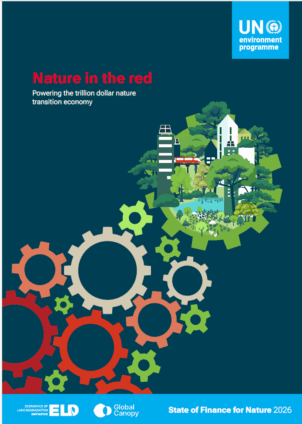
The findings are contained in UNEP’s latest report titled “State of Finance for Nature 2026”, which is based on global financial data from 2023.
According to the report, about US$7.3 trillion was spent globally on activities that damage nature in 2023. Out of this amount, US$4.9 trillion came from private sector investments, mainly in industries such as energy, utilities, industrial production, and basic materials. In addition, governments provided US$2.4 trillion in environmentally harmful subsidies, including support for fossil fuels, agriculture, water use, transport, and construction.
In contrast, spending on nature-based solutions (NbS), actions that use nature to address climate and environmental challenges remains very low. The report shows that only US$220 billion was invested in NbS globally in 2023. Nearly 90 percent of this funding came from public sources, such as governments and international institutions.
Private sector investment in nature-based solutions was especially weak. Businesses and financial institutions invested only US$23.4 billion, representing just 10 percent of total NbS funding. UNEP says this shows that companies and investors have not yet invested seriously in nature-based solutions, even though they depend heavily on nature for their operations.
The report warns that current investment levels are far below what is needed. To meet global environmental goals, investment in nature-based solutions must increase 2.5 times, reaching US$571 billion per year by 2030. UNEP notes that this amount equals just 0.5 percent of global Gross Domestic Product (GDP), making it affordable if priorities change.
UNEP Executive Director Inger Andersen said the figures show the scale of the challenge facing the world.
“If you follow the money, you see the size of the challenge ahead of us. We can either invest in nature’s destruction or power its recovery—there is no middle ground,” she said.
She added that while funding for nature-based solutions is increasing slowly, harmful investments and subsidies are growing much faster.
“This report offers leaders a clear roadmap to reverse this trend and work with nature, rather than against it,” Andersen said.
To support this shift, the report introduces a new framework called the Nature Transition X-Curve. The framework is designed to help governments, businesses, and investors move away from harmful activities and increase investment in nature-friendly solutions.
The Nature Transition X-Curve shows how countries can phase out damaging subsidies and investments while at the same time scaling up nature-based solutions and nature-positive projects across all sectors of the economy. It also provides guidance for both public and private actors along supply chains.
Germany’s Minister for Economic Cooperation and Development, H.E. Reem Alabali-Radovan, stressed the urgency of changing global financial flows.
“The world’s financial flows need an urgent shift from degrading the environment to investments in nature-based solutions,” she said. “The private sector plays a key role in this.”
She added that German development policy supports countries in recognizing the value of their natural resources so that nature can be included in major economic and policy decisions.
The report also highlights real-world examples of how nature-based solutions are already being applied. These include greening cities to reduce extreme heat, integrating nature into road and energy projects, and developing building materials that remove carbon dioxide from the atmosphere.
UNEP stressed that successful nature-positive investments must respect local environments, cultures, and communities, while ensuring fairness and inclusion.
The report also states that shifting finance toward nature is not just an environmental issue, but an economic opportunity that can help build a sustainable and resilient future for people and the planet.
Latest Stories
-
Two lorry station masters arrested over alleged plot to kill creditor over ₵91k debt
24 minutes -
SIGA’s claim on highest audited proportion inaccurate – Bright Simons
25 minutes -
Money bouquets, spraying and dancing on cash unlawful – BoG warns
51 minutes -
Sam George pushes for nationwide 4G upgrade of rural telephony sites
51 minutes -
Local Government Ministry to support MMDAs to deliver gov’t agenda
1 hour -
At least five killed in Sudan’s South Kordofan in attack by rebel group
1 hour -
“Music is so stressful” – Headless YouTuber on why he won’t return
1 hour -
Cleveland police chief proud of force but being ‘let down’ by funding
2 hours -
Black Sherif drops new 6-track EP ‘Sun Sherif’
2 hours -
GTA partners Africa’s Brain Bank for Medical City groundbreaking
2 hours -
How to check 2026 WASSCE results on mobile phone
3 hours -
President Mahama is a professional comedian – DKB
3 hours -
Final day of Joy FM Back-to-School Fair: Come shop, save and prepare for the new school year
4 hours -
GSE showed strong performance in August 2026 despite recording more stock losses
6 hours -
If CJ needs ethics law to know SOE comments were wrong, he may not be worthy of office – Arthur Kennedy
7 hours