

Audio By Carbonatix
The Chief Executive Officer of Telecel Ghana, Ing. Patricia Obo-Nai, has called for a fundamental rethink of Ghana’s education system, warning that widening gaps between academic training and industry needs risk undermining national development.
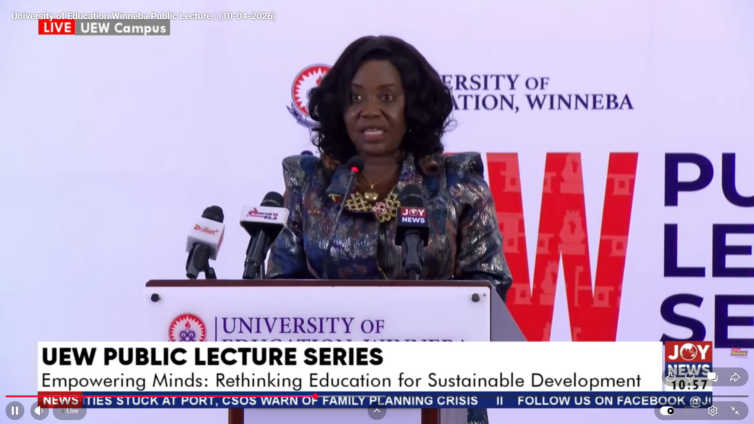
Speaking at the University of Education, Winneba (UEW) Public Lecture Series 2026 on Friday, April 10, she described the forum as “a national conversation” that extends beyond academia and demands urgent reflection on how the country prepares young people for the future.
“I thank the leadership of the University for this important national conversation,” she said.
“I refer to it as a national conversation deliberately because this goes beyond an academic gathering. This is the kind of platform that places demand on our country to think about systems preparing our young people and whether we are moving at the same speed as the future approaching them.”
Ing. Obo-Nai praised UEW for its central role in shaping Ghana’s educational foundation, noting that teacher training institutions have a far-reaching impact on society.
“UEW has long carried a unique responsibility in Ghana’s educational journey because training teachers is shaping generations,” she stated. “You shape how our children first learn confidence. You shape how our curiosity is formed. And you shape how young people begin to imagine possibilities.”
She stressed that education must remain relevant in a rapidly changing world shaped by technology, inequality, and shifting economic demands.
According to her, failure to adapt curricula to contemporary realities risks creating a disconnect between learning and employability.
“The word that stands out in the theme is rethinking,” she noted, referring to the lecture topic Empowering Minds: Rethinking Education for Sustainable Development. “It means asking whether systems designed for one era are still fit for another.”
“The skills that industries demand, including mine, are evolving faster than many curricula in technology is changing. If education remains unchanged whilst everything around it changes, we are creating a gap between learning and relevance.”
She warned that the consequences of such a gap are already visible. “Students feel it first, employers feel it next, and eventually the economy feels it most.”
Ing. Obo-Nai also emphasised the need for stronger collaboration between academia and industry, arguing that no single institution can address the challenges of skills development alone.
“Industry must participate by helping shape graduate readiness for work,” she said.
Highlighting Telecel Ghana’s interventions in education and skills development, she outlined several initiatives aimed at bridging the gap between classroom learning and workplace demands.
She mentioned the company’s Next Generation Graduate Programme, which she said is designed “to transition students from university to professional life through practical work experience and structured mentoring.”
She also highlighted the Telecel Female Engineering Scholarship Programme, which has run for nearly a decade.
“We are intentional about investing in the future of women in engineering by supporting them financially in their final year and providing them with valuable work exposure through internships,” she said.
According to her, gender inclusion in technical fields is critical to innovation. “When women remain in engineering, sectors become stronger, solutions broader, and industries more representative of the society they serve.”
Ing. Obo-Nai further referenced the Telecel Digitech Academy, implemented in partnership with the Ghana Education Service and the National STEM Centre, which has trained about 2,000 students across 13 regions in robotics, coding and web design.
She described the initiative as part of Ghana’s necessary “digital shift,” adding that students have developed innovative solutions including automated irrigation systems, bushfire-fighting robots, assistive tools for persons with visual impairments, flood detection systems and wind energy prototypes.
“Today, digital literacy has become a basic requirement for relevance,” she said. “Irrespective of sector, digital confidence is increasingly shaping how far our youth can go.”
Addressing students directly, she urged them to take their studies seriously in a rapidly evolving world. “The quality of life of a country is reflective of its quality of education,” she said. “Whilst we build roads, expand industries, and invest in technology, human capability must grow at the same pace.”
She encouraged a shift in mindset about education beyond formal qualifications.
“Let us not treat education as something you complete. Let’s treat it as something you continue—keep learning, questioning, and building beyond qualification.”
Latest Stories
-
National Defence University to strengthen Ghana’s response to emerging security threats – Haruna Iddrisu
1 minute -
Pupil arrested after two teachers shot at French school
8 minutes -
Lamisi takes ‘Let Us Clap’ tour across five countries and 18 dates
26 minutes -
DVLA cuts roadworthy contract cost from $155.4m to GH¢2m – CEO
27 minutes -
Okyeame Kwame calls for free university education for farmers’ children
31 minutes -
Black Stars: Two decades of coaching triumphs and turmoil (2006–2026)
35 minutes -
DVLA plans simulator-based driving tests to assess prospective drivers in Ghana
43 minutes -
FDA disposes of 40-foot container of non-compliant diapers imported from Spain
45 minutes -
PAC disappointed by Agric Ministry’s failure to present key witnesses in GH¢69bn special audit inquiry
54 minutes -
DVLA to digitise road accident reporting, requiring location coordinates before reports are filed
54 minutes -
GJA accepts Mahama’s request to organise national forum on hate speech
1 hour -
Democratizing the judiciary: Why Judges in Ghana should engage “We the People” through social media platforms.
1 hour -
Bond market: Turnover increases by 47% to GH¢4.07bn
1 hour -
DVLA prepares electronic queue system to reduce congestion
2 hours -
Hearts of Oak coach Kapor raises alarm over poor pitches in Ghana football
2 hours