

Audio By Carbonatix
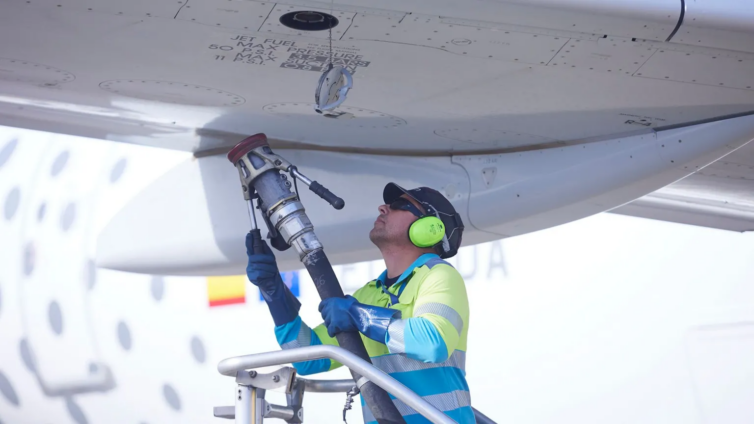
Europe will suffer jet fuel shortages in just three weeks if the Strait of Hormuz does not reopen, the trade body for the continent's airports has warned.
The Persian Gulf is a major source of aviation fuel, accounting for about 50% of Europe's imports.
Airports Council International (ACI) Europe said its members had "increasing concerns" about the availability of jet fuel, particularly as the summer tourism season approached.
It warned that smaller airports are particularly vulnerable.
"A supply crunch would severely disrupt airport operations and air connectivity – with the risk of harsh economic impacts for the communities affected, and for Europe," ACI Europe's director-general, Olivier Jankovec, wrote in a letter to the European commissioners for energy and tourism.
"At this stage, we understand that if the passage through the Strait of Hormuz does not resume in any significant and stable way within the next three weeks, systemic jet fuel shortage is set to become a reality for the EU."
Several airlines worldwide have already cut flights and hiked passenger charges due to concerns about fuel shortages.
Last week, the benchmark European jet fuel price hit an all-time high of $1,838 (£1,387) per tonne, compared with $831 before the war began.
Jankovec urged the EU to intervene, writing that "relying on market forces and adaptation alone is not an option".
He criticised the lack of EU-wide assessment and monitoring of jet fuel production and availability.
ACI Europe wants the EU to engage in collective jet fuel purchasing. The body has also called for the temporary lifting of restrictions and regulations on importing jet fuel.
The letter, which was written on 9 April and first reported by the Financial Times, said: "This crisis should also be the opportunity to reinforce support for SAF [sustainable aviation fuel] production and affordability,
"The price of conventional jet fuel is likely to remain at higher levels in the medium to long-term."
Jankovec added that airports with fewer than a million passengers per year were already struggling with viability "without even accounting for the impact of jet fuel shortages".
He warned the current crisis could make airports even more fragile and threaten local communities, potentially impacting European cohesion.
Air travel contributes €851bn (£741bn) to European economies' GDP every year and supports 14 million jobs.
Latest Stories
-
Chief Justice urges employers to tackle mental health stigma in workplaces
20 minutes -
Analysis: Ghana’s yellow fever numbers reveal a gap between vaccination and protection
51 minutes -
Education Ministry welcomes suspension of teachers’ strike
1 hour -
Vice Chancellors Ghana appeal to striking university administrators to resume work
1 hour -
KNUST postpones 2026/2027 academic year reopening indefinitely amid GAUA strike
1 hour -
Fire destroys mattress factory at Sokoban in Kumasi
2 hours -
ECOM-SMS Ghana launches ‘Agriculture Our Future Clubs’ to address threat of ageing farmer population
2 hours -
Nicholas Atsu Kumi
2 hours -
Cherif Sarr: Economic participation needs more pathways, not one prescribed route
2 hours -
Cyber Security Authority: Ghana led Operation Blackout, not FBI
2 hours -
GH¢800,000 goods destroyed as fire engulfs Kia Rhino truck on Apedwa-Kibi Road
2 hours -
Chief Justice calls for supportive workplaces to address mental health stigma
2 hours -
NVI CEO defends GH¢13m spending on training, workshops and conferences
2 hours -
Ghana targets first locally manufactured vaccine by 2027
2 hours -
Teachers suspend strike after reaching agreement with government
3 hours