

Audio By Carbonatix
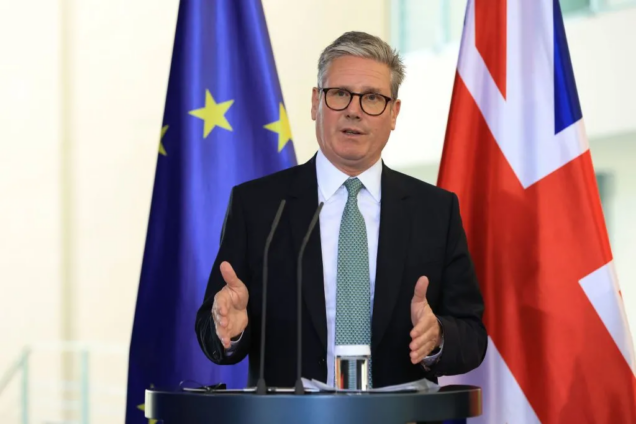
Sir Keir Starmer is planning legislation to allow the UK to adopt new EU laws without Parliament having to hold a full vote each time.
The measure is meant to make it easier for the UK to "dynamically" align with future rules required to deliver new deals in areas like food standards.
The government says MPs and peers will retain "a role" in scrutinising new rules adopted under the plan.
But the plans provoked strong opposition from the Conservatives and Reform UK.
The new legislation, expected later this year, would give ministers a fast-track route for introducing draft laws to align with future European standards designed to ensure a single market in the trade of goods and services.
The new powers would apply to agreements they are planning with the EU on food standards, carbon pricing for industry and electricity trading.
New rules would be introduced as "secondary" legislation, which receives less scrutiny and gives MPs a more limited role in approving it.
This echoes the process that was followed before Brexit - when the government adopted hundreds of such laws each year to fulfil EU legal obligations.
But it is likely to prove more controversial this time, because the UK no longer has voting rights at the EU to shape European legislation in the first place.
Labour has also abolished the dedicated Commons committee that used to assess new EU legislation - raising questions over how future European rules will be scrutinsed by MPs.
'Great uncertainty'
Conservative shadow business secretary Andrew Griffith said it would mean Parliament is "reduced to a spectator while Brussels sets the terms".
Reform UK leader Nigel Farage has vowed to oppose the legislation "every step of the way", calling the plans "a backdoor attempt to drag Britain back under European Union control".
However, the government said the process would "allow us to deliver" its planned EU deal on food standards, which it has estimated will be worth billions of pounds a year to the UK economy by cutting red tape for exporters.
Increasingly, ministers have also been leaning into the argument that the backdrop of the Iran war has strengthened the logic behind closer alignment with the EU.
Speaking to BBC Radio 5 Live, Sir Keir said: "We're in a world where there's massive conflict, great uncertainty. And I strongly believe the UK's best interests are in a stronger, closer relationship with Europe.
He added that the government was "trying to make trade easier" which "translates into lower prices" for consumers.
Summer summit
The government has previously said that its food deal will require Great Britain to dynamically align with EU rules in areas such as food flavourings, animal health and the labelling requirements for organic pet food.
As part of its proposed deal to link the UK with the EU's carbon trading regime, the government is also expecting to align with EU rules relating to the trading of carbon allowances, although the specifics are yet to be revealed.
Ministers are hoping to unveil deals in both these areas at a summit expected to take place during the summer.
The government has also signalled it is interested in striking further deals with the EU beyond those it has already committed to.
Chancellor Rachel Reeves recently said she would consider a closer relationship where it helps deliver on a set of broadly-defined "national interest principles".
These include boosting economic growth, supporting investment or helping to increase the UK's "security and resilience".
Latest Stories
-
Ray Michael Djan Jr puts Ghanaian creativity on global stage with Chelsea anthem
6 minutes -
Matilda Dibloni Kokar elected USAG president after two-year dormancy
9 minutes -
NPP delegates wanted youthful energy with Kojo Bamba’s election – Political scientist
12 minutes -
Zenith Bank supports Childhood Cancer Unit at Greater Accra Regional Hospital
13 minutes -
KMA empowers 64 persons with disabilities; Mayor unveils plan for sustainable skills centre
15 minutes -
DJs Union urges musicians to prioritise respect, communication amid industry tensions
22 minutes -
“Ghanaian DJs deserve their flowers” – Lasmid
23 minutes -
Zenith Bank supports childhood cancer unit at Greater Accra Regional Hospital
24 minutes -
‘Who’s in charge doesn’t really matter; we’re all servants’ – John Boadu on leader of NPP
28 minutes -
Christa Pike’s prognosis still unclear after failed execution, lawyer says
43 minutes -
SLTF to advance fees for first-year students facing admission payment deadlines
46 minutes -
Ghana Institute of Architects calls for action to make adequate housing a human right
46 minutes -
BoG, Police arrest seven over alleged misuse of Ghana Cedi as bouquets
47 minutes -
NCPTAs appeal to striking teachers to return to classroom
47 minutes -
Government plans engineered landfills and waste transfer stations nationwide – Ayariga
49 minutes