

Audio By Carbonatix
A member of Parliament’s Constitutional and Legal Affairs Committee, Nana Agyei Baffour Awuah, has argued that the High Court overstepped its mandate in its recent ruling on the powers of the Office of the Special Prosecutor (OSP).
An Accra High Court, on April 15, ruled that the OSP does not have independent authority to prosecute criminal cases, directing that all matters initiated by the anti-corruption body be referred to the Attorney-General’s Department.
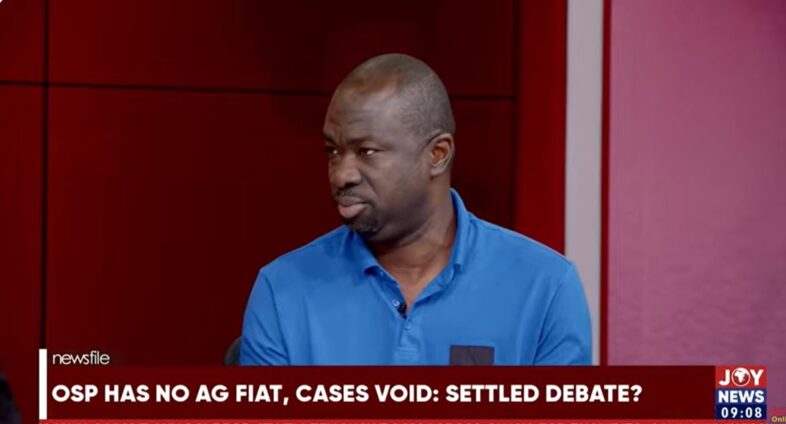
Speaking on JoyNews’ Newsfile on Saturday, the lawmaker, who also serves as Vice Chair of the Subsidiary Legislation Committee, maintained that aspects of the case bordered on constitutional interpretation—an area he insists falls exclusively within the jurisdiction of the Supreme Court.
According to him, the nature of the originating motion filed before the court clearly raised questions requiring proper interpretation of Article 88 of the 1992 Constitution, particularly in relation to the prosecutorial authority of the Attorney-General’s Department versus that of the OSP.
“The moment a relief is framed as seeking a declaration on the interpretation of the Constitution, it goes beyond the remit of the High Court,” he stated.
Mr Awuah explained that while the High Court has the authority to apply the law and exercise supervisory jurisdiction, including issuing orders such as quo warranto, it cannot assume jurisdiction over matters that fundamentally require constitutional interpretation.
He emphasised that jurisdiction is determined by the reliefs sought in a case, noting that where an applicant explicitly asks the court to interpret constitutional provisions, the proper forum is the Supreme Court.
“In such circumstances, the appropriate step would have been to refer the matter to the Supreme Court rather than proceed to determine it,” he argued.
He further pointed out that although the presiding judge may have viewed the issue as one of application rather than interpretation, that distinction is critical in determining the limits of the court’s authority.
The comments add to the growing legal debate surrounding the High Court’s ruling, which has triggered wider discussions about the scope of prosecutorial powers and institutional boundaries between the OSP and the Attorney-General.
Latest Stories
-
Jerry Afriyie completes permanent move to Genk
6 minutes -
Official: Sevilla unveil Ghanaian winger Emmanuel Abrokwa on long-term deal
50 minutes -
Eric Tinkler motivated by challenge of improving Kotoko
1 hour -
Today’s front pages: Wednesday, August 19, 2026
1 hour -
‘You can’t improve players on pitches like this’ – Kotoko coach Tinkler
2 hours -
Petroleum Commission says regulatory reviews have saved Ghana US$2.2bn
2 hours -
Prosecution of former NPP appointees not political persecution – Mustapha Gbande
2 hours -
Revised Ghana Card fees approved by Parliament, not unilaterally introduced – NIA
2 hours -
NIA says Labone Prestige Centre is optional, district offices remain operational
2 hours -
Three-month-old baby girl found abandoned in Ada bush
2 hours -
Boakye Agyarko vows to rebuild NPP into a winning force ahead of 2028
2 hours -
One seriously injured as four vehicles crash on Ofankor–Pokuase stretch days after fatal accident
2 hours -
GES denies GH¢1,500 Free SHS payment directive, urges parents to ignore viral claim
4 hours -
The losses were necessary – Manteaw defends GoldBod’s costly push to win Ghana’s gold market
4 hours -
We are concerned about inflation outlook when it comes to MPC decisions – BoG Governor
4 hours