

Audio By Carbonatix
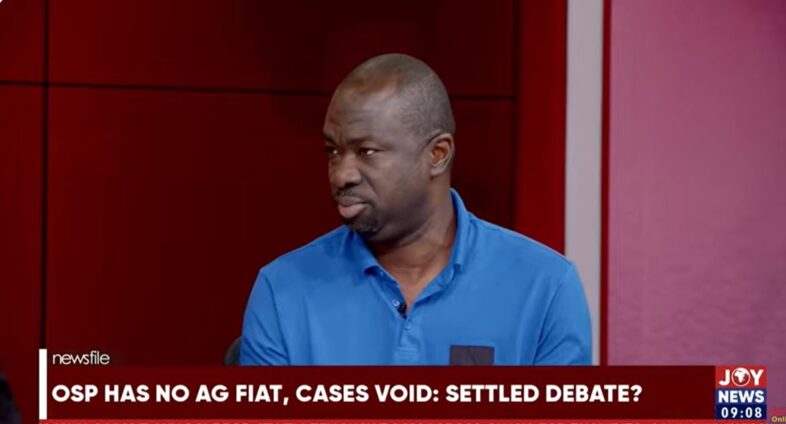
A member of Parliament’s Constitutional and Legal Affairs Committee, Nana Agyei Baffour Awuah, has argued that the High Court overstepped its mandate in its recent ruling on the powers of the Office of the Special Prosecutor (OSP).
An Accra High Court, on April 15, ruled that the OSP does not have independent authority to prosecute criminal cases, directing that all matters initiated by the anti-corruption body be referred to the Attorney-General’s Department.
Speaking on JoyNews’ Newsfile on Saturday, the lawmaker, who also serves as Vice Chair of the Subsidiary Legislation Committee, maintained that aspects of the case bordered on constitutional interpretation—an area he insists falls exclusively within the jurisdiction of the Supreme Court.
According to him, the nature of the originating motion filed before the court clearly raised questions requiring proper interpretation of Article 88 of the 1992 Constitution, particularly in relation to the prosecutorial authority of the Attorney-General’s Department versus that of the OSP.
“The moment a relief is framed as seeking a declaration on the interpretation of the Constitution, it goes beyond the remit of the High Court,” he stated.
Mr Awuah explained that while the High Court has the authority to apply the law and exercise supervisory jurisdiction, including issuing orders such as quo warranto, it cannot assume jurisdiction over matters that fundamentally require constitutional interpretation.
He emphasised that jurisdiction is determined by the reliefs sought in a case, noting that where an applicant explicitly asks the court to interpret constitutional provisions, the proper forum is the Supreme Court.
“In such circumstances, the appropriate step would have been to refer the matter to the Supreme Court rather than proceed to determine it,” he argued.
He further pointed out that although the presiding judge may have viewed the issue as one of application rather than interpretation, that distinction is critical in determining the limits of the court’s authority.
The comments add to the growing legal debate surrounding the High Court’s ruling, which has triggered wider discussions about the scope of prosecutorial powers and institutional boundaries between the OSP and the Attorney-General.
Latest Stories
-
GES working around the clock to get teachers back to class, says Daniel Fenyi
3 hours -
French PM warns against escalation of school protests after 164 arrested
3 hours -
UK tries to stop Trump’s diesel export ban
3 hours -
Late Olise goal gives France win over Belgium
3 hours -
Mancini enjoys first win since return as Italy boss
3 hours -
Interest payments to average a high 20% of government revenue over next 4 years
4 hours -
Anthropic warns AI may pose ‘existential risks to humanity’ in IPO filing
4 hours -
Joe Hart trusts Man City chair Al Mubarak over ruling
4 hours -
Strategy of accumulating foreign reserves, gold carries high fiscal cost – S&P Global
4 hours -
Weak institutional arrangements, high debt servicing constrain Ghana’s rating – S&P
4 hours -
Man City CEO defiant over Premier League charges
4 hours -
Infantino makes bigger cash pledge to Fifa members
4 hours -
Bond market: Turnover declined by 28% to GH¢1.56bn
4 hours -
Volta Region National Public Speaking contest advances drug prevention conversation
4 hours -
New health training facility at Ampoma-Jema to address admission shortfalls, but Minister flags missing amenities
5 hours