

Audio By Carbonatix
The Senior Vice President of IMANI Africa and lawyer, Kofi Bentil, has strongly rebuffed the recent controversy surrounding the Office of the Special Prosecutor (OSP) and its prosecutorial powers, stating that the issue was resolved long before the Special Prosecutor Act was passed.
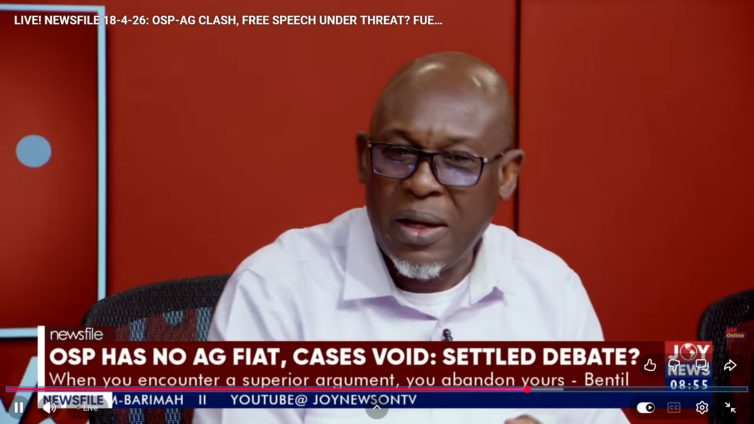
Speaking on JoyNews’ Newsfile programme on Saturday, April 18, Bentil outlined his position, stressing that the debate over the OSP’s authority was rooted in principle and had been settled through a robust legislative process.
Mr Bentil reflected on the importance of parliamentary debate, noting that while differing opinions are natural in any democratic process, the objective is to arrive at a superior argument—an approach he believes was reflected when Parliament passed the law establishing the OSP.
“When you encounter a superior argument, you abandon yours. It doesn’t make you a fool; it makes you better,” he explained.
“That’s what Parliament is for: a place to debate, to listen, and to ultimately make decisions based on the better argument. And on the issue of the OSP, we settled it. The arguments were made, they were considered, and we came to a resolution.”
He also addressed criticism over his reference to Dr Dominic Ayine, a lawyer and former parliamentary representative who has opposed the OSP’s powers, as “his brother”.
Mr Bentil emphasised that despite their disagreements, the issue was not personal but a matter of legal and constitutional principle.
“I’ve known Dr Ayine for 30 years, and while we may disagree, it’s not a fight, it’s a matter of principle,” Bentil said. “Dr Ayine presented his argument well, but in the final analysis, it was clear that he encountered a superior argument and, as any reasonable person would, conceded.”
The central concern surrounding the OSP has been the relationship between its powers and those of the Attorney-General, an office appointed by and accountable to the President.
Mr Bentil argued that the Attorney-General’s monopoly over prosecutorial authority was a major obstacle in the fight against corruption. According to him, the creation of the OSP was a necessary reform to bypass this bottleneck and ensure that corruption cases could be pursued independently.
“The Attorney-General, who can be hired and fired by the President, holds a monopoly on prosecutorial power. This has long been identified as one of the key challenges in fighting corruption in Ghana,” he explained.
“The OSP was created to break this monopoly and give a credible, independent body the authority to prosecute corruption cases, particularly those involving public officers.”
He added that the establishment of the OSP was driven by the need for a more independent and effective mechanism to combat corruption, with the initial memorandum to Parliament highlighting the need to address institutional bottlenecks, including the Attorney-General’s monopoly.
“The memorandum that accompanied the bill made it clear that the OSP was designed to address institutional bottlenecks, including the issue of the Attorney-General’s monopoly,” he said.
“By establishing the OSP, we are creating an independent body with the authority to investigate and prosecute corruption without the influence of the executive branch.”
Mr Bentil maintained that there is no ambiguity regarding the OSP’s legal powers, pointing to Section 4 of the Special Prosecutor Act, which he said clearly defines the authority of the office.
“There is no controversy here,” he said. “The law was debated, and it was settled. Section 4 of the law clearly gives the Special Prosecutor the authority needed to perform their duties. Those who are resurrecting this issue now are simply trying to achieve a particular goal by stirring confusion.”
He further noted that the OSP was created to address challenges in prosecuting corruption cases that were previously affected by institutional and political interference, leading to delays or stalled prosecutions involving high-ranking officials.
“The reason we established the OSP was because we were faced with a situation where cases were piled up, and there was interference at every turn,” he explained.
“You couldn’t prosecute someone you were sitting in Cabinet with. The OSP was meant to tackle this problem, and the law was written to ensure that it had the independence and authority to do so.”
Mr Bentil warned that the renewed controversy appeared to form part of a broader attempt to weaken the office, rather than a genuine legal debate.
“Some people want to kill the office, and they’ll use any excuse to do so,” he said. “This is not a debate about the law; it’s an attempt to return to the status quo, where corruption was allowed to thrive under the influence of political interference.”
He added that the effectiveness of the OSP also depends on the integrity of its leadership, noting that public confidence will be shaped by how the office is exercised.
“The occupant of the office matters, and the conduct of the person in that position will play a crucial role in shaping public opinion,” he said. “But let’s not confuse the issue: the law was settled. The arguments were made, and the Special Prosecutor’s authority was clearly established.”
Mr Bentil called on Ghanaians to focus on ensuring that the OSP remains strong and independent in the fight against corruption.
Latest Stories
-
White vs traditional marriage: Aesthetics above culture?
8 minutes -
Tumu Municipal Hospital receives new delivery bed to boost maternity care
15 minutes -
Telecel Ghana unveils Project X with Black Sherif partnership
25 minutes -
Rev. Kwadwo Bempah defies restriction on preaching on buses; warns it won’t succeed
39 minutes -
French Embassy to partner Kobby Kyei Media for bloggers’ training
42 minutes -
Nestlé and NBA announce multi-year international marketing partnership
56 minutes -
Mahama sends condolences to Nigeria over plane crash that killed 25
56 minutes -
Our lifestyles may be killing us but our spatial planning is too
1 hour -
12 arrested as police seize firearms, suspected drugs in Tamale
1 hour -
Chamber of Mines challenges Reuters report on proposed mining law
1 hour -
LA 2028: Black Queens take first leg advantage with 3-0 win over Mauritius
1 hour -
UG academic calendar could collapse if GAUA strike extends into next week – Awandare
1 hour -
Black Sherif partners with Telecel Ghana to promote Telecel Cash
1 hour -
Nestlé Ghana expands Tema factory, raises evaporated milk production capacity
1 hour -
Telecel Ghana launches CARE Month with customer rewards and community outreach
1 hour