

Audio By Carbonatix
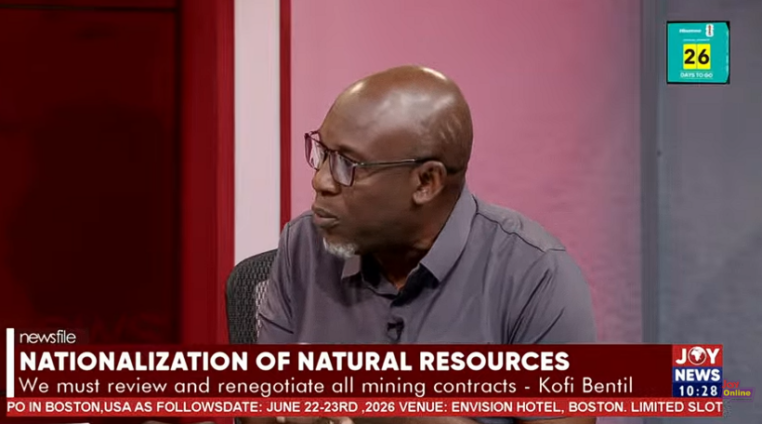
Senior Vice President of IMANI Africa, Kofi Bentil, is calling for a comprehensive review and renegotiation of all mining contracts in Ghana, arguing that the country is now in a stronger position to secure better terms than when many of the agreements were originally signed.
Speaking on JoyNews’ Newsfile on Saturday, May 16, Mr Bentil said many of the existing contracts were negotiated when the country had weaker bargaining power.
“At the time we were signing them, we were on a weaker foot. Today, we are not on the same weak position,” he stated.
He insisted that Ghana must take advantage of its improved position to reset terms in a way that better reflects national interest.
“We should review all the contracts and renegotiate them now,” he stressed.
Mr Bentil also reflected on Ghana’s repeated attempts over the past decades to establish local gold refining capacity, noting that several initiatives have collapsed due to structural and human resource challenges.
“We have tried gold refining in this country in the last 30 years many times… it collapsed and we’ve gone back and forth,” he said.
He cautioned against over-reliance on wishful thinking in fixing long-standing industrial challenges, stressing the need for practical collaboration across the value chain.
“Wishing and hoping is not enough. We need collaboration and structured engagement to figure out how we are going ahead,” he noted.
According to him, Ghana must move away from isolated efforts and instead build strong partnerships involving capable local players and investors.
“We should look at these people with different eyes because they are capable of doing things. They have the appetite to tackle big business,” he said.
Mr Bentil further argued that no single local actor currently has the full capacity to manage the entire mining value chain alone, calling for group-based collaboration instead.
“If you look at the value chain, we don’t have everything. We should mobilise groups, not individuals,” he added.
While acknowledging concerns about resource nationalism, he warned that emotionally driven approaches to mining policy have historically undermined progress.
“This emotional resource nationalism has led us into trouble in the past. We start by giving it to Ghanaians and then we sell off,” he noted.
He urged policymakers to adopt a more gradual and strategic approach, focusing on contract renegotiation, value addition, and structured partnerships rather than rushed reforms.
“We should go slowly but surely. What we need is to rewrite the contracts better and build value chain collaboration,” he said.
Latest Stories
-
Power restoration fault suspected in Kumasi Central Market fire
4 hours -
The 7-foot giant of Ngleshie Amanfro: Seven-foot Ghanaian Ephraim Saawa dreams of joining the national basketball team
5 hours -
Government promises support for Kumasi Central Market fire victims
5 hours -
Vibes The Movie: Big Ghun’s Ghanaian film earns five nominations at 2026 REFFA
5 hours -
MamaCare CEO warns unresolved conflicts among health workers could undermine maternal and neonatal care
6 hours -
Health professionals urged to translate medical knowledge into practice to save mothers
6 hours -
Conflicts among care providers linked to maternal, neonatal deaths – Expert
7 hours -
GIS marks 10th TIME conference, champions improved teaching practices
7 hours -
BRICS Or Balance? What Ghana’s bid really means
8 hours -
GPRTU wants full TRAFFITECH-GH implementation to start in 2027
8 hours -
How 10-mile walks for basic education birthed a 50-year legal career for Justice Korbieh
8 hours -
Mahama announces plans to import electric wheelchairs for PWDs
8 hours -
KGL U17 Colts 2026: Western beat Prempeh Elite Academy to set up final final with Greater Accra Region
8 hours -
Late Solanke strike salvages 10-man Spurs draw at Man United
9 hours -
Gender Ministry to monitor welfare of Nana Akua Addo’s children amid domestic violence case
9 hours