

Audio By Carbonatix
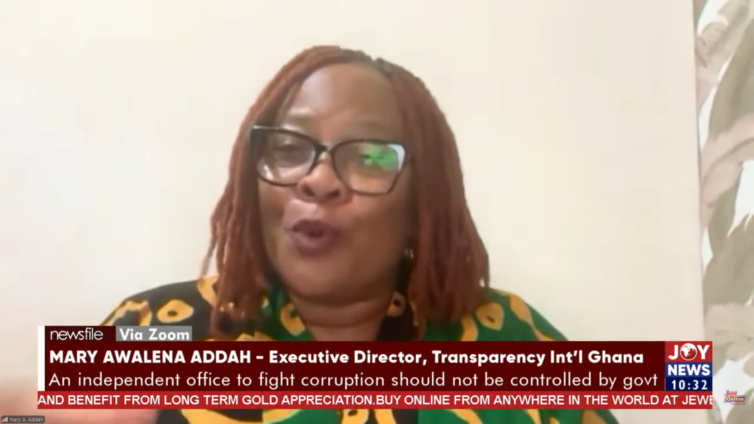
Executive Director of Transparency International Ghana, Mary Awalena Addah, has emphasised the need for independence in anti-corruption institutions, warning that government control undermines their effectiveness.
Speaking on JoyNews’ Newsfile programme on Saturday, Addah highlighted the challenges in establishing a fully independent anti-corruption office in Ghana, pointing to constitutional constraints and political opposition as persistent obstacles.
“Civil society had, through advocacy and extensive research, concluded that the fight against corruption could be strengthened by separating investigatory and prosecutorial functions. Unfortunately, we could not achieve this due to constitutional issues,” she said.
Addah traced the origins of the Office of the Special Prosecutor (OSP) to early proposals under the NACA framework, which had envisaged a truly independent prosecutor. She noted that while the OSP was later established under a different model, civil society engaged the process to ensure the office remained a credible anti-corruption instrument, even if imperfect.
Citing recent data, she pointed to measurable achievements of the OSP. In its first fully operational year, the office expanded its caseload from 27 to 167 cases, recovered GH₵35 million, and prevented potential losses exceeding GH₵7.18 billion.
Public confidence in the OSP also remains strong, with 77.7% of citizens surveyed insisting that an independent anti-corruption office should not be controlled by the government. Additionally, 55.2% of respondents identified the OSP as the most trusted institution to investigate and prosecute corruption.
“While the OSP may not be perfect, it has made significant gains in holding public officials accountable and pursuing asset recovery,” Addah said. “Its independence is crucial; if it remains under executive control, its mandate is compromised, and it cannot fulfil its role effectively.”
Addah also criticised political efforts to undermine the OSP, noting that both previous and current administrations have, at various points, sought to limit its influence through court challenges or legislative changes.
She stressed that such distractions divert the office from its primary mandate of investigating corruption, monitoring procurement, and preventing future abuses.
Latest Stories
-
Ghana lose Morocco friendly as Atlas Lions turn to Mali
2 hours -
2026/2027 GPL: Kelvin Nkrumah strike sends Medeama top of league table
2 hours -
Emmanuel City crowned champions of maiden Global Game Scouting Tournament
2 hours -
Thomas Partey loses father Jacob Teye Partey
2 hours -
Martin Kpebu explains when EOCO can arrest Manhyia South MP after securing court warrant
2 hours -
EOCO’s reasons for seeking Manhyia South MP arrest warrant not justified – Kpebu
3 hours -
MTN Ghana warns SMEs against sharing PINs amid digital fraud risks
3 hours -
Yendi nursing students warn restricted access to skills lab could affect their training
3 hours -
Minority awaits formal notice of arrest warrant for Manhyia South MP – Annoh-Dompreh
3 hours -
LTIF announces 2026 Pan-African edition in Accra from October 6-7
3 hours -
Mfantsipim needs broader funding partnerships to bridge infrastructure gap – Prof Baiden
3 hours -
MP status must not shield anyone from law enforcement – Kwakye Ofosu
3 hours -
EOCO had tactical team ready to arrest Baffour Awuah – Felix Kwakye Ofosu
3 hours -
Afoko can unite NPP’s factions, says Charles Owusu Juanah
3 hours -
Guardiola backing Man City after guilty verdicts
3 hours