

Audio By Carbonatix
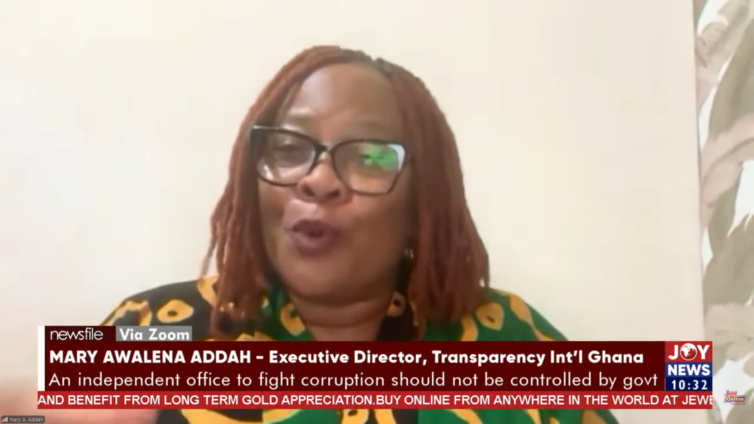
Executive Director of Transparency International Ghana, Mary Awalena Addah, has acknowledged progress in the fight against corruption through the Office of the Special Prosecutor (OSP), while highlighting structural and constitutional limitations that have prevented the office from achieving its full potential.
Speaking on JoyNews’ Newsfile programme on Saturday, April 18, Addah reflected on civil society’s role in shaping Ghana’s anti-corruption framework. She explained that Transparency International and other advocacy groups had long called for a stronger anti-corruption architecture, including a fully independent prosecutorial office, as outlined in early NACA proposals initiated during the current President’s tenure.
“Civil society concluded that the fight against corruption could be strengthened if we separated investigatory and prosecutorial functions,” Addah stated.
“Unfortunately, due to constitutional constraints, we were unable to achieve that ideal. Nonetheless, the establishment of the OSP was the best compromise at the time, and we supported it with evidence-based recommendations.”
Addah noted that despite its imperfections, the OSP has recorded measurable results. Between 2024 and 2025, the office expanded its caseload from 27 to 167 cases, including corruption and corruption-related offences. It has also recovered approximately GH₵35 million and averted potential losses exceeding GH₵7.18 billion.
She further cited public confidence in the OSP, referring to a recent survey in which 77.7% of citizens supported anti-corruption bodies operating independently of government control. Additionally, 55.2% of respondents identified the OSP as the most credible institution to investigate and prosecute corruption cases, ahead of constitutionally mandated bodies such as the Commission on Human Rights and Administrative Justice (CHRAJ).
Addah also reflected on political challenges faced by the OSP, noting attempts to undermine the office under both previous and current administrations.
“The office has been subject to attempts to undermine it, both in previous and current administrations. These distractions risk impeding the OSP from fulfilling its mandate of investigating corruption, overseeing procurement-related offences, and recovering misappropriated assets,” she noted.
Despite these challenges, she reaffirmed the continued relevance of the OSP, pointing to ongoing initiatives, including proposals for a national ethics and anti-corruption office, as evidence of gradual reform within Ghana’s anti-corruption framework.
“While the OSP may not be a flawless institution, the evidence shows tangible progress. Civil society remains committed to supporting reforms that enhance its effectiveness and independence,” she concluded.
Latest Stories
-
Banks NPL ratio of 16.1% is still too high – S&P
48 minutes -
Guidelines, regulations of cryptocurrency in Ghana fall short of comprehensive oversight – IMF
1 hour -
I didn’t want to be in the spotlight – Tems
2 hours -
COCOBOD’S GH¢16.3bn SPV: Real progress toward a sustainable cocoa sector
2 hours -
Impossible for England to find another Kane – Tuchel
4 hours -
Ghana lose Morocco friendly as Atlas Lions turn to Mali
4 hours -
Burnham ‘really concerned’ if Man City owners sell up after rule breaches
4 hours -
2026/2027 GPL: Kelvin Nkrumah strike sends Medeama top of league table
4 hours -
Punish Manchester City this season, say other club chiefs
4 hours -
Emmanuel City crowned champions of maiden Global Game Scouting Tournament
4 hours -
MPship should not shield anyone from arrest – Felix Ofosu-Kwakye
4 hours -
Thomas Partey loses father Jacob Teye Partey
4 hours -
Gov’t rejects Baffour Awuah ‘kidnap’ claims, says EOCO officer was lawfully executing arrest
4 hours -
Martin Kpebu explains when EOCO can arrest Manhyia South MP after securing court warrant
4 hours -
EOCO’s reasons for seeking Manhyia South MP arrest warrant not justified – Kpebu
5 hours