

Audio By Carbonatix
The White House has said it will work more closely with US artificial intelligence (AI) firms to combat "industrial-scale campaigns" by foreign actors to steal advances in the technology.
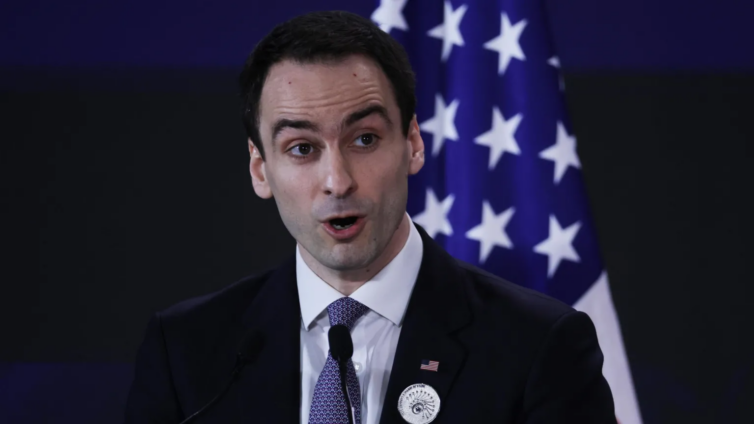
Michael Kratsios, Director of Science and Technology Policy, wrote in an internal memo that the administration had new information indicating "foreign entities, principally based in China" were exploiting American firms.
Through a process called "distilling", such firms are essentially copying AI technology developed by US companies, he said.
A representative of China's US embassy in Washington DC said its development was "the result of its own dedication and effort as well as international cooperation".
In the memo, Kratsios said the aim was to "systematically undermine American research and development and access proprietary information".
In an attempt to avoid and halt "malicious exploitation," he said the White House will be doing four things:
- sharing more information with US AI companies about "tactics employed and actors involved" in distillation campaigns
- working to "better coordinate" with companies to fight the attacks
- develop a set of "best practices to identify, mitigate, and remediate" them
- "explore" how the White House can hold foreign actors accountable for such distillation
The memo did not detail any specific plans for action against foreign entities found to be distilling US AI technology.
A White House spokesperson declined to comment beyond the memo.
A representative of China's US embassy in Washington DC took issue with "the unjustified suppression of Chinese companies by the US" in response to the memo
"China is not only the world's factory but is also becoming the world's innovation lab," the representative added.
"China's development is the result of its own dedication and effort as well as international cooperation that delivers mutual benefits."
Distillation campaigns are carried out by firms that usually operate many thousands of individual accounts for a given AI chatbot or tool, allowing them to appear as normal users.
Those accounts then undertake more coordinated attempts to "jailbreak" or otherwise expose information about AI models that is not supposed to be made public, which is saved and applied to their own AI model building and training.
"As methods to detect and mitigate industrial-scale distillation grow more sophisticated, foreign entities who build their AI capabilities on such fragile foundations should have little confidence in the integrity and reliability of the models they produce," Kratsios said.
While Kratsios did not name any foreign entities, leading AI companies like OpenAI and Anthropic have said they are dealing with such distillation activity.
Earlier this year, Anthropic described distillation "attacks" by three AI laboratories, DeepSeek, Moonshot, and MiniMax, saying it had found them all to be working to copy Anthropic models through distillation campaigns. All three of the labs are based in China.
OpenAI has also accused DeepSeek of copying its technology.
DeepSeek, Moonshot, and MiniMax did not immediately respond to BBC requests for comment.
DeepSeek was initially released last year and quickly became one of the most popular AI models and chatbots among users.
The firm said at the time that the model cost only a few million dollars to create, a fraction of the hundreds of billions of dollars being spent by other AI firms to build their models and tools.
Last month, the DeepSeek chatbot suffered a major outage. It is expected to soon release a new version of its AI model.
US President Donald Trump is expected to visit China in May.
Latest Stories
-
Girls must have equal place in Ghana’s digital future – Vice President
6 minutes -
High Court issues EOCO warrant to arrest Manhyia South MP Baffour Awuah
11 minutes -
Ghana at the heart of global PR excellence
19 minutes -
Ghana Institute of Architects clarifies position on ARC-ASG dispute amid ongoing case
20 minutes -
NDC supporters storm Fomena constituency office over alleged disqualification of chairman aspirant
23 minutes -
NPA CEO assures tanker drivers of action on welfare concerns
24 minutes -
Karpowership seeks contract extension as Ghana’s power demand grows
27 minutes -
Gender Ministry inaugurates committee to drive early childhood development
29 minutes -
Four Schools, One Crown: Prempeh, Corpus Christi, Mfantsipim and St Augustine’s battle for NIQ trophy
29 minutes -
HIV status cannot be used to deny employment under Ghana law – Ghana AIDS Commission
30 minutes -
Buffer Stock calls for expansion of national storage capacity as it falls below 50,000 metric tonnes
31 minutes -
Central Regional Minister urges use of religious platforms to change environmental, sanitation practices
54 minutes -
Henry Kweku Banning
54 minutes -
Execution of US murderer Christa Pike halted an hour before it was due to happen
56 minutes -
GoldBod generates US$1.87bn in FX in September, exceeds monthly target
60 minutes