

Audio By Carbonatix
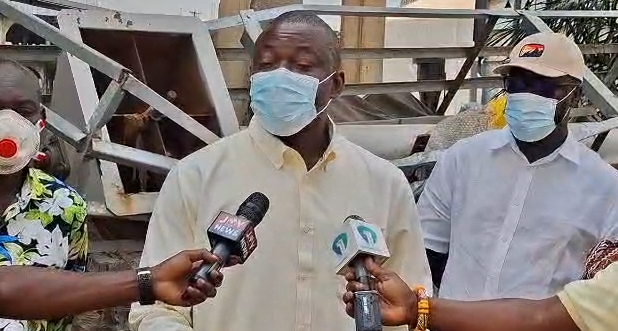
The Deputy Chief Executive Officer of the National Food Buffer Stock Company (NAFCO), Osmond Amuah, has called for urgent investment in Ghana’s food storage infrastructure, warning that the country’s current storage capacity is below 50,000 metric tonnes.
According to him, the limited storage capacity poses a challenge to Ghana’s ability to build adequate emergency food reserves in the event of disruptions to global food supply.
Mr Amuah said Ghana consumes more than six million metric tonnes of maize and rice annually, creating the need for significant storage capacity to ensure food security during emergencies.
He explained that Ghana should be able to maintain enough food reserves to feed the population for at least 90 days, which he described as an ideal global standard.
He said this is particularly important because disruptions such as pandemics, wars, prolonged droughts or interruptions along major international trade routes could affect the country's ability to import food.
“If, God forbid, we have another COVID or the Strait of Hormuz gets closed, the Suez Canal also gets closed, and then there's war within our neighbouring country or a long, prolonged spell of drought, how do we feel?” Mr. Amuah asked.
Mr Amuah said Ghana must maintain sufficient food stocks because importing food from other parts of the world can take several weeks.
“Typically, it will take eight to twelve weeks to bring produce from any part of the world,” he said.
He explained that the country therefore needs adequate reserves to sustain the population while waiting for imported food supplies to arrive.
According to him, Ghana's monthly requirement for maize and rice alone is more than 500,000 metric tonnes when annual consumption is divided across the year.
However, the country's current storage capacity remains far below that requirement.
“Now, as I speak, our storage capacity in terms of available warehouse is not up to fifty thousand metric tons,” he stated.
Mr Amuah said the significant gap between national food requirements and available storage capacity makes it urgent for government to invest in warehouses, silos and other storage infrastructure.
He noted that even if Ghana had enough resources to purchase food for an emergency reserve, the country would still face the challenge of where to store it.
“So that means that there's a huge gap,” he said.
“We really need rapid development, rapid support in infrastructure so that at least as a nation, when any eventuality befalls us, at least we can be dignified by feeding our own citizenry.”
He called for support in the provision of additional warehouses, silos and appropriate equipment to strengthen Ghana's capacity to store food.
Mr Amuah said NAFCO has already taken steps to improve its storage capacity using internally generated funds.
He explained that the company undertook extensive renovation of its storage facilities, increasing its functioning capacity from less than 10,000 or 12,000 metric tonnes to about 50,000 metric tonnes.
“We have demonstrated that even internally, using our internal IGFs, we've done massive renovation exercises,” he said.
He believes additional government support could enable NAFCO to significantly expand the country's food storage capacity.
“You can imagine if we have the muscles behind us, what we can do. The possibilities would be endless,” he added.
Mr Amuah said strengthening national storage infrastructure would help Ghana build a more resilient food system and ensure that the country can continue feeding its population during major emergencies and disruptions to global food supplies.
Latest Stories
-
I don’t have an official car, I use my own – Pelpuo
32 seconds -
Maiden Black Star Fashion Week to highlight Ghana’s national fashion platform
51 seconds -
GPRTU has entrusted vehicle inspection responsibility to station masters – GPRTU member
1 minute -
President Mahama to open housing finance conference in Accra on October 7
9 minutes -
Cocaine probe: Speaker is right in dismissing Minority’s motion of parliamentary inquiry – Dr Pelpuo
9 minutes -
Academic City presents cybersecurity white paper to Communications Minister
10 minutes -
Pelpuo calls for independent commission to oversee Ghana’s public sector remuneration
10 minutes -
Bekwai MP to engage Assembly over traders displaced by market redevelopment
11 minutes -
Accra-Abidjan flight relaunch will boost trade, investment and regional integration – Ambassador Alhassan Abu
13 minutes -
Mahama tasked me to identify initiatives that fit Reset Agenda – Pelpuo
14 minutes -
Makola and Abossey Okai named in crime index as fake goods trade grows
16 minutes -
John Boadu, Justin Kodua, Nana B lead NPP’s race in latest survey
21 minutes -
Abdul-Rashid Pelpuo praises Mahama’s UNGA 81 address as bold and decisive
22 minutes -
Girls must have equal place in Ghana’s digital future – Vice President
34 minutes -
High Court issues EOCO warrant to arrest Manhyia South MP Baffour Awuah
38 minutes