

Audio By Carbonatix
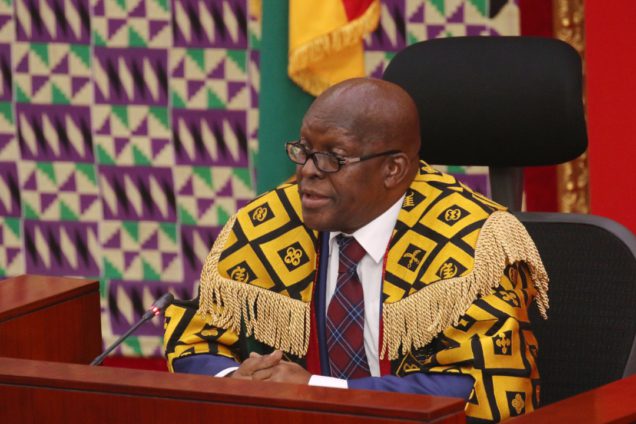
Speaker of Parliament, Alban Bagbin, has tasked 5 committees of Parliament to investigate the concerns of school feeding caterers.
The Speaker also charged the committees to ascertain the challenges faced by the National Food Buffer Stock Company which is struggling to perform its role.
The committees are; Education, Finance, Gender, Children and Social Protection, Health and Food and Agriculture. They have been tasked by the Speaker to examine the feasibility, sustainability and state of affairs of the School Feeding Programme and report to the House before the end of October, 2022.
Speaking in Parliament on Tuesday, July 12, he stated that this will ensure that "food, an essential requirement of life, is made available to the vulnerable school-going children in the country."
School Feeding caterers embarked on a strike to demand an increase in their feeding grant from 0.97 pesewas to 3 cedis.
The Buffer Stock Company has also been struggling to provide food to some senior high schools across the country.
The Speaker paid a surprise visit to the two entities last month and says the organizations are facing peculiar challenges which must prompt Parliament to act.
Addressing the House, the Speaker bemoaned the poor state of the National School Feeding Programme and entreated the 5 committees to expedite investigations into the concerns raised.
"A matter of concern and public interest has been brought to my attention in the aftermath of the caterers of the School Feeding Programme's recent protest and strike action. The caterers who ceased operations in May this year are requesting that the amount be increased from 0.97 pesewas to GH₵3 per child per meal.
"The caterers have also threatened to terminate their contract due to the non-payment of arrears by the government. The situation affects vulnerable school children and future leaders of this country," Mr. Bagbin said.
The Speaker also revealed that the Management of both the School Feeding Secretariat and the Food Buffer Stock Company explained the causes of the struggles and called on members not to turn a blind eye.
The issues he highlighted included "recent price increase in food prices, stocking of food commodities for government use, and the inability of the company to stock at the peak of harvest."
He added that both institutions are not happy that "the efficacy and viability of such laudable programmes are being affected by lack of funding."
In spite of the challenges, the Speaker believes the School Feeding Programme has a great potential to accelerate the nation's progress towards the attainment of the United Nations Sustainable Development Goals that seek to address hunger, poverty and malnutrition.
Latest Stories
-
Ghana housing finance conference adopts communiqué to improve affordable housing access
3 hours -
Special Initiatives Minister urges Wa Technical Institute to enrol more girls as EU-backed solar training lab opens
3 hours -
In the matter of my first year at the Bar
3 hours -
ActionAid Ghana calls for an end to child marriage, greater investment in girls’ rights
3 hours -
Newsfile to tackle World Cup visa scandal, beach demolitions, education strikes, BRICS bid
4 hours -
UK-Ghana Trade & Investment Summit: Trade Resource Centre to help businesses maximise UK-Ghana trade opportunities
4 hours -
Embassy of Denmark celebrates World Maritime Day
4 hours -
Linking LEAP to productive inclusion could cut extreme poverty by 2030 – UNICEF
5 hours -
Trade Ministry backs use of creative arts to rehabilitate prison inmates
5 hours -
Negotiations with government to continue despite strike suspension – GNAT
5 hours -
‘Ghana cannot afford to waste public resources; every cedi has a job’ – Ato Forson
5 hours -
Ghana expects economic boost as World Assemblies of God Congress brings 10,000 delegates to Accra
5 hours -
Joy in Nayilifong as Farouk Aliu Mahama donates 100kVA transformer to improve power supply
6 hours -
Chief Justice urges employers to tackle mental health stigma in workplaces
7 hours -
Analysis: Ghana’s yellow fever numbers reveal a gap between vaccination and protection
7 hours