

Audio By Carbonatix
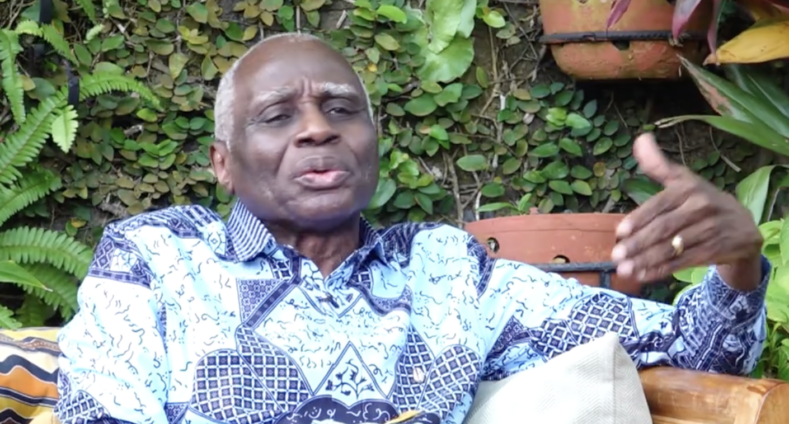
Legal luminary Tsatsu Tsikata has declared that residents of the Santrokofi, Akpafu, Likpe and Lolobi (SALL) traditional areas are “owed reparation” following their disenfranchisement in the 2020 general elections.
He warned that the episode poses a serious threat to Ghana’s democratic order.
Speaking on PM Express on Joy News, Mr Tsikata stood firmly by his position when pressed by host Evans Mensah on whether he meant the call for reparations literally.
“Yes, because they are part of this country, if they had a representative in parliament, that representative would have had access to the Common Fund and so on, which they could have used for projects in that area.
"During those four years, they had no representation. And so in my mind, whatever the state can do to ensure that what they were not able to access in that period should be accorded to them. I think that’s fair.”
More than 17,000 voters in the SALL enclave were unable to vote in the parliamentary election after their area was moved to the Oti Region without being assigned a constituency.
While they participated in the presidential vote, they had no Member of Parliament, leaving the Hohoe seat occupied by John Peter Amewu uncontested by them.
For Mr Tsikata, who served as counsel for the petitioners in the case, the implications go far beyond the immediate political outcome.
“I really believe that what happened in respect of SALL is not only unprecedented, but it is a danger to the Republic, because if you can have these situations where pockets of the country find that they are somehow just excluded, you can imagine how the build-up of that sort of experience, it’s more than one few places.”
He cautioned that such exclusions risk eroding public confidence in the legal and democratic system, invoking a classic legal analogy to underscore the stakes.
“That’s why I also use the analogy of my law professor Hart, that you want to distinguish a legal system from a gang of robbers. Because a legal system is a system which is understood by the whole society, as you know, working for the benefit of the society as a whole.”
Mr Tsikata stressed that the rule of law must be seen to work for all citizens, not remain abstract rhetoric.
“But this shouldn’t just be pronouncements, because if they are just pronouncements, then you can also have a gang of robbers which constitutes itself into seemingly an order, and they try to instruct people what to do and so on.”
He placed responsibility on the judiciary and legal practitioners to reinforce public trust through action.
“But there is a difference, and we lawyers and those in the judiciary must eagerly ensure that that differentiation is clear in the minds of the population, that we are there to administer justice. That must be the clear testimony on the part of judges.”
Reflecting on the SALL experience, he admitted it falls short of that ideal.
“Some of the experiences that I’ve recounted do not suggest that, but I think we can encourage more and more of that commitment to justice, that commitment to the rule of law and so on.”
Latest Stories
-
GPRTU wants full TRAFFITECH-GH implementation to start in 2027
2 minutes -
Mahama announces plans to import electric wheelchairs for PWDs
5 minutes -
KGL U17 Colts 2026: Western beat Prempeh Elite Academy to set up final final with Greater Accra Region
24 minutes -
Late Solanke strike salvages 10-man Spurs draw at Man United
34 minutes -
Gender Ministry to monitor welfare of Nana Akua Addo’s children amid domestic violence case
41 minutes -
Benedict Okyere Yeboah: Ghana’s football problem goes beyond sacking a coach
50 minutes -
GPL 2026/27: Darkwah Wiafe’s winner sees All Blacks beat Kotoko
56 minutes -
ITF World Tour : Patel Wins Boys’ Singles Final at J100 Accra
1 hour -
Ghana must pursue BRICS partnership if it brings economic benefits – Kpebu
1 hour -
Success and Wright Claims J100 Accra Girls’ Doubles Championship
1 hour -
ITF J100: America’s Wright wins J100 Accra Girls’ Singles Title
1 hour -
Expedition hopes to find aviator Amelia Earhart’s plane on remote island
1 hour -
US seeks changes to rejected $109m health compact with Ghana – Mahama
2 hours -
Nine dead in mass shooting at Pennsylvania home
2 hours -
‘Time for Ukraine to get new president,’ says Trump after Zelensky condemns diesel deal
2 hours