

Audio By Carbonatix
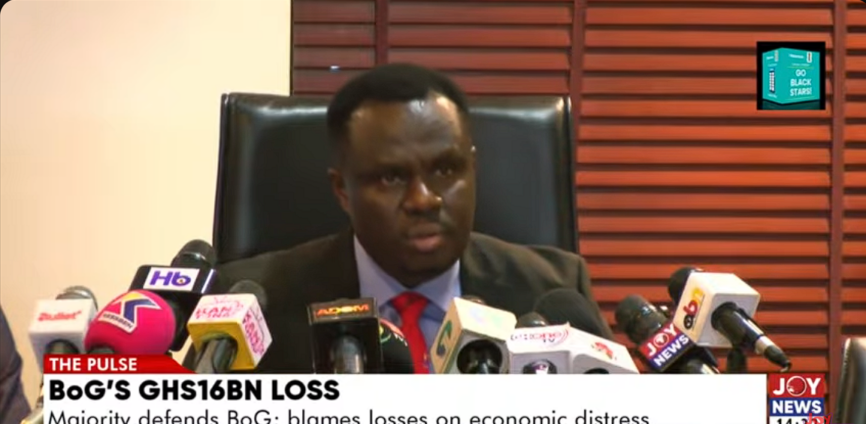
The Chairman of Parliament’s Economic Committee and Member of Parliament for Amenfi West, Eric Afful, has urged the public to avoid assessing the Bank of Ghana’s financial losses using the framework of a commercial bank.
Addressing a press conference in Accra on Tuesday, May 5, he said that although the Bank reported a net loss of GH¢15.6 billion in the 2025 fiscal year, alongside an other comprehensive income charge of GH¢19.32 billion and a negative equity position of GH¢96.3 billion, these figures must be viewed within the broader mandate of central banking.
"While these figures are significant, they must not be interpreted through a narrow lens of commercial banking. Central banking is fundamentally a public policy function, and its financial outcomes often reflect the cost of stabilising the economy, he said.
Mr. Afful emphasised that a proper understanding of the 2025 results requires a review of the recent economic history between 2022 and 2024, when the Bank recorded cumulative losses of approximately GH¢80.85 billion.
He detailed that the Bank incurred a loss of GH¢60.81 billion in 2022, GH¢10.55 billion in 2023, and GH¢9.49 billion in 2024, a period he described as one of the most severe macroeconomic crises in Ghana’s history.
During that time, he noted inflation surged to a peak of 54.13% in 2022, then eased to 23.84% by the end of 2024. The Ghana cedi also depreciated significantly, reaching about GH¢17 to the US dollar by December 2024, representing a depreciation of approximately 19.7%.
Gross international reserves stood at about $9.3 billion in 2024, covering roughly four months of import needs, while the Bank’s equity position weakened to negative GH¢64.34 billion in 2023 before improving slightly to negative GH¢61 billion in 2024.
Given this context, Mr. Afful argued that the 2025 financial outcome should be seen as “the continuation of a deliberate and necessary policy intervention” aimed at restoring macroeconomic stability.
“In 2025, the Bank’s balance sheet reflected a negative equity position of about GH¢96 billion. However, macroeconomic indicators show a strong and decisive turnaround,” he stated.
He pointed to a sharp decline in inflation to 5.2% by the end of 2025, further easing to 3.2% by March 2026. The Ghana cedi also appreciated significantly by about 40.7% against the US dollar and other major currencies.
Additionally, gross international reserves rose to approximately $13 billion, providing about 5.7 months of import cover.
Mr. Afful further highlighted the Ghana Accelerated National Reserve Accumulation Programme (2026–2028), under which reserves are projected to reach up to 15 months of import cover.
He pointed out that the Bank’s financial performance should not be viewed in isolation, but rather as part of a broader strategy to stabilise the economy and strengthen Ghana’s macroeconomic fundamentals.
Latest Stories
-
Ghanaians now get more data for less money- Sam George
38 seconds -
MTN commits US$1.1bn to Ghana network expansion after 5G reforms – Communications Minister
3 minutes -
Ahafo Clergy call for stronger action against galamsey and Tano river pollution
4 minutes -
GMSA calls for protection of Muslim students’ religious rights in mission schools
6 minutes -
MTN cuts 100 Mbps fibre package from GH¢987 to GH¢299 – Sam George
7 minutes -
Sam George touts lower data costs, enhanced DStv value under Mahama
9 minutes -
Women’s Football: Sharon Sampson, Evelyn Badu and top performers from the weekend
9 minutes -
NACOC warns of rising cannabis addiction among children in Volta through toffees, soft drinks
11 minutes -
3,372 BECE candidates without results to get second chance to resit exam
11 minutes -
Elsie Appau-Klu calls for Cosmetology Council, formalisation of beauty and wellness sector
16 minutes -
Government to deploy sovereign virtual platform for secure high-level meetings – Nana Oye Bampoe Addo
16 minutes -
Fire destroys belongings in Tabora Alhaji apartment
17 minutes -
Social media language creeping into students’ examination scripts – WAEC
18 minutes -
Students still struggle to translate word problems into maths – WAEC
19 minutes -
Ghana’s cancer care needs modern radiotherapy equipment, stronger research capacity – Kwamigah-Atokple
19 minutes