

Audio By Carbonatix
Africa is producing more health workers than ever before, yet millions still lack access to care, hundreds of thousands remain unemployed, and many are leaving the continent, a new report by the World Health Organisation (WHO) has revealed.
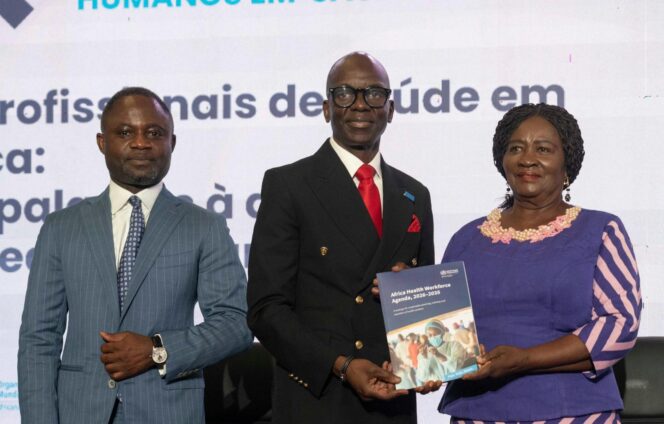
Launched on May 6, 2026, during the Second Africa Health Workforce Investment Forum in Accra, the report, State of the Health Workforce in Africa 2026: Plan. Train. Retain exposes a worsening crisis driven not just by training gaps, but by failures in employment, distribution and retention.
Africa’s health workforce has grown significantly, rising to 5.72 million in 2024 from 4.3 million in 2018. Despite this progress, the continent still has only 46% of the health workers it needs, leaving millions without essential services.
The report highlights a troubling, widespread shortage alongside high unemployment. In 2024 alone, about 943,000 trained health workers were jobless, even as health systems struggle with understaffing.
Ghana’s Vice President, Prof Jane Naana Opoku-Agyemang, underscored the urgency of the situation, stating that “Africa’s future depends on the strength of its human capital,” adding that investing in health workers is “not just a health priority, it is an economic and development imperative.”
Echoing this, Ghana’s Health Minister, Kwabena Mintah Akandoh, said “training alone is not enough,” stressing the need to “create jobs, strengthen skills, and retain talent.”
Although the WHO has slightly revised Africa’s projected health workforce shortage from 6.1 million to 5.85 million by 2030, the report warns that the improvement is fragile and could easily reverse without stronger investment and reforms.
According to the WHO Regional Director for Africa, Dr Mohamed Yakub Janabi, the crisis has evolved beyond mere shortages. He noted that “the crisis is no longer defined by scarcity alone,” warning that “too many remain unemployed while millions go without care.”
Training capacity has expanded, with over 325,000 graduates each year. However, weak alignment between education systems and job markets means many graduates remain unemployed or stuck in insecure roles.
Even where workers are available, the quality of care remains a concern. The report says that health professionals correctly diagnose only about 62% of cases and provide appropriate treatment in just 40%, exposing patients to preventable risks.
It also looks at retention as another growing challenge. Nearly 46% of health workers are considering migration due to poor working conditions and limited career opportunities. At the same time, absenteeism continues to drain health systems, costing up to 20% of wage bills.
Despite these setbacks, the report makes a strong investment case. Every US$1 invested in the health workforce could generate up to 10 times in financial returns and over 30 times in broader social and economic benefits.
To close the gap, countries are urged to increase spending by about US$4 per person annually or expand workforce budgets by roughly 15% each year.
As leaders convene in Accra, they are expected to review progress under the Africa Health Workforce Investment Charter and mobilise new commitments. The forum will also unveil the Africa Health Workforce Agenda 2026–2035, a strategy aimed at transforming how countries plan, train and retain health workers across the continent.
Latest Stories
-
Ghanaian youth demand 40% of climate adaptation budget for four northern regions
34 minutes -
Wengam cautions African pastors against materialism, complacency
39 minutes -
Nine of the best TV shows to watch this September
2 hours -
Lionel Messi scores 4 goals as Inter Miami net 7 in record win
2 hours -
‘No alcohol on duty’ — Bagbin warns parliamentary security officers
3 hours -
Canada installs large Lake Ontario sign in latest jab at US
3 hours -
Sand-winning destroys over 50 acres of farmland at Tsumkpo
4 hours -
Akufo-Addo praises Dagbon for upholding Peace Accord
5 hours -
Ghana High Commission to UK steps in as stranded musician Barosky considers returning home
5 hours -
Norway’s new king remembers ‘my dear father’ in first speech
6 hours -
5 Fiscal Council members cleared
6 hours -
At least 37 dead and hundreds evacuated after strike on Kyiv weapons depot
6 hours -
Guinea-Bissau chosen to pilot ECOWAS community health policy
7 hours -
Health service support centres to give patients in 3 West African countries a stronger voice in healthcare
7 hours -
Thieves steal 600-diamond necklace from Vienna museum in broad daylight
7 hours