

Audio By Carbonatix
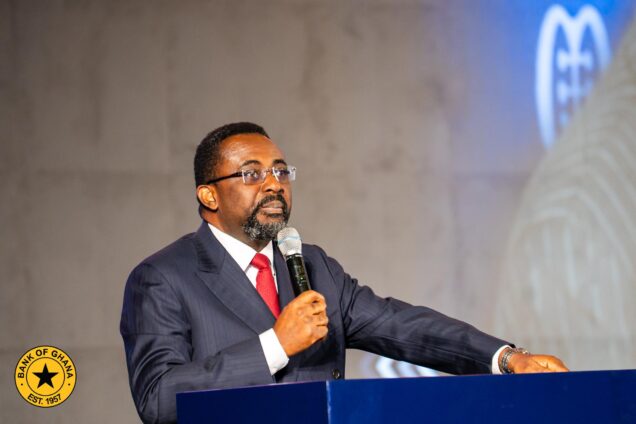
The Governor of the Bank of Ghana (BoG), Dr. Johnson Asiama, has called for bold leadership, coordinated policy reforms, and stronger institutional resilience to transform Ghana’s economic recovery into long-term prosperity and industrial growth.
Speaking at the 10th Ghana CEO Summit, Dr. Asiama said Ghana has reached a critical stage in its economic journey following years of global shocks, domestic imbalances, and financial sector challenges.
“The question before us now is no longer whether Ghana can recover. The real question is whether we can transform this recovery into a foundation for sustained prosperity, industrial competitiveness, and inclusive growth,” he stated.
Addressing participants on the theme “Monetary Stability, Financial Sector Reform and Industrial Growth: Driving Ghana’s Economic Transformation from Vision to Action,” the Governor stressed that economic transformation requires decisive leadership, policy coordination, technological innovation, and public confidence in state institutions.
“This transformation requires far more than conventional approaches. It demands bold and decisive leadership, coordinated policy actions, technological innovation, institutional resilience, and above all, public confidence in the institutions entrusted with managing the economy,” he said.
Dr. Asiama noted that despite the economic difficulties Ghana faced in recent years, the country now has an opportunity to move from recovery to sustainable growth.
“Within these challenges lies a unique opportunity to move beyond aspiration and translate our national vision into practical action and measurable outcomes that improve livelihoods, strengthen businesses, and restore confidence across the economy,” he added.
The Governor described macroeconomic stability as the foundation for economic growth, explaining that low inflation and stable exchange rates are critical for investment and job creation.
“A stable macroeconomic environment characterized by low and predictable inflation, as well as stable exchange rates, provides the confidence businesses need to invest, expand, and create jobs,” he stated.
According to him, without price and exchange rate stability, businesses struggle to plan while investors become reluctant to commit long-term capital.
“Without confidence in economic management, long-term capital will retreat,” he cautioned.
Dr. Asiama said the Bank of Ghana had implemented decisive measures to restore confidence in the economy after years of economic turbulence marked by inflationary pressures, weakened market confidence, and tightening global financing conditions.
“Our monetary policy strategy has focused on restoring credibility, strengthening the monetary policy framework, rebuilding reserves, and stabilizing market expectations through disciplined policy implementation,” he explained.
He revealed that inflation has moderated significantly, foreign exchange conditions have stabilised, reserves have strengthened considerably, and confidence in the economy has improved.
However, he warned that the current global environment remains uncertain, particularly due to geopolitical tensions and commodity price volatility.
“The recent geopolitical tensions in the Middle East remind us that the global environment remains highly uncertain,” he said.
Dr. Asiama noted that the Bank of Ghana’s decision to strengthen international reserves last year has helped cushion the country against external shocks.
“That is why we are able to withstand the impact of the ongoing crisis even better than some of our peer countries, because we built resilience,” he noted.
The Governor further disclosed that the central bank has introduced several reforms to reinforce policy credibility and improve monetary policy effectiveness.
“We have revamped our monetary policy framework, enhanced liquidity management operations, strengthened reserve accumulation, and improved transparency and accountability in policymaking,” he stated.
He explained that these reforms are aimed not only at stabilising the economy but also at supporting sustainable economic growth and restoring investor confidence.
The 10th Ghana CEO Summit brought together policymakers, business executives, and industry leaders to discuss strategies for accelerating Ghana’s economic transformation through leadership, innovation, and industrial growth.
Latest Stories
-
Amin Adam calls for review of fuel taxes as diesel prices remain above GH¢18
8 minutes -
World Vision Ghana, Ahafo districts sign MoU for universal WASH coverage
38 minutes -
When the gold engine stutters: What Ghana’s Cedi and reserves are telling us about the new economic architecture
55 minutes -
Two reportedly die after being trapped in mining pit at Juaboso
1 hour -
Petrosol cleans up Wa Municipal Hospital, to donate medical equipment
1 hour -
KiDi brings the hits to London in sold-out UK headline concert
2 hours -
The last goodbye of Ghanaian shot dead in the US
2 hours -
MCC opens door to Ghana again as MiDA revives development partnership
2 hours -
CSIR moves to turn scientific research into jobs, national growth
2 hours -
More patrons troop in as 3rd Republic Bank-JoyNews Habitat Fair clinic enters final day stretch
2 hours -
‘If NPP was ‘insensitive’ over fuel prices, NDC must accept same description now’ — Amin Adam
2 hours -
German, Russian foreign ministers hold rare talks amid rising tensions
2 hours -
Gov’t to develop policy for Ghanaian Sign Language in education
3 hours -
Accra Academy defend ODADEƐ ’90 5-a-side title
3 hours -
Ghana risks EU gas market access over methane emissions – Expert warns
3 hours