

Audio By Carbonatix
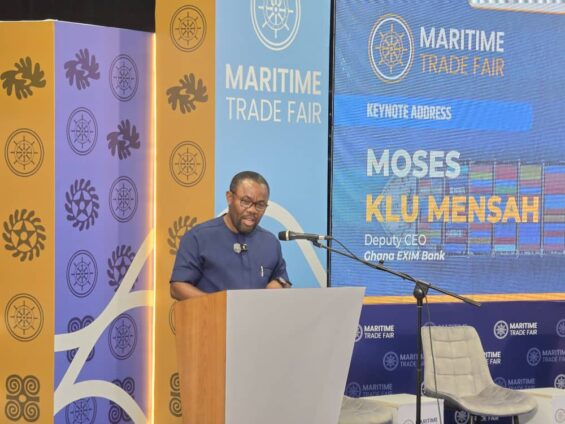
The Deputy Chief Executive Officer in charge of Banking at the Ghana Export-Import Bank (GEXIM), Moses Klu Mensah, has underscored the need for stronger investment in maritime infrastructure, technology, logistics and financing to drive Africa's economic transformation and improve trade competitiveness.
According to him, the maritime sector remains a critical gateway for industrialisation, export growth, investment attraction and job creation, and must therefore be treated as a national and continental competitiveness priority.
Mr Mensah made the remarks in a speech delivered on behalf of the Chief Executive Officer of GEXIM, Sylvester Adinam Mensah, at the opening of the Maritime Trade Fair in Accra on the theme: "Shaping Africa's Maritime Future: Maritime, Technology and Finance."
The event brought together regulators, financiers, insurers, technology providers, logistics operators, industry leaders and emerging start-ups to discuss the future of Africa's maritime industry.
Mr Mensah said Ghana and Africa must view the maritime economy as a strategic platform that connects producers to markets, supports exports and imports, enables industrial production and influences the cost of doing business.
He noted that efficient ports, reliable logistics systems, affordable financing, responsive regulation and modern technology were essential for building a strong export economy and ensuring Africa's competitiveness under the African Continental Free Trade Area (AfCFTA).
Mr Mensah identified finance as one of the key drivers of maritime growth, explaining that exporters, logistics companies, freight forwarders, warehousing firms, insurers and technology providers all require access to capital to expand operations and improve efficiency.
He said institutions such as GEXIM play an important role not only by providing finance but also by helping businesses become export-ready and competitive in international markets.
The Deputy CEO further stressed the need to align regulation, infrastructure and investment to remove bottlenecks, reduce transaction costs and facilitate the smooth movement of goods across ports and borders.
He also highlighted the importance of technology in improving efficiency, transparency and risk management within the maritime sector, saying digital solutions could support cargo tracking, customs processing, payment systems, insurance verification and access to trade information.
"The future of maritime trade will belong to countries that combine physical infrastructure with digital capability," he stated.
Mr Mensah further called for sustainable investment in maritime infrastructure, logistics and industrial value chains, noting that Ghana's strategic location, political stability and improving port infrastructure positioned it to play a stronger role in Africa's maritime future.
Maritime Sector Undergoing Significant Transformation
On her part, the Executive Director of Whitestone Shipbrokers, Gertrude Adwoa Ohene-Asienim, said the maritime sector was undergoing significant transformation driven by technological innovation, changing trade patterns, sustainability requirements and increasing demand for efficient supply chains.
She said developments such as digital platforms, fintech solutions, automation and smart logistics systems were reshaping the industry and creating new opportunities for African businesses.
Mrs Ohene-Asienim noted that the Maritime Trade Fair provided an important platform for dialogue, innovation, collaboration and practical solutions to challenges confronting the sector.
She also stressed the need for greater inclusion and capacity development, particularly among women and young professionals, saying Africa's maritime future would be shaped not only by infrastructure and technology but by people with the skills, ideas and leadership to drive change.
She urged stakeholders to strengthen partnerships across government, industry, academia and the private sector to unlock the full potential of the maritime economy and position Africa for sustainable growth.
Latest Stories
-
Oil hits over 1-week low on hopes of boost to diplomacy in Iran war
41 minutes -
They take GH¢100, sometimes GH¢200 – Okada riders allege police extortion in Accra
50 minutes -
NACOC: We’ve found no presidential escort among suspects in €225m France cocaine case
59 minutes -
Don’t turn students away over trunks and chop boxes – GES
1 hour -
Italian Apple store employees strike on iPhone 18 Pro launch day
1 hour -
Apple’s Tim Cook sees Australia’s social media curbs as ‘world-leading’, PM says
1 hour -
Amazon raises minimum hourly pay by $1 to $20 for US operations workers
2 hours -
Insurance cost has largely remained stable – NPA boss on transport fare pressure
2 hours -
Multiple unions threaten strikes at Barrick’s flagship Mali gold mine, documents show
2 hours -
Infantino invited to African summit as he faces challenge to FIFA leadership
2 hours -
NPA boss flags ‘recalcitrant’ transport operators raising fares arbitrarily
2 hours -
GPRTU fare hike put on ice after talks with government – NPA boss reveals
3 hours -
I’m greatly worried – NPA boss on threat of higher transport fares
3 hours -
We are largely import-dependent – NPA boss on Ghana’s fuel vulnerability
4 hours -
Ghana’s fuel market is built for turbulence – NPA’s Edudzi Tamakloe explains why
4 hours