

Audio By Carbonatix
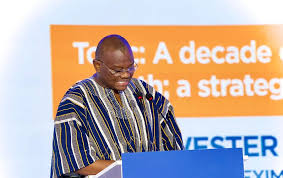
The Chief Executive of the Ghana Export-Import Bank (GEXIM), Hon. Sylvester Adinam Mensah, has underscored the need for a more comprehensive approach to supporting businesses, cautioning that access to finance alone is insufficient to drive sustainable export growth.
Delivering a keynote address at the bank’s 10th anniversary international conference on Wednesday in Accra, Mr Mensah outlined key lessons from GEXIM’s first decade, signalling a strategic shift towards a more integrated and results-driven model.
“The first lesson from our first decade is that finance by itself is not enough,” he stated. He explained that many businesses struggle not due to a lack of ambition, but because of structural constraints such as high or mismatched capital, weak market information, unreliable logistics, and difficulties in meeting standards.
“In other words, businesses need a complete support system, not just a single facility,” he added.
The Chief Executive stressed that export competitiveness is built long before products reach international markets. “It is built in farm productivity, factory efficiency, quality assurance, storage, packaging, logistics, governance, and management discipline,” he noted, warning that weak foundations would continue to undermine export performance regardless of global demand.
He also highlighted the reality of domestic competition, pointing out that international trade pressures begin within local markets where imported goods compete directly with locally produced items.
Mr Mensah emphasised the need for development finance institutions (DFIs) to strike a balance between ambition and discipline. “We must be bold enough to support transformation, but rigorous enough to preserve the quality of our balance sheet, risk controls, and credibility,” he said, adding that sustainable impact depends on strong and resilient institutions.
According to him, these lessons are informing a strategic reset at GEXIM, with a sharper focus on execution and accountability. The bank, he noted, is transitioning from a broad mandate to a more targeted approach that prioritises key sectors, deepens financial instruments, strengthens partnerships, and links interventions to measurable outcomes.
“As we look to the next phase, our approach will be more focused, delivery-oriented, and accountable,” he said.
The remarks form part of broader deliberations at the conference, which is examining how GEXIM can enhance its role in driving Ghana’s trade competitiveness and industrial transformation.
Latest Stories
-
Kaizen as a strategic pathway for micro business scale-up in Ghana
40 seconds -
Minister orders suspension of Obuasi SHS headmaster over alleged sexual misconduct following JoyNews investigation
5 minutes -
Over 38,000 commercial, 150,000 residential customers unbilled – Ghana Water MD
34 minutes -
Several injured as Sprinter bus collides with ‘trotro’ at Odorkor
34 minutes -
Ghana records progress on reparatory justice agenda – Ablakwa
51 minutes -
Mahama commissions Christian Tetteh Yohuno Ward Complex at Police Hospital
1 hour -
Vice President calls for wider access to Ghana’s political party histories
1 hour -
Republic Bank JoyNews Habitat Fair to connect prospective homeowners with exhibitors in Ho from October 16 to 18
1 hour -
Obaasima Summit: ‘AI is not a spiritual attack’ — Rev. Dr. Ofori-Boateng urges young women to embrace technology
1 hour -
GHS to distribute 80,000 pairs of locally-made protective footwear to health workers
2 hours -
GoldBod boosts local jobs as 90% of gold undergoes refining in Ghana – Sammy Gyamfi
2 hours -
The search for the politically unblemished: Are we asking the impossible of public appointees?
2 hours -
Ghana seeks climate finance access for debt-restructuring countries
2 hours -
Afenyo-Markin urges stronger media scrutiny of public institutions
2 hours -
GoldBod recovers GH¢38.7m in legacy PMMC debts, targets remaining arrears
2 hours