

Audio By Carbonatix
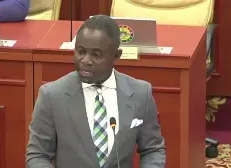
The Health Minister, Kwabena Mintah Akandoh, says he did not need parliamentary approval to suspend the Chief Executive Officer of the Komfo Anokye Teaching Hospital (KATH), Dr. Paa Kwesi Baidoo, after criticism over the decision.
The matter was brought before Parliament by Minority Leader Alexander Afenyo-Markin, who called on the Minister to explain the circumstances surrounding the suspension and the process that informed the decision.
Raising the issue on the floor of Parliament on Tuesday, June 16, Mr. Afenyo-Markin criticised what he described as the minister's failure to adequately engage Parliament before taking action against the hospital's chief executive.
According to him, Parliament had been left to learn about developments in the health sector through media reports rather than direct communication from the minister.
"We hear interviews in the media without recourse to the House. We see letters by the Minister taking action against some chief executives," he said.
The Minority Leader further reminded the House of Mr. Akandoh's previous role as Ranking Member on Parliament's Health Committee, noting that he had consistently demanded accountability from ministers and government officials.
While acknowledging that the minister's previous conduct had strengthened democratic oversight, Mr. Afenyo-Markin argued that his elevation to ministerial office now required a different approach.
"What he did then was good for democracy; I agree. But now that our colleague has risen to that high office, and especially when he is a Member of this House, our expectation is that he utilises the platform of Parliament for us to understand what is happening in his sector," he said, describing the situation as "very concerning."
Responding to the concerns, Mr. Akandoh maintained that his actions were consistent with a policy directive issued by President John Dramani Mahama regarding the handling of emergency cases at public health facilities.
According to the minister, the president had made it clear that no health institution should refuse emergency treatment under any circumstances.
"The president issued a policy direction in the health sector that no facilities should turn away emergency cases, and he (the president) added that even if the life of the person must be saved on the ground, we should do so," he said.
Mr. Akandoh stressed that directives issued by the president constitute government policy and must be implemented by ministers responsible for their respective sectors.
"That was a policy direction, and when the president speaks, it's a policy that the Minister must implement," he added.
The Health Minister further argued that no individual or authority within the public health system has the power to close any section of a state-owned health facility without government approval.
"Let me put on record that nobody, absolutely nobody in this country, has the right to close any portion of a public health facility without the consent of the state, in this case, the minister," he stated.
Citing provisions of the law governing teaching hospitals, Mr. Akandoh said ministerial directives take precedence over decisions made by hospital boards.
"Section 36 clearly establishes that whatever the Minister says or directs, the board shall apply the same," he explained.
He further stated that "the decision of the Minister is not subject to the review of the board. It is the decisions of the Board that is subject to the review of the Minister."
The Minister said his decision to suspend the KATH CEO followed discussions regarding the closure of the hospital's Accident and Emergency Unit, which he believed was inconsistent with the president's directive.
According to Mr. Akandoh, the hospital's chief executive acknowledged the error and apologised during the meeting.
"The man admitted and apologised before other officers and me," he stated.
He explained that the suspension was intended to serve as a deterrent while investigations were conducted into the circumstances surrounding the closure.
"To send a clear signal, punitive actions are meant to serve as a deterrent. We then proceeded to direct the Board to allow the said CEO to sit aside for two weeks and then investigate the PRO," he said.
The minister also dismissed suggestions that parliamentary approval was required before taking such administrative action.
"Mr. Speaker, is it a decision I needed the approval of the House to do so?" he asked.
Latest Stories
-
Ghana seeks long-term mining investments that benefit local communities – Armah-Kofi Buah
17 minutes -
Ghana’s Ambassador to China, Kojo Bonsu, presents credentials to Nepalese President
30 minutes -
Fairtrade Africa’s Cocoa Hubs Project strengthens rural service centres in cocoa-growing communities
35 minutes -
SEC cautions investors against fraudulent investment schemes
37 minutes -
Land Ministry urges rCOMSDEP operators to reserve earnings for land reclamation
40 minutes -
Commercial drivers give authorities one week to clear traders from lorry terminals, bus stops
45 minutes -
Nana B denies claims that Kojo Bamba was his driver and bodyguard
1 hour -
Engage Now Africa to construct a 10-unit classroom block for struggling Navrongo Vocational Training Centre
1 hour -
One digital financial breach could expose linked accounts to fraud – Financial Crimes Manager
1 hour -
Ghana Russia Centre signs ICT cooperation agreement with Moscow University
1 hour -
The powerhouses of the village: Honouring Ghana’s rural women on International Rural Women’s Day
1 hour -
Vincent Assafuah petitions CHRAJ to investigate alleged irregularities in 2026 World Cup visa arrangements
1 hour -
12-year-old boy found dead in muddy pit at Opeikuma
2 hours -
GHS begins Yellow Fever vaccination campaign in three Upper West districts
2 hours -
Organised Labour pushes for higher 2027 base pay despite slowing inflation
2 hours